Venture funding is not your cue take your feet off the pedal and go buy a red Ferrari or an expensive Bali vacation for you and loved ones. It’s also not your birthright. What else is Venture Capital not? There is a whole post about it, inspired by our conversation around the first day of DEMO Africa and the investor landscape in Africa. What else happened today?
DEMO Africa day two:
After the all-day ABAN Angels investors’ summit and mixer yesterday, DEMO Africa kicked into full gear today. 15 startups are pitching before investors and savvy tech evangelists today. 15 more will pitch tomorrow. Check here for the full Agenda.
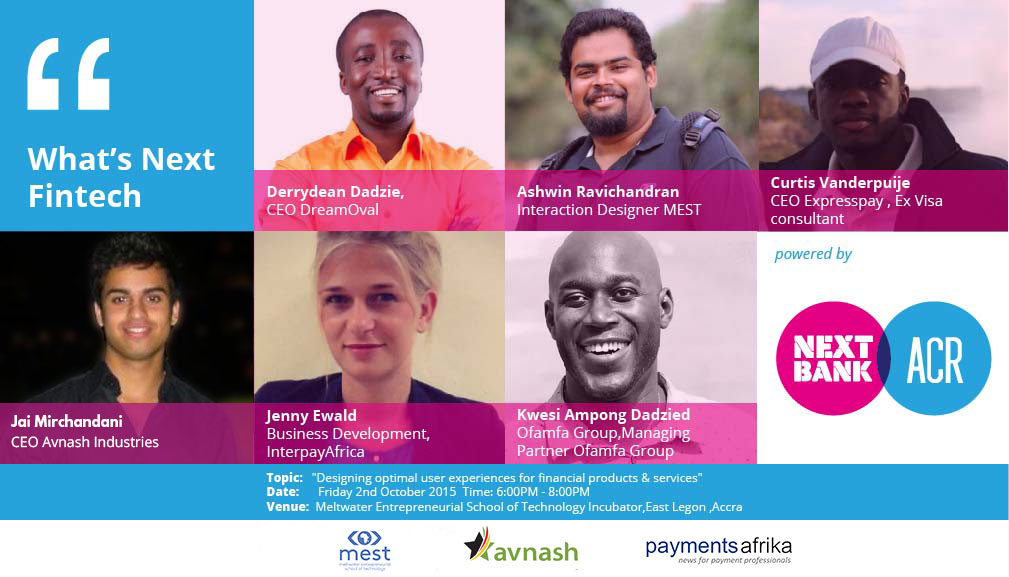
On October 2nd, 2015, Next Bank, a social enterprise focused on streamlining financial services, will host its first FinTech conference in Accra, Ghana. The conference is themed around “designing optimal user experiences for financial products and services.” Register to attend.
Airtel seems determined to increase their internet access services across Africa. All they need are able partners. One of the partners they’ve closed won’t help them in Nigeria. So how can they get into Africa largest market with their insane internet speed? These original gangsters can help out.
The Nigerian banking sector tightens loose security threads by introducing the BVN. So we decided to bring you up to date on what the BVN does and doesn’t do.
So you sorely want to be an entrepreneur but seems you have been shorn of ideas. Normally, slowing down would help, but if think that’s a stretch – I think it is – how about cloning an idea from the tech mecca? Here are some ready made solutions you can check out for inspiration or, this just between us, customization.
In the last 12 months, Totohealth has raised more than USD $ 140,000 dollars in equity investments and grants from various sources including Spark International, Indigo Trust, Spring Accelerator, mlab and two local investors- a sign to entrepreneurs that the market is taking note of local solutions for local problems and are willing to financial back great social ventures.
On October 2nd, 2015, Next Bank, a social enterprise focused on streamlining financial services, will host its first FinTech conference in Accra, Ghana.
The conference is themed around “designing optimal user experiences for financial products and services” and will have financial services and technology experts in attendance, as well as designers, regulators and tech entrepreneurs.
Jai Mirchandani, the CEO of Avnash Industries, Derrydean Dadzie of DreamOval , Kwesi-Ampong Dadzie, Arnold Kavaarpou and Curtis Vanderpuije, CEO of Expresspay are some of the confirmed influencers expected at the event.
Participants will also discuss how indigenous solutions like mPESA can be “consolidated with intentional and collaborative efforts from stakeholders within the financial services ecosystem.”
Event Details:
Venue: Meltwater Entrepreneurial School of Technology Incubator
Have you seen yclist? It’s a listing of Y Combinator’s alumni; the dead ones, thriving ones, those exited and those trundling along.
What I noticed going through this list is, some of the startups on here could easily be replicated in Africa, contextualized and be executed the hell out of.
So you are probably thinking, “oh, this is just fraud, this is stealing someone else’s idea.” Well, actually, no. Nobody owns ideas, unless the idea is an invention has been patented. But even those have geographic limitations.
I’ll go right ahead and pick out four ideas on here (which definitely do not have patents on them) that should totally be cloned in Africa and immediately too:
There is only so much of your wardrobe you wear in a day, a week or even a year. Why not rent out those not on your rotation at any point in time and make money while at it? Or you are cash-strapped and need a dress for that all-white Yoruba Boys owambe? Jump on the app and find a fit you can rent. There will be hangups and I can already imagine a couple of those. Like when that guy got a spill on the white Dashiki of this other guy at the Saturday shinding. Well. Time to apply the mind. This will obviously thrive as a hyperlocal service.
Social meals. The idea is to share a meal with a group of people – most likely, strangers. It’s very much like a carpooling services for restaurant tables. Say it’s a Friday evening and you don’t want to hit the club.You are tired of your same old friends and the Friday routine. Put up a meal invite on grubwithus along with details like the kind of people you are hoping to spend the evening with, venue, time and other non-freaky deets and see how many take you up on the offer. This is very much like Eat.Drink.Lagos’ lunchclub but with an app and accessibility to a lot more regular folks with its less prohibitive pricing. @smallbigchops on Twitter, also does something similar with #TwitterGrubMingle. I see a lot of practical emergent behaviours on here.
High-end restaurants are known to begin making meals after patrons had placed orders. After which these patrons go back, take a seat and wait another 45 minutes for their meals. Usually, there is WiFi so the wait is bearable even sometimes worth it. But what if you want to pop in and out. You know, there is a huge desk full actual paperwork back at the office you need to get back to. OrderAhead to the rescue. I know loooots of people who will use this app. Of course, this could always integrate pickup and delivery like some local startups already do, but this particular substrate has not been explored yet.
What are your kids doing this weekend? Definitely not home watching the Aveggies. That’s fine, but they could be doing more. Like learning how to rig up Rasperry Pis or making model trains, or learning to code, or doing any of the number of things at mini-events listed on Camperoo, or its Nigerian brother that we will call, KidsTakeOut. The last summer vacation in Nigeria saw a lot of kids stay home for three months stretch with only the boring summer classes to go on. Of course, there were cool creative and geeky activities going on across town, but they were simply not curated in one easily accessible place. An app like this listing all activities around town could give parents more options on where they want their kids to be. They can even hire a chaperone to help look out for them.
There could also be grownups version of this. Why not? A list of creative weekend engagements that could help corral a person’s creativity.
So, DEMO Africa began with much ado yesterday with an angel investor bootcamp…lots of budding and veteran investors in one place with one goal. Figuring out the smartest ways and places to put their capital. Speaking with a few friends, while chatting about the issue of funding and startups, I couldn’t help but noticing that several misconceptions exist about what exactly venture capital (VC) is.
To the more experienced eye, they might seem pedestrian, but the following misconceptions are actually more common that you would think.
1. Venture capital is a debt
A debt is money that is owed and is to be returned at a later day. With debts, sooner or later, you’ll have your creditors banging on your door asking for their money back. Not so with venture capital, which is (ideally) a calculated risk on the part of the investor. If the venture fails, well, the entrepreneur says sorry, and everyone goes home.
That is not to say that you can piss your investors’ money away. Unlike creditors, venture capitalists expect their money back many times over. Else, they would not invest in the first place. And once you get the reputation for losing money, you’ll probably never raise again.
2. Venture capital is a grant
Grants are non repayable funds usually handed out on a project by project basis for typically philanthropic purposes. VC on the other hand is business oriented. And while grants can be granted (pun intended) for any specific project with a tilt towards non-profits, VC is mainly for high growth businesses. Simple version – if your project or business isn’t going to yield huge profits, it’s best to not hold your breath waiting for VC.
3. Venture capital is your birthright
Just the fact that you’re a startup doesn’t entitle you to VC. Neither does the fact that your startup looks good on paper. For one, prospective businesses/startups are never evaluated in isolation. There are indices to consider – the founder’s experience, skill competence of the team, milestones already met, vision etc. Even if you do well in all these things, there’s still something called investor instinct. You can’t force anyone to give you money. You could try, but that’s why we have prison.
4. Venture capital is for every venture
Venture capital is typically for young, high growth businesses. However, all startup journeys do not have to go through VC street. Your business may be bootstrapped from day one. You also have the other option of crowdfunding. Basically, you don’t have to run around for VC if you can help it. If you do decide to, make sure your business fits the profile.
5. Venture capital is your ticket to Tahiti
Sometimes, venture capitalists are convinced a business is the next unicorn and proceed to invest millions of dollars in it. But then the founder gets greedy. Or foolish. Rather than doubling over on efforts to make sure the business delivers on all its potential (see my next point) he/she relaxes and starts to spend some of that money on things that would be considered excesses. Some even go as far as buying ferraris and exotic real estate. Or they build edifices. In my opinion these are the worst set of people in the world.
Listen, venture capital is for building the business and making sure it scales and maxes out all its potential. How hard can this be?
6. Venture capital is #winning
Let’s say you successfully scale the investment hurdle and receive funding. You’re out of the woods, right? Wrong. Read this.
See that? You have far more to do and far more to prove after you raise money, than you do before. It’s when the real work begins. The records show that despite receiving VC and mentorship from some of the industry’s finest minds, a sizeable number of startups, close to 50%, fail. Ah, I see some of you running for the door. Good. The rest who are still here can go on looking for VC. You just might have what it takes.
Yesterday, the news hit the interwebs about Airtel Bharti’s partnership agreement with Liquid Telecom. The details of the partnership will allow Airtel piggyback on Liquid Telecom’s terrestrial fibre network to deliver faster internet speeds across all their 3G and 4G networks.
Basically, anywhere Liquid’s infrastructure is present, Airtel can deliver insane broadband speeds to their customers. I was excited when I read this news until it dawned on me – Liquid Telecom is not in Nigeria.
Ever the Sherlock Holmes, I decided to do a little scouting to see if there were any companies with a terrestrial fibre network in Nigeria. Turns out Nigeria has about 41,000 kms of the fibre stuff. These are some of the companies that own it.
1. Main One
Landed in 2010, covers over 7,000 km distance from London, with initial landing stations in Nigeria, Ghana and Portugal.
2. Globacom – Glo 1
Landed the shores of Nigeria in 2009, with a capacity of 640 Gbit/s, covers a distance of 10,000 km from Lagos to UK, connecting 17 African and European countries.
3. Suburban Telecoms
Almost 3,500 km of fibre optic cables in Nigeria.
4. Multi-Links
Has a terrestrial fibre optic network spanning 8,232 km in Nigeria.
5. MTN – West African Cable System
Commenced operation in 2011 and has links from Europe, West Africa and South Africa, with bandwidth capacity of over 5.12 Terabytes (Tbps) and spanning a distance of 14,530 km.
Airtel seems to be willing. The infrastructure is here. Let’s make this happen guys.
Before I start this post, I’m going to make some assumptions
One, you can read (duh).
Two, you’re comfortable. (You’re not sitting on hot coals, or facing a countdown clock on a doomsday device etc) because you’re gonna be reading for a while.
Three, you know what a university is, even though you may not have entered one (because almighty JAMB or the witches in your father’s village denied you).
So, let’s begin.
Identity theft is a real thing. And even though online transactions are safer than ever, there are still lazy people out there who would rather use their genius to steal your money than to work for an honest living. Since the CBN’s cashless policy is here to stay, they came up with a biometric identification system, tagged Bank Verification Number (BVN) to help curb fraud and theft.
What’s a BVN?
The BVN is an 11 digit number that acts as your universal ID in all banks in Nigeria. Think of it as a socio-security number but for the banking industry. It ensures you can engage in transactions at any Point of Banking operations.
Another way to think about the BVN is like a university matric number. When every student gets admitted into the tertiary institution, they get allocated a number. That number is your identification in the school’s system until the day you graduate. You may have an impressive name like Thomas Pink, but the school isn’t going to call you that. If for some reason you get allotted the numbers LAG/419/666, well too bad. To the system, you’re now Mr 419.
Bottom line: your BVN is your ID in the banking system.
It’s one BVN per person
Listen to this carefully. You are not meant to have more than one BVN. If you do, you’re going to end up on EFCC watchlist. Seriously though, one person – one BVN. Remember the matric number analogy? Yes, it applies here. When you take a course in another department, or you switch faculties, your matric number will not change. The same way, your BVN does not change from bank to bank.
You mean I’m stuck with whatever 11 digits I’m allotted on that fateful day?
Nods.
The BVN is attached to your name across all banks/financial institutions
But what of my other bank accounts?
That’s easy. Let’s say you have three accounts in three different banks. Let’s call them, bank A, bank B, and bank C. Here’s what you do: walk into Bank A with any acceptable form of ID – driver’s license, national ID card, Voter’s card, National passport. Register for the BVN. Wait for 24 hours and get the number sent to you via SMS. Take that number to Bank B. Tell whoever attends to you, I got a BVN and I wanna link my account. Remember to say it with attitude. And a smile. Repeat for Bank C, ad infinitum.
What if I change my address? Or my name?
Go to the same bank where you got your BVN and tell them you need to update your biodata. Your BVN number remains the same.
Biometrics. Sounds like a medical term
Don’t worry. They won’t be placing needles in you or anything like that. The biometrics refer to your unique human features which would make it more difficult for anyone to impersonate you or access your account without proper authorization. It’s an extra layer of security. If you’re thinking retinal and DNA scanners, you’re probably thinking 25 years ahead.
Right now, the only biometrics they need from you are your 10 digit finger prints, your picture (a headshot) and your biodata. Boring, I know. Welcome to twenty first century Nigeria.
Wait, those biometrics aren’t things that can be done over the phone
Exactly. There’s no registering for a BVN by proxy. You have to be in the bank to do it. In fact, folks who are outside the country had to return to register. Otherwise, no BVN. But the authorities are starting to make concessions on that.
Wow! Sounds serious
Did I mention this thing is being enforced by the CBN? The Central Bank has endured a lot of bad press and seem determined to correct a lot of that this year by implementing changes in the system. So they are taking this BVN campaign very serious. They’re even clamping down on Bureau de Change operators, ordering them to refuse any transactions without presentation of BVNs. In fact, any Bureau de Change that fails to adhere to instruction will be penalised (first offenders would be made to pay a fine of a million naira).
So, yes it’s serious.
Okay I’ve gotten my 11 digit number, is that all?
Did you get a card with your BVN? Because you should. Your bank should contact you, informing you to come pick up a card (similar to an ATM) with the BVN number on it.
When you finally get yours, you will not be required to present any other ID again at the bank. That’s right, no more “Where is your international passport, driver’s license, national ID card?” and so on. Just flash your BVN card and you should be attended to.
Your bank owes you a card that goes with your BVN
What the BVN is not
Some fears exist about the consequences of having no BVN. Let me clarify. Come the deadline (October 31, 2015), and you’re still without a BVN, your account will not be closed. You’ll just lose access, to all of them if you have multiple accounts. The only way to resume activity on your accounts would be, you guessed right, to get a BVN.
BVN will also not increase your credit-worthiness. At least, not automatically. There’s some misleading info on the interwebs about the benefits of having a BVN which is that it will help you secure loans.
If the bank refused to give you any loans prior to getting the BVN, they won’t be changing their minds after you get one. The BVN isn’t a magical give-me-a-loan card. This isn’t Monopoly. If you want a loan, you may need to ditch your gambling habit and get some collateral.
The BVN is an idea that promises easier banking activities. Ideally, when next you’re going to the bank, you shouldn’t be required to present any form of identification except your BVN. But this is Nigeria. For now, take your ID card along, just in case.