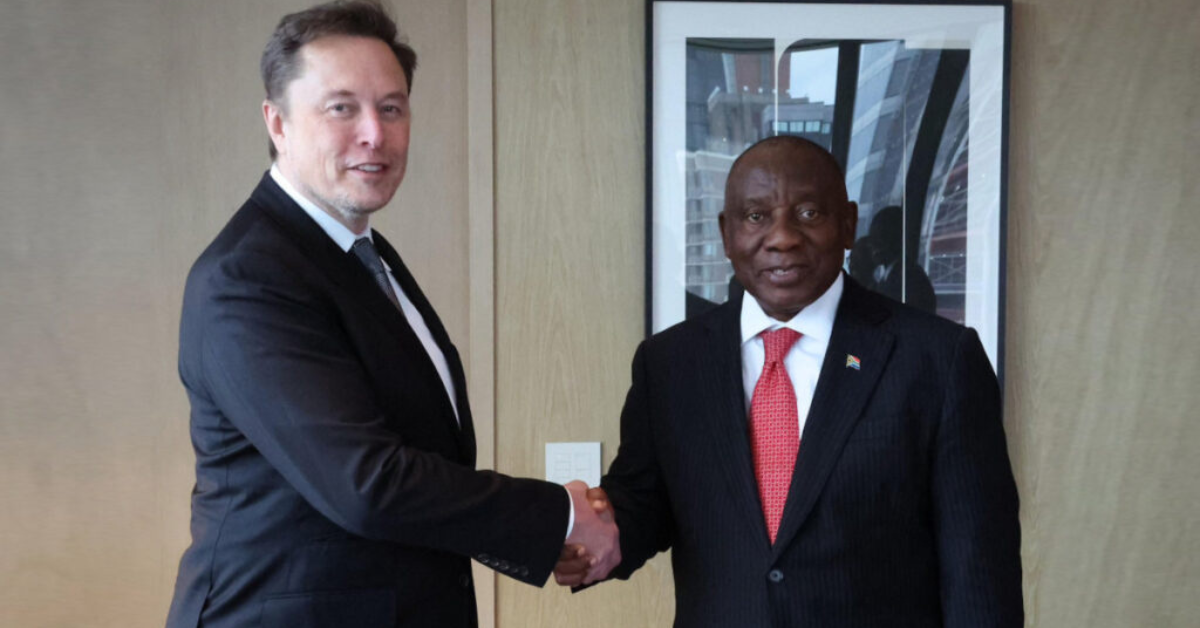
The operation of Starlink in South Africa remains unclear after Wednesday’s high-stakes meeting between President Cyril Ramaphosa and Donald Trump, who were joined by Elon Musk. The talks took place amid a backdrop of heightened tensions, with the agenda largely focused on accusations surrounding South Africa’s racial policies and land reform, leaving the status of any Starlink-related negotiations unclear.
South Africa’s telecoms regulator, the Independent Communications Authority of South Africa (ICASA), told TechCabal that “Starlink has not yet applied for a licence” despite reports indicating a proposed workaround for local black ownership laws to facilitate Starlink’s operation in the country.
While Starlink has already secured operations in 18 African countries—including South Africa’s immediate neighbors Botswana, Zimbabwe, and Mozambique — the continent’s largest economy continues to be left out. The exclusion stems from Black Economic Empowerment (BEE) regulations that require telecom providers to have 30% local ownership, as stated by ICASA.
The ongoing dispute between Elon Musk and the South African government had escalated into a public spat with Musk, in a provocative social media post, claiming, “The government will not grant Starlink a to operate simply because I am not black.” South African officials quickly pushed back, clarifying that no formal application had been submitted for consideration.
Local telecommunications giants, including Vodacom, MTN, Telkom, and Cell C, have strategically aligned with the regulatory status quo. Vodacom has explicitly backed ICASA’s position, stating that it “supports the enforcement of Black Economic Empowerment (BEE) laws” and believes in “the importance of adhering to national regulations that promote inclusivity and redress historical inequalities.
“I have been in ICASA meetings where some of our biggest broadcasters and telcos have said, ‘Why have we been ignored for years on the difficulties of operating in this regulatory climate?’ But as soon as Elon Musk jumps up and down, suddenly there are reports about the department considering changes to the law. This is not good for the country,” said Professor Justine Limpitlaw, an electronic communications law specialist.
Regional regulatory perspectives on Starlink
Across the region, South Africa’s hardline approach aligns with Namibia, where its regulator, the Communications Regulatory Authority of Namibia (CRAN), ordered Starlink to cease operations in late 2024 and is currently reviewing its application. Lesotho, too, initially resisted Starlink due to concerns over Basotho ownership, a requirement in the country’s telecom sector, but later granted a 10-year licence.
Botswana initially rejected Starlink’s application in early 2024 due to missing requirements and imposed high licensing fees—P5,600 (about $400) for applications, P386,000 (about $27,500) annually, plus 3% of revenue. After a year-long regulatory battle, direct intervention by President Mokgweetsi Masisi led to Starlink’s approval in May 2024.
In contrast, Mozambique, Eswatini, and Zimbabwe have taken a more open stance. Mozambique was among the first African nations to adopt Starlink in 2022, citing its potential to transform the ICT sector. Eswatini – Granted Starlink a five-year licence in June 2023 after an application submitted in March 2023. The service launched in December 2023, making it the 8th African country with Starlink connectivity. The regulatory process was relatively straightforward, with the Eswatini Communications Commission determining that Starlink met all requirements.
In Zimbabwe, POTRAZ (Postal and Telecommunications Regulatory Authority of Zimbabwe) granted Starlink s worth $575,000 in 2024 in partnership with IMC Communications, sidestepping the issue of mandatory equity requirements through local collaboration.
“Musk has, at times, been open to local ownership agreements, but in this case, the regulatory maneuvering appears to be more about political strategy than business flexibility,” Limiptilaw said.
Despite the political theatre, any resolution remains bound by the current legal framework. “To cover the country with satellite service, you need an individual end. I don’t think ICASA has much regulatory wriggle room, that’s where the law is at the moment,” said Limpitlaw.
Attempts have been made to address the regulatory standoff. ICASA introduced draft satellite regulations partly in response to the Starlink issue. “Even when the regulator brought out draft satellite licensing regulations, Starlink did not even attend the hearings,” Limpitlaw noted.
South Africa’s Department of Communications has floated possible legal amendments that would replace the current 30% equity requirement with a broader BEE-equivalent model. “They had promised draft amendments by July,” said Limpitlaw. “But we are already halfway through May, and the bill has not materialised. And it is not something that the President, the Department, or ICASA can resolve on their own. This requires amending legislation.
Commenting on South Africa’s need for Starlink, Anri van der Spuy, a digital policy expert and researcher, noted that, compared to some of its neighbours who have granted licences to Starlink, South Africa has relatively high connectivity levels already. 78% of the country’s population uses the Internet, according to Statista.
“Digital divides here are largely not a supply-side challenge [the lack of infrastructure, which Starlink would address], but rather a demand-side challenge [inequalities],” said Spuy.
Spuy noted that many of the 30% of our people who are not using the Internet live in rural areas, are women, are aged, or have low levels of income or education. While some areas in SA do need to be better connected, many of the unconnected are not using the Internet because of these and other inequalities, despite the infrastructure often being in place for them to use it. “As such, even if we had Starlink, many people would not adopt or benefit from it.”
As Lesotho recently secured Starlink access to ease its 50% trade tariffs, all eyes are now on South Africa, where the high-level talks have yet to clarify the future of Starlink’s operations in South Africa