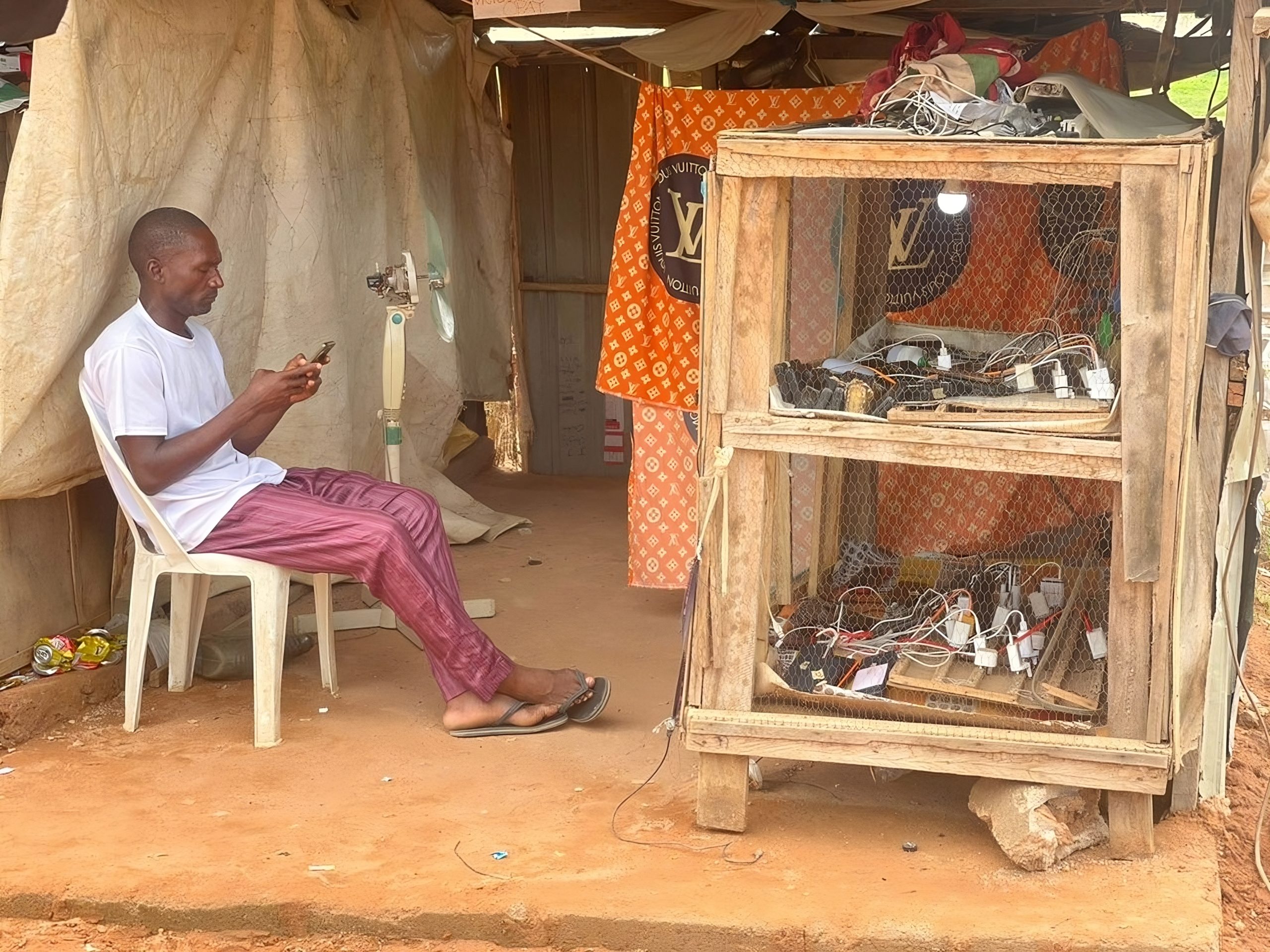
When Bobby Ogbolu set up a small charging booth in front of his father’s house in Ikotun, Lagos, in late 2017, it wasn’t a grand business plan. It was to make extra money when acting gigs were slow. Back then, there was little competition.
“I was the only one doing it in my area then,” he recalls.
Ogbolu’s pricing was straightforward: ₦100 ($0.06) to charge a phone, ₦150 ($0.095) for a power bank, and ₦500 ($0.3) for a laptop. Using a generator most days, he made about ₦4,000–₦5,000 in net profit daily. By the end of the month, his profits hit between ₦70,000 ($44.6) and ₦80,000 ($51).
Though Ogbolu ran the business for only 9 months, he says, “In 2018, it was decent money.”
$1 was about ₦310 at the time, according to Trading Economics. With today’s exchange rate of roughly ₦1,570 to the dollar, Bobby’s 2018 monthly take-home is worth about ₦354,000 ($225.5)–₦404,000 ($257.3) in 2025.
Across Nigeria, small charging booths like Bobby’s have become an everyday fixture, sprouting in busy markets and street corners. They are a direct response to the country’s chronic power shortages, which force millions to find ways to keep their devices alive. In an economy where 92 million people still lack reliable electricity, these booths fill a crucial gap, turning the nation’s blackouts into a business opportunity.
How they run and earn today
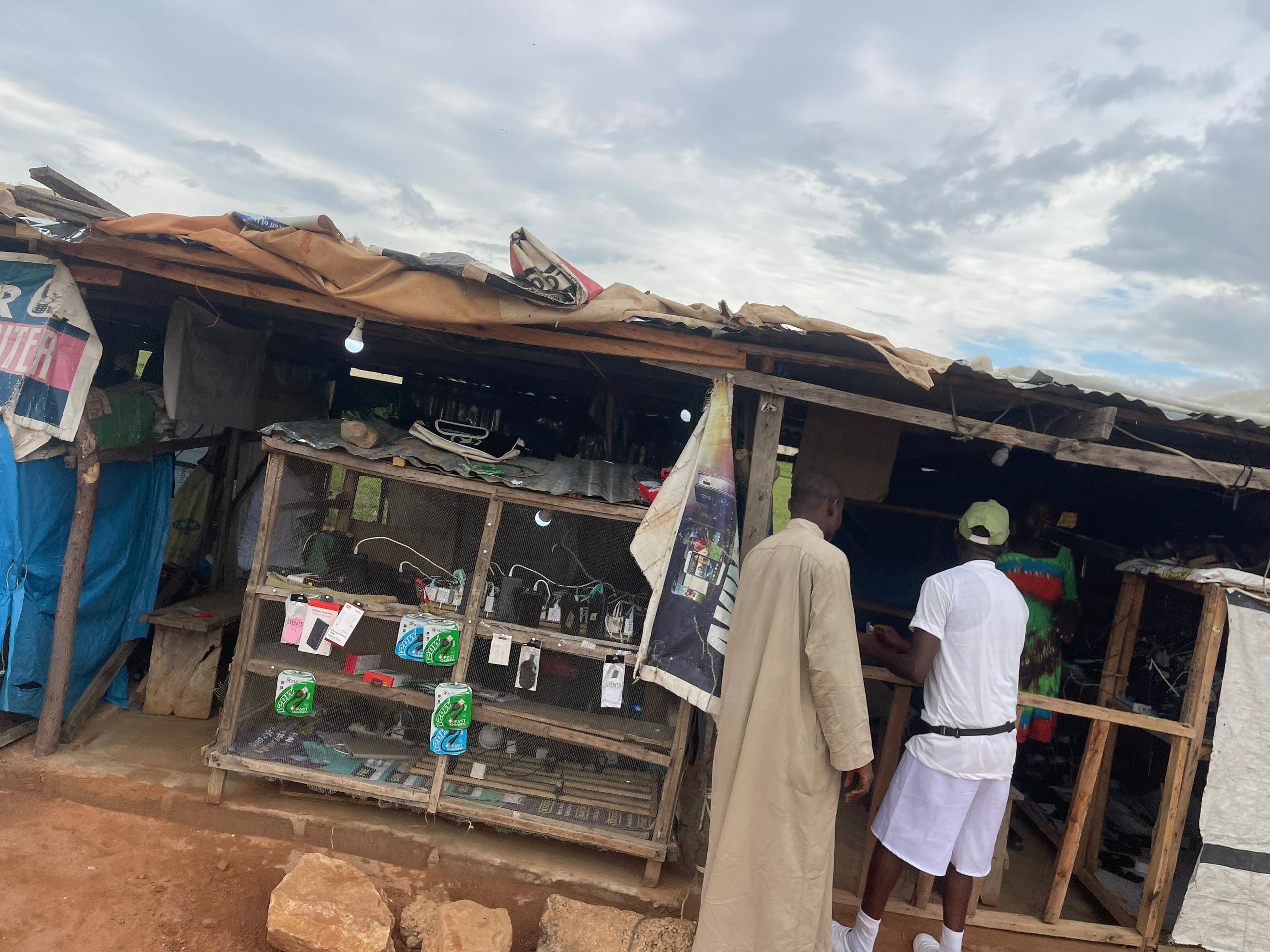
Kayode Oluwatobi, an Ibadan-based operator of King-HOC Gadgets, who has been in the business for two years, nets about ₦150,000 monthly. In Lagos’ NYSC camp “Mammy market”, Davidson Ventures reports daily gross profits of ₦5,000–₦6,000 ($3.2- $3.8). While those numbers are smaller than Bobby’s 2018 figures (adjusted for inflation), they reflect a business that still pays, especially in areas with erratic power supply.
In a different league entirely is Pawatank, a solar-powered charging startup founded in 2019 by Bakare Kolade in Ado-Ekiti, Ekiti State. With six charging stations–three B2B and three B2C stations– Pawatank averages around 9,000 charging sessions monthly, generating ₦800,000–₦900,000 ($509.6- $573.2) in net profit. Their stations are fully automated, with customers paying ₦1.5 (0.096 cents) per minute of charging via smart access systems. The company has 11 staff and runs two hardware models: a “mini” station with 30 mobile ports and five laptop ports (often in smaller markets or campuses) and a “standard” station for higher traffic locations.
For smaller businesses such as King-HOC Gadgets and Davidson Ventures, the operations are simple: make a payment, plug in your device, collect an ownership card with a number on it, and unplug your device when it is full.
“Once you bring your phone, they add a tape with a number for identification,” Funmilayo Loko, a university student who charges her device at Iyana bus stop in Lagos, says.
Powertank has a more complex operation model: “The power card is an NFC Card that carries the user’s identity and allows them to authenticate and make payments or initiate a charging session without advice. What’s the point of having an automated station or a self-service station when your phone is dead and you have to still log into an app to do all of that?” Bakare says.
Despite operators’ efforts, theft and damage are real concerns.
“I didn’t leave my phone for long, because I was scared it could still get stolen despite the preventative measures,” Loko says when she charged her phone.
Voltage fluctuations are another issue. Greatness Ola-Thomas, a customer who has used booths in multiple locations, says devices can take much longer to charge and sometimes get damaged because of the load on the power source.
What they spend to earn
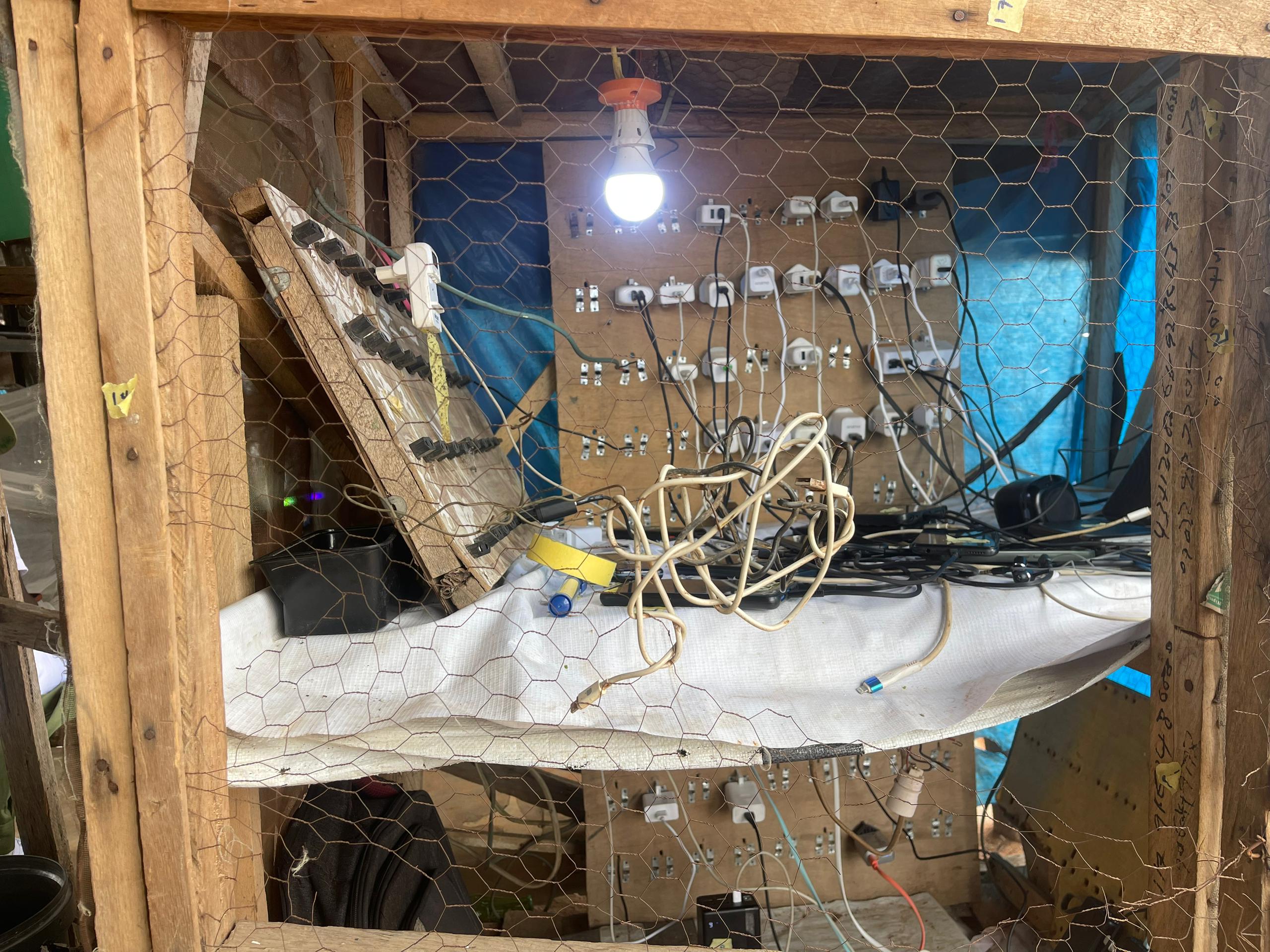
Ogbolu got started for about ₦15,000 ($9.6) in 2018. Today, operators say you can spend upwards of ₦200,000 ($127.4) to set up. According to Davidson Ventures, this includes covering charging boards, cages to lock up devices, and a generator.
And the work doesn’t stop there. “From time to time, you keep changing the ports,” Davidson Ventures explains. Replacing a charging port can cost anywhere from ₦4,000 ($2.5) to ₦15,000 ($9.6), depending on quality.
But the biggest line item is fuel costs.
On average, King-HOC Gadgets spends ₦8,000 ($5.1) daily on petrol — about ₦192,000 ($122.3) a month — just to keep the generator running six days a week. NYSC camp operators say their daily expenses range from ₦5,000 ($3.2) to ₦12,000 ($7.6), depending on usage.
However, some operators are finding ways around the fuel trap. Chinedu, who runs a solar-powered charging station, spends an average ₦10,000 ($6.4) monthly on operations, mostly replacing faulty charging sockets. Pawatank takes that approach to the next level. By pairing rugged solar panels with secure smart-lock charging ports, the company spends ₦300,000–₦400,000 ($191.1-$254.8) monthly across all six stations — a fraction of what multiple generator-powered booths would burn in the same period.
Lifelines for remote workers
With the rise of remote work and digital side hustles, staying powered is no longer a convenience; it’s essential for income. Phones, laptops, MiFi modems, ring lights, and power banks need charging, and not everyone can do it from home.
Joseph Jonathan, a remote worker, visited charging booths regularly when he lived in a blackout-prone area in Nuwalege, Abuja, between 2021 and 2022. “Because I work remotely, my devices need to be charged at all times,” he says. Eventually, he had to buy a power bank because he couldn’t keep going to the power stations.
For workers without solar or inverter setups, these booths are a lifeline. The cost adds up, but in Nigeria’s unpredictable power landscape, the alternative—missed deadlines and losing freelance gigs—is often worse.
Nigeria’s power problem
These charging stations operate against national grid collapses and chronic power outages. Nigeria’s daily power generation averages between 3,000–4,500 MW for a population of over 200 million. The result is a country where blackouts are commonplace and can last days, weeks, or even months.
Running a generator isn’t much better. The removal of fuel subsidies in 2023 doubled petrol prices in many states, making daily generator use unsustainable for most households. Solar power, while cleaner and cost-effective in the long run, still demands a significant upfront investment that many Nigerians cannot afford. All these rising costs feed into how much end users pay at these stations.
In Tola’s neighborhood, a prolonged outage pushed phone charging prices from ₦200 ($0.13) to ₦500 ($0.32), a jump tied directly to rising petrol prices. In Ola-Thomas’s old community in Amachara, Abia State, the power was out for up to three months. In Loko’s, it was different.
“The light was bad for a week, so I was desperate,” Loko says.
Market opportunity
According to Dr. Ayodele Oni, an expert in the power sector, “many states in Nigeria are taking advantage of the enabling provision of the fifth alteration to the Nigerian Constitution of 1999 as amended.”
Before the alteration, Nigeria’s Constitution allowed federal and state governments to make laws about electricity, but states had limited powers. They could only legislate on power distribution (which covers how electricity is delivered locally) and on generation and transmission in areas not connected to the national grid. But with the Fifth Alteration, states now have more legal freedom to generate, transmit, and distribute electricity within their territories. This shift opens the door for more state-led energy initiatives, potentially improving supply and fostering competition in the energy sector.
Electricity infrastructure is largely inadequate [and] there will still be a gap, which is what this [charging station] business model seeks to address.”
Charging booths are no longer the monopoly businesses they were in Ogbolu’s day. Davidson estimates about ten operators in the Lagos NYSC camp market alone. Still, where outages persist, demand remains high.
Some operators like King-HOC Gadgets are adding extra features, including lockers, fast-charging options, or even phone rentals, to differentiate themselves. The business also bundles the charging service with other offerings like phone repairs, accessories sales, or printing services.
What lies ahead
For many small charging booth operators, expansion means adding a second location or upgrading to a bigger generator. King-HOC Gadgets says he’d like to open more outlets across Ibadan’s busiest junctions. Davidson Ventures at Lagos’ NYSC camp sees the business as a long-term hustle: as long as there are blackouts, there will be customers.
Pawatank is thinking on a much bigger scale. For Bakare, phone charging is just the entry point into a wider clean energy network. “We’re heading into an era of electric vehicles,” he says. “The device charging is just how we enter the market. The goal is to build a ground for EV charging stations across Nigeria.”
In the near term, the company plans to deepen its presence on campuses, where even schools with 24/7 electricity often lack safe, accessible sockets for students. Pawatank’s lockable charging boxes let users secure their devices while they attend classes, solving access and security problems.
Another frontier is transport hubs. Bakare paints the scene: you arrive in a new city at 11 p.m., your phone and power bank are dead, and there’s no vendor around. Pawatank stations, accessible 24/7 via a prepaid card or NFC scan, could be installed in bus parks and motor terminals, with pricing that adjusts for late-night “premium” convenience.
Even if Nigeria’s power sector dramatically improves, Bakare believes the need for secure, distributed charging infrastructure will persist. “[Power supply] everywhere doesn’t mean enough sockets everywhere,” he says, “There are still problems to solve.”
Dr. Oni says that to break even, these businesses may adopt strategies such as proper costing, operating the charging booth facilities at peak periods where the electricity demand is high, and adopting other means of running the charging booth facility.
Exchange rate used is $1 to ₦1,570 *
Mark your calendars! Moonshot by TechCabal is back in Lagos on October 15–16! Join Africa’s top founders, creatives & tech leaders for 2 days of keynotes, mixers & future-forward ideas. Early bird tickets now 20% off—don’t snooze! moonshot.techcabal.com