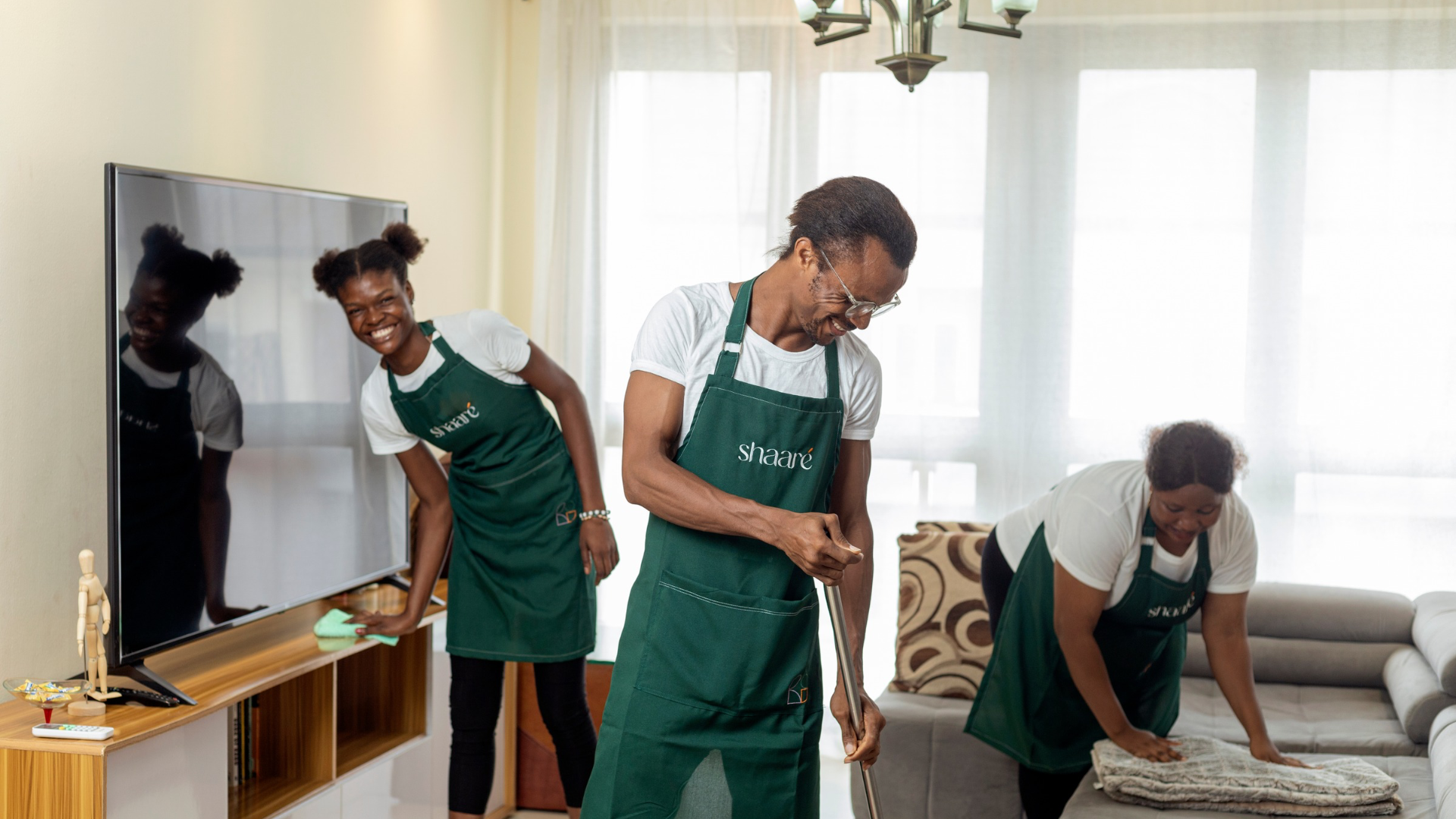
Finding reliable domestic help in Nigeria is often difficult. It is a trust-lacking, informal industry where users rely on word-of-mouth referrals to find competent home care agents. Shaaré, a Nigerian home service marketplace that connects households to vetted cleaners known on the platform as sparklers, was built in 2023 to fill that gap.
Domestic work in Nigeria operates within the largely informal labour market. According to a 2025 report by the Nigerian Economic Summit Group (NESG), 93% of the nation’s workforce was employed in the informal sector in 2024. Unlike formal sectors that offer clear dispute mechanisms or legal backing, Nigeria’s informal workforce sometimes lacks access to protection and labour rights enjoyed in regulated employment, especially for domestic workers whose jobs don’t follow a regular schedule and are outside the formal employment frameworks. Shaaré intended to use its platform to connect the domestic workers who fall among these 93% to households that require their services.
But for a long time, even this tech-enabled solution came with a significant challenge of speed. Shaaré’s promise to refine the experience of service delivery came with a significant caveat of speed. While the platform offered a vetted alternative to the informal domestic cleaning market, its backend operations were manual and slow. Customers would sometimes wait up to 12 hours to get a booking confirmation.
On December 17, the company launched an instant matching feature, a new algorithmic system designed to automatically pair a paid booking with the best fit sparkler immediately. “It’s the biggest leap we’ve ever made as a company,” Awazi Angbalaga, founder of Shaaré, said. “It’s designed to transform how bookings happen, how work moves, and how fast we can offer great service.”
Instant matching and why Shaaré built it
Shaaré’s origins were decidedly low-tech. The company began in 2023 as a simple WhatsApp group where Angbalaga manually connected a handful of cleaners with friends and family who needed help.
“It was very scrappy,” she admitted, noting they were faced with issues, including payment collection. To solve the problem, the team set up a Paystack storefront, typically used for e-commerce, and created over 200 product variations to cover every possible combination of a bedroom, guest toilet, and weekly service, services that could be offered.
Behind the scenes, the operation ran on Google Sheets and a web of no-code automations that Angbalaga cobbled together herself. The new instant matching replaces that workflow with an automated system that ranks sparklers based on several factors, including location, availability, skill fit, and past performance ratings. Once a customer completes payment, the system surfaces the best-fit sparkler and updates their calendar immediately. It also provides the ability for users to book a preferred sparkler if they want a specific cleaner they have come to trust.
The trust deficit
Technology may reduce delays and double bookings, but it doesn’t erase the deeper trust issues that plague the informal sector, including fears of theft, misconduct, or incompetence. For a platform like Shaaré that acts as an intermediary, the reputational risks are high. Angbalaga acknowledges that trust is the true product, describing the company as a care layer integrated into the tech ecosystem.
To mitigate the risks inherent in sending strangers into private homes, the company enforces a vetting process that includes verifying home addresses, demanding guarantors, checking work history, and training during the onboarding process.
Angbalaga admits that despite the new automation, the company still relies heavily on customer feedback to police quality.
“We depend on our customers to know what truly is going on at the moments where we don’t have eyes,” she said, noting that human intervention and investigation remain a critical safety net. “The moment we hear back from customers on anything, we take that really seriously.”
Shaaré is not alone in trying to organise this sector. Companies like Eden Life pioneered subscription-based concierge models, while others like SweepSouth, the South African marketplace that expanded into Nigeria in 2022, focus on managed cleaning teams or ad-hoc bookings. What sets Shaaré apart, according to Angbalaga, is its emphasis on on-demand access without subscriptions.
The platform operates on an 80/20 revenue split, with 80% going to the sparkler. To ensure fair pricing in a city where no two apartments are alike, Shaaré uses a dynamic pricing calculator. The tool adjusts rates based on home size, factoring in that a four-bedroom home in Lagos likely includes extra living areas, and calculates transport stipends automatically based on the worker’s location.
Shaaré has remained bootstrapped, a choice Angbalaga says allowed the company to validate the market demand without the pressure of artificial growth. Now, the challenge is synchronisation. While the platform’s technical capacity has effectively levelled up with this update, its ground operations are still playing catch-up.
“Operationally, we’re not there, but we’re going to get there, and that means more cities for Shaaré, more jobs, and more customers served,” Angbalaga said. In a market where most households still rely on referrals and intuition, Shaaré bets that its structure can earn trust.