

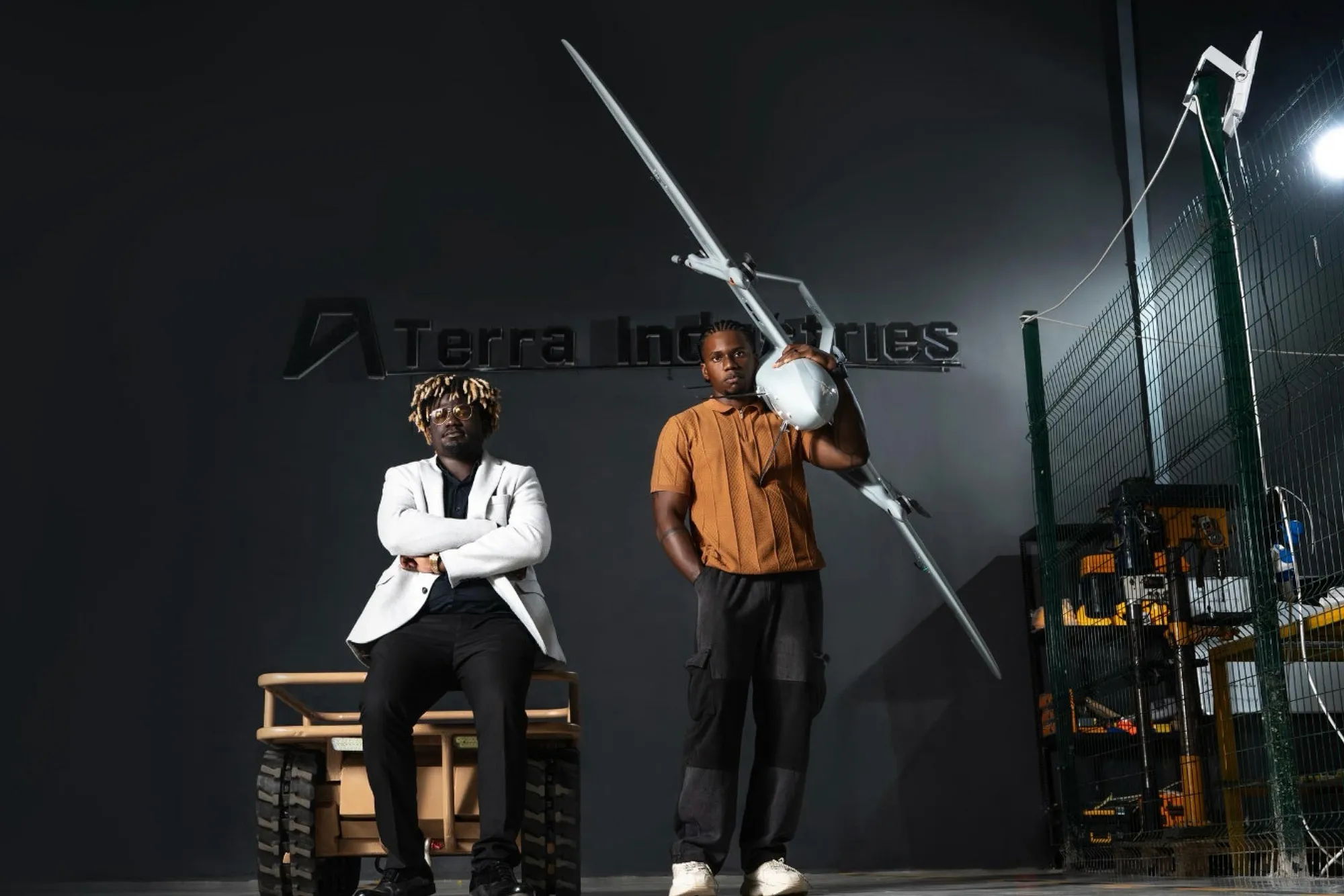
Terra Industries, a Nigerian defence-technology startup that integrates hardware and software by building drones and monitoring locations through proprietary software, has raised $11.75 million from U.S. investors. The round, the largest yet in Africa’s nascent defence-tech sector, sets Terra apart from a wave of smaller regional players and signals growing investor confidence in vertically integrated defence solutions on the continent.
The round was led by Silicon Valley venture firm 8VC, Valour Equity Partners, Lux Capital, SV Angel, Leblon Capital, Silent Ventures, Nova Global, and angel investors, including Micky Malka, who participated in the round. Alex Moore, a defence partner at 8VC and a board director at Palantir, a US public company that sells enterprise software platforms for data-led decision-making, joined Terra’s board in 2025.
From its 15,000-square-foot facility in Abuja, Nigeria’s capital, the startup, founded in 2023, formerly known as Terrahaptix, designs and manufactures unmanned aerial vehicles (UAVs), ground systems, and autonomous sentry towers used to secure power plants, mines, and other critical infrastructure across Africa for both government and commercial customers.
The raise and backing from investors in global defence tech startups like Anduril and Palantir vaults Terra into a small but growing cohort of African startups attempting something most have avoided: building advanced hardware and software systems locally, at scale, for security and defence markets long dominated by foreign suppliers.
Terra says it has generated over $2.5 million in revenue since it was founded in 2023, and the new funding will expand manufacturing capacity at its Abuja facility and support software and business development hires in San Francisco and London.
Can Terra’s hardware-software mix work?
Defence tech is an unforgiving market globally; in Africa, its growth is stunted by small margins, lack of skilled expertise or qualified human capital, and thin hardware margins that can disappear as production scale increases. Software promises recurring revenue and defensibility if enterprise clients trust and adopt it.
Terra blends the hardware-first approach pioneered by Anduril and the software-centric model associated with Palantir for its product philosophy. The startup mirrors Anduril in several ways, as it shares investors such as 8VC, Valour Equity Partners, and Lux Capital (8VC is led by Palantir co-founder Joe Lonsdale) and builds physical security infrastructure, including sentry towers similar to those Anduril deploys.
Like Palantir, however, Terra treats software as the centre of gravity. Its goal is to minimise human intervention at protected sites by automating detection, analysis, and response. Palantir’s long-term strategy has been to become a modern defence prime by owning the orchestration layer across complex systems, and Terra has adopted a similar thesis through ArtemisOS, its unified platform for large-scale security operations that ingests and analyses data in real time.
Where Terra differentiates itself from Chinese and Israeli competitors bidding for African defence and security contracts is vertical integration. It designs and manufactures drones, builds its software, deploys systems, and manages on-the-ground operations locally, reducing reliance on foreign intermediaries to secure government and commercial assets on the continent.
These parallels make Terra legible to its largely American investor base: a familiar defence-tech thesis applied to an underserved geopolitical market, executed by founders with local credibility and technical depth. If Palantir is the brain and Anduril the body, Terra is an attempt to combine both: purpose-built for regions with limited intelligence infrastructure but rising security needs.
By selling integrated systems rather than standalone drones, Terra can charge clients on a one-time basis for customised hardware, while charging a recurring subscription for its ArtemisOS software, creating predictable revenue streams, and reducing its reliance on after-sales services to sustain cash flow. The defence-tech startup can price based on value delivered rather than units shipped. A blended software play also deepens customer lock-in, raises switching costs, and improves margins over time.
What makes Terra different?
In recent years, Africa’s $100 billion annual spending on infrastructure like power plants, mines and refineries, which sit in remote or unstable regions where insecurity—terrorism, sabotage, illegal mining, and organised crime—has become a material economic risk. Governments and operators have traditionally relied on imported defence systems from China, often with limited local support and high costs.
Terra’s pitch is that security for African infrastructure needs to be built differently: vertically integrated, locally manufactured, and tightly coupled with software that can autonomously detect and respond to threats across vast terrain. In effect, it wants to become a “defence prime,” a role that companies like Anduril Industries and Palantir now play in the US.
“Africa is industrialising faster than any other region, with new mines, refineries, and power plants emerging every month,” said Nathan Nwachuku, co-founder and CEO of Terra Industries. “But none of that progress will matter if we don’t solve the continent’s greatest Achilles heel, which is insecurity and terrorism.”
When Nwachuku and co-founder Maxwell Maduka began working together in 2023, the startup was building drones on a demand-led basis for clients. The founders had seen a pattern common across African hardware startups: import most components, assemble locally, markup prices and hope the margins survive the logistics, maintenance, and FX risks. At the time, Terrahaptix opted to take the harder route, building its own carbon airframes, power systems, and batteries, importing only sensitive optical components.
Imported drones, Nwachuku argued, came with poor training, limited after-sales support, and little local know-how. By producing most components in-house, Terrahaptix could customise systems for clients and control pricing. Its early products included Archer, a long-range surveillance drone; Duma, a ground drone; and Kallot, a sensory tower that detected threats up to 5km away. The startup served clients in the power sector, inspecting dams and mining operators securing remote sites.
Within its first full-year, the startup said it crossed $1 million in revenue, selling contracts to enterprise clients at an average deal size of $100,000. Terra Industries still builds and operates Archer, Duma, and Kallot.
The commercial traction exposed a larger opportunity. Beyond drones, infrastructure operators were also buying outcomes: persistent security, rapid response, and actionable intelligence. That required software orchestration as much as hardware.
Today, Terra’s systems—air and ground drones, and a sensory tower—are orchestrated through ArtemisOS, a unified proprietary software that handles real-time threat detection, autonomous mission planning, and intelligence gathering. Terra says its technology now protects infrastructure assets valued at $11 billion, including hydropower plants in northern Nigeria, the Geometric Power Plant in Aba, and gold and lithium mining operations in Ghana and Nigeria.