

Prediction
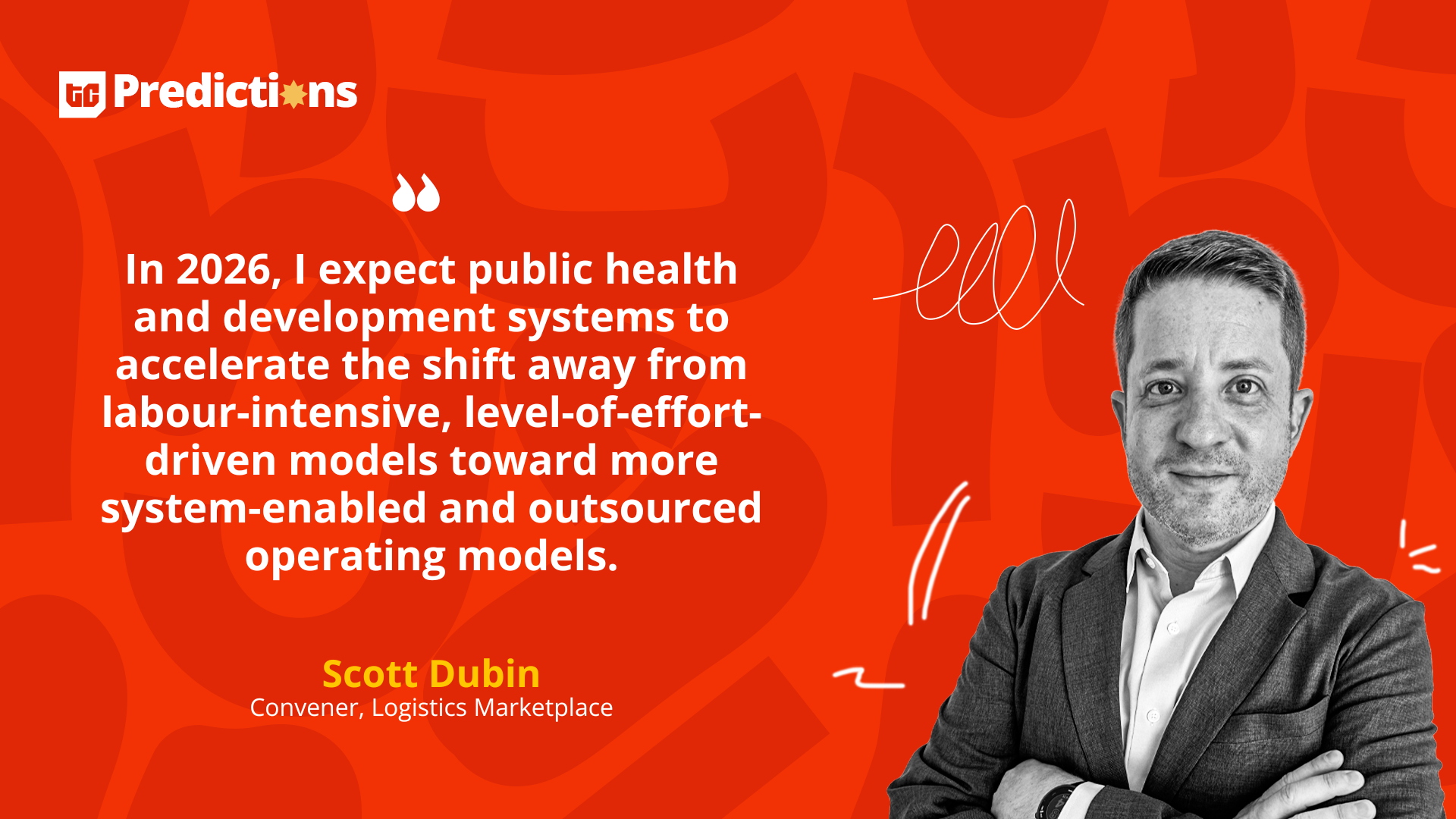
In 2026, I expect public health and development systems to accelerate the shift away from labour-intensive, level-of-effort-driven models toward more system-enabled and outsourced operating models.
Specifically, governments and donors will rely less on large in-house teams and embedded advisors and more on shared platforms, private sector service providers, and standardised systems to deliver results. This will not just be a cost-cutting exercise. It will fundamentally change how work gets done, with fewer manual processes, clearer accountability, and more emphasis on performance rather than presence.
In short, necessity will force a move from staffing solutions to operating solutions.
Supporting Evidence
The strongest signal is sustained budget pressure. Donor funding is tightening, government fiscal space is constrained, and the cost of maintaining large technical teams is becoming harder to justify. At the same time, expectations for results, speed, and transparency have not gone down.
I have seen this pattern before. When resources are abundant, systems tolerate inefficiency. When resources tighten, organisations are finally willing to question long-standing assumptions about how work must be done. We saw this during COVID, when constraints forced rapid adoption of new delivery models that had been discussed for years but never implemented.
This mirrors a broader historical pattern. When labour becomes scarce or expensive, societies invest in tools, systems, and outsourcing to close the gap. From the Industrial Revolution to the rise of the internet to today’s use of AI, constraints have consistently driven leaps in productivity.
Public health and development are late to this shift, but the conditions that trigger it are now firmly in place.
Risk Factor
The biggest risk is institutional inertia.
Even under financial pressure, organisations may choose to protect familiar models rather than redesign them. In some cases, budgets may be temporarily patched through alternative funding sources, delaying hard decisions. In others, there may be a lack of technical confidence to implement new systems well, leading to failed pilots that reinforce resistance to change.
If leaders respond to constraints by simply shrinking existing models instead of rethinking them, the opportunity for real transformation could be lost.
But if even a critical mass chooses to redesign how work is delivered rather than who delivers it, 2026 will mark a meaningful turning point.
Who is Scott Dubin?
Scott Dubin is a global supply chain and logistics specialist with more than 20 years of experience building and modernising health and humanitarian supply chains in high-complexity environments. He is Advisor for Supply Chain – Private Sector Engagement at the Global Fund to Fight AIDS, Tuberculosis and Malaria, where he leads efforts to integrate private-sector capabilities—such as logistics outsourcing, last-mile delivery innovation, and emerging technologies—into public health supply chains.
Dubin has played a leading role in advancing 3PL/4PL engagement models and public–private partnerships across multiple countries, including work on pharmaceutical warehousing systems and last-mile distribution in hard-to-reach settings. He has also helped accelerate the use of drone logistics in health supply chains, supporting both operational pilots and policy guidance.
Before joining the Global Fund, Dubin served as Senior Advisor for Supply Chain Private Sector Engagement at USAID, where he led research and authored guidance on unmanned aerial systems for health delivery. At Chemonics International, he was Director of Warehousing & Distribution and led the first sustained bidirectional cargo drone programme, improving diagnostic turnaround and emergency response in Malawi.
Earlier in his career, he held operational leadership roles with Mercy Corps and the U.S. Department of State, managing logistics for stabilisation missions in South Sudan, Libya, and Darfur. He has also worked in the private sector, co-founded a finance startup in the Balkans, and began his international development career as a Peace Corps Volunteer in Macedonia.