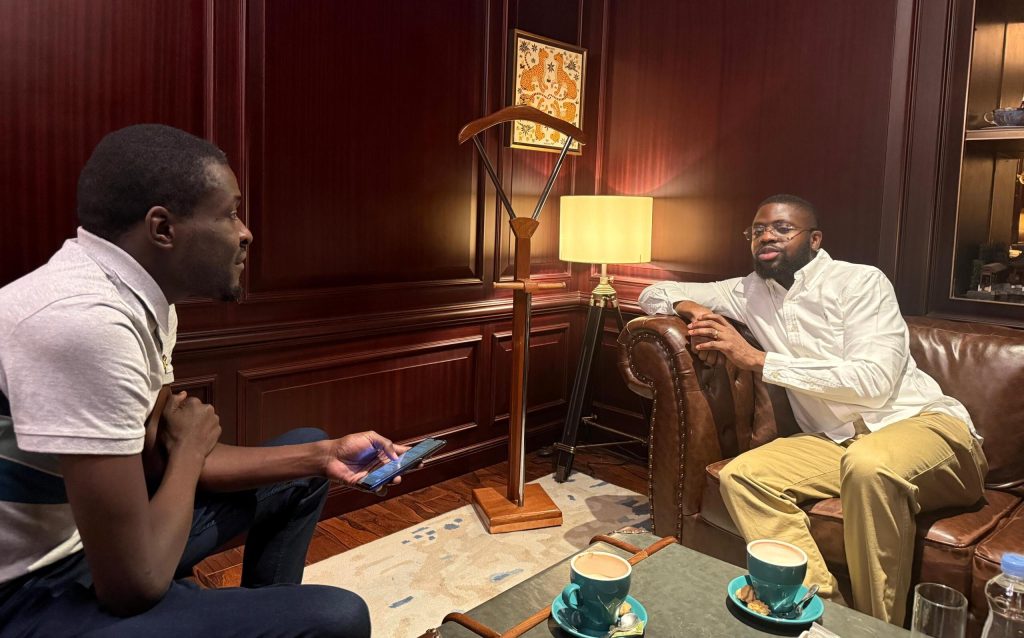
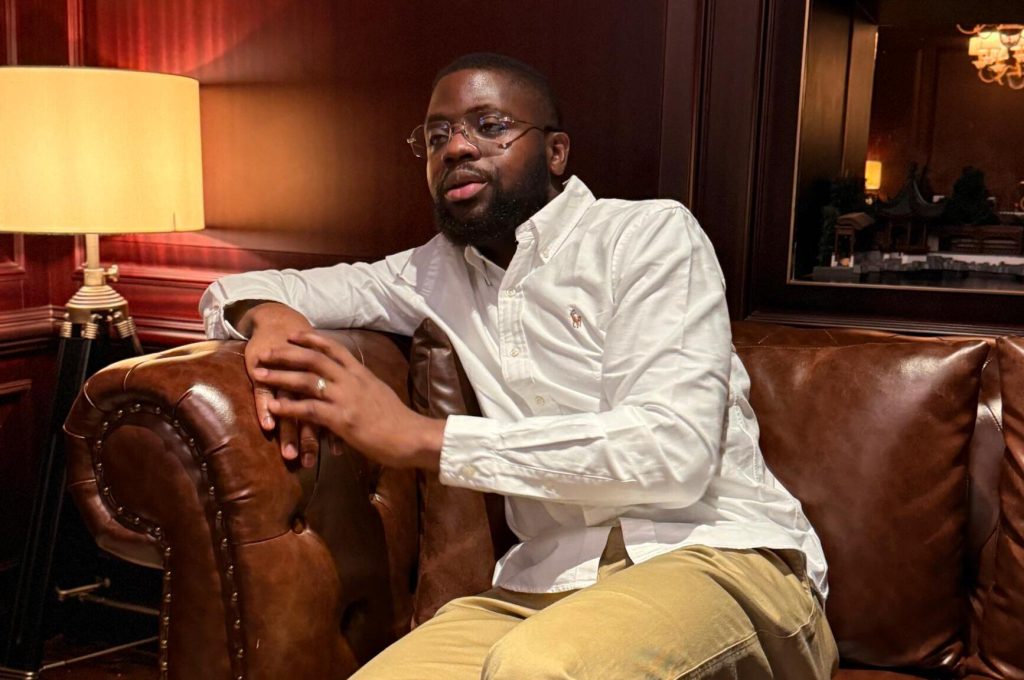
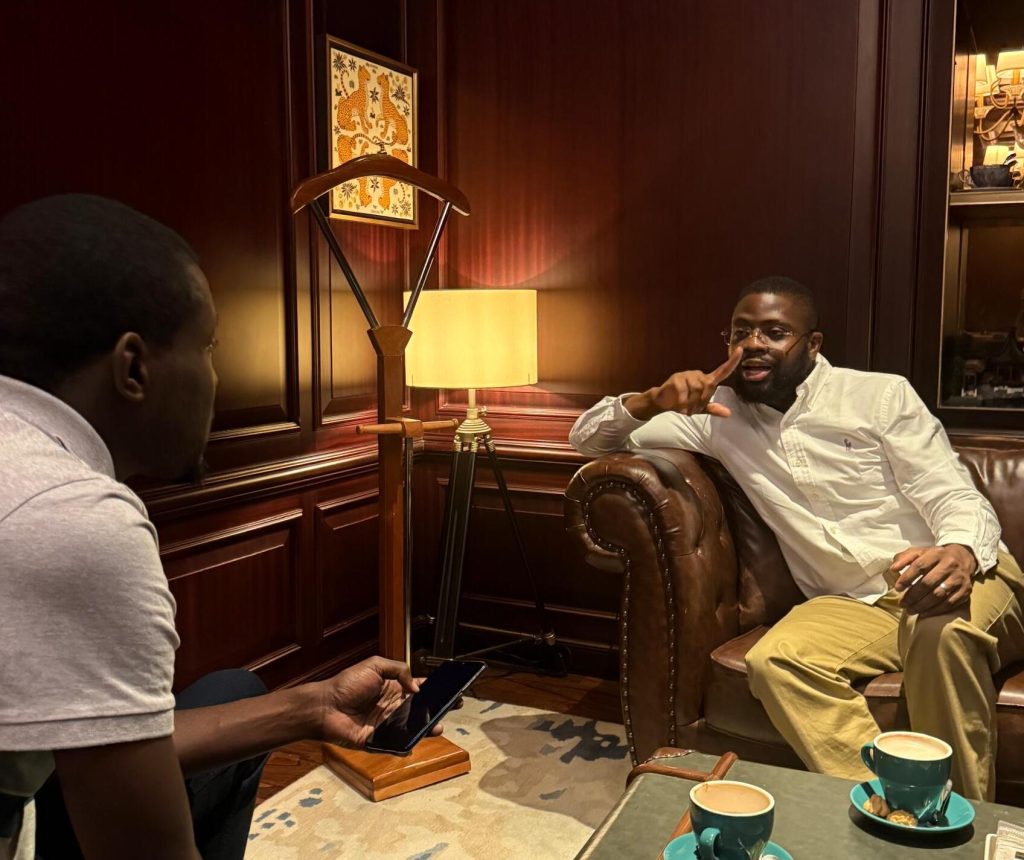
The Tulia Lounge at Pan Pacific Nairobi in GTC Tower is designed for conversations that require patience. Behind the dark wood panelling and beneath muted wall lights, it is a room more accustomed to conversations in instinctively lower voices and with no rush. The leather chesterfields absorb posture.
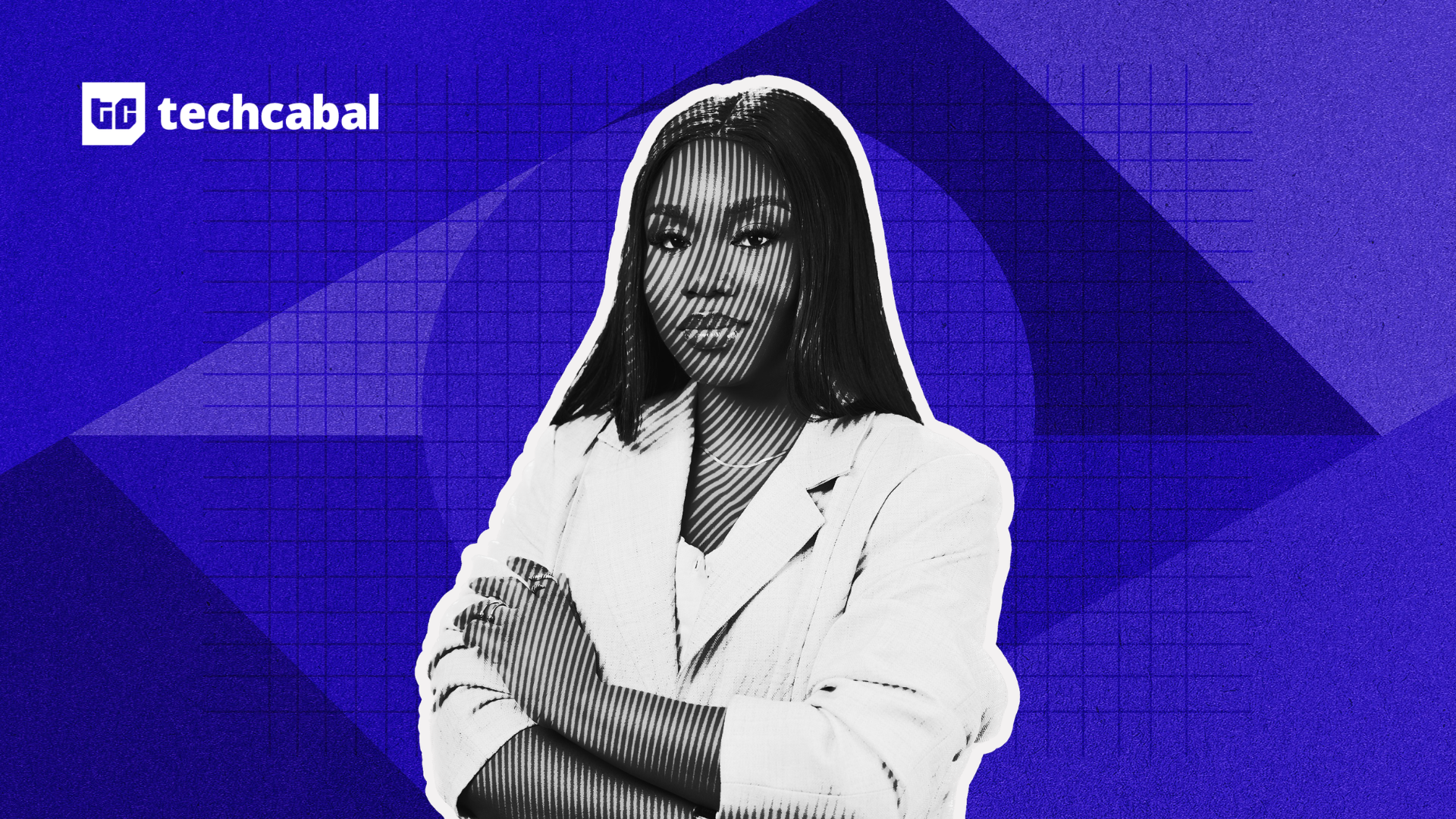
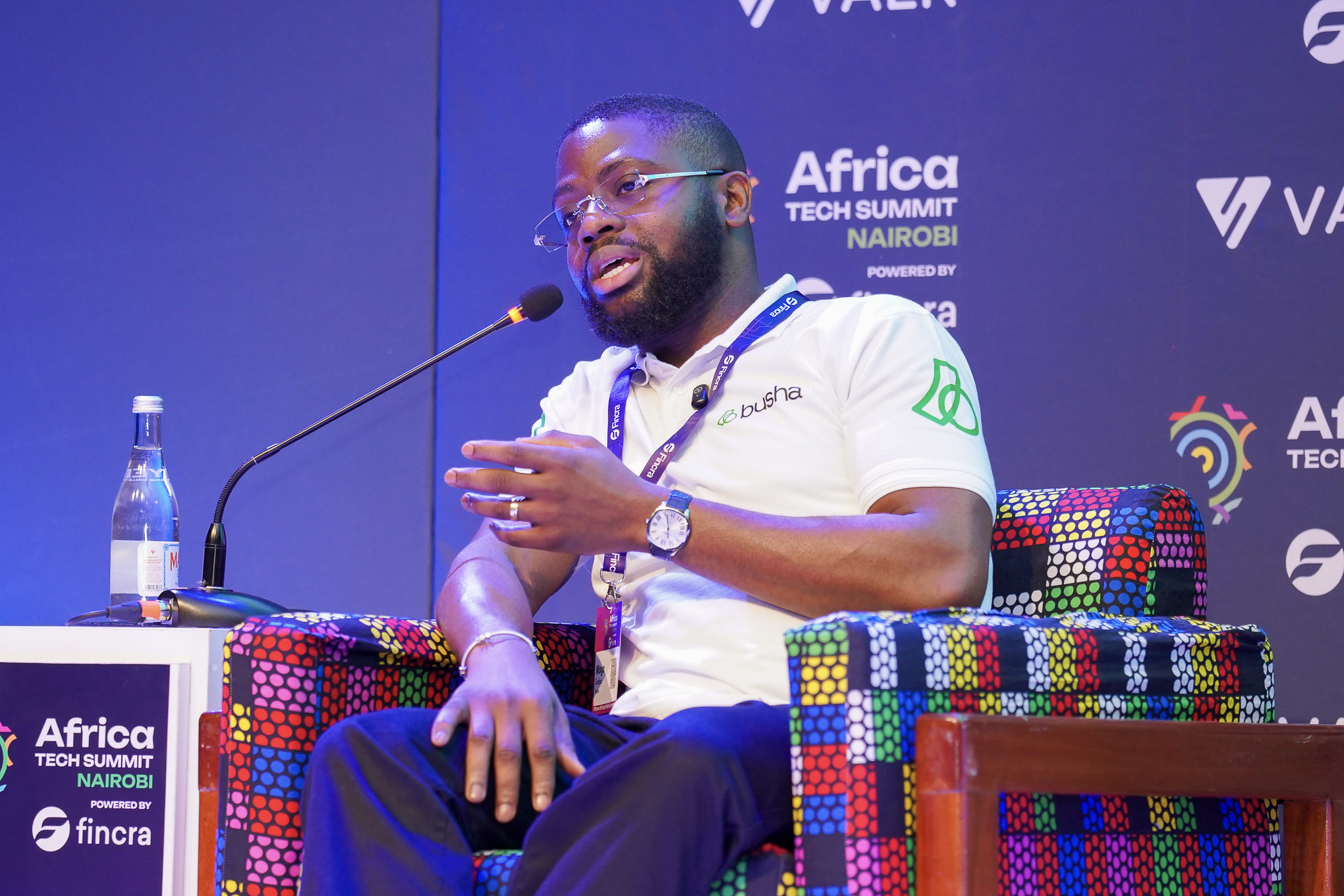
I arrived with time to spare. He did not. When the co-founder and COO of Nigerian crypto exchange Busha Moyo Sodipo finally appeared, apologising with a grin about time-zone juggling and late nights, the encounter instantly shed any hint of boardroom formality.
Over brief introductions and a catch-up on his latest visit, he confesses that he has been to Nairobi several times, yet barely knows it. His experience of the city, he says with a wry smile, rarely extends beyond Westlands, the familiar loop of airport, hotel and meeting rooms. For all Nairobi’s restless energy, his encounters with it have been largely professional, compressed into boardrooms and back-to-back schedules.
He ordered white hot chocolate; I took Kenyan masala tea, fragrant and warm. What followed was less an interview than a conversation about the constructions of ambition. He spoke about building Busha with the sort of honesty that only comes from lived experience: the sacrifices that go unseen, the emotional toll of market volatility, the contours of upbringing that shape one’s relationship with money. Towards the end, a brief video call with his daughter brought family into the narrative with effortless ease.
This interview has been edited for length and clarity.
When you’re not thinking about crypto markets and regulation, what does a perfect afternoon look like for you?
The perfect afternoon? It has to be on the weekend. On a weekday, it’s difficult not to think about the markets or everything. Even if you don’t want to think about it, a client can reach out, customers, staff, anyone can really reach out. A perfect afternoon would be on the weekend, maybe a Sunday, where I could watch a movie or binge-watch a new series. The whole weekend, just lazying in bed. Or if F1 is in season, I’ll be watching the race. So, a lazy afternoon, binge-watching a series or different movies, or watching F1.
What’s the last non-business book you read, and did it change how you think about risk, money, or people?
I’ve not really been a good reader since I got into fintech. I pick them up, I start, and I don’t finish. The last non-business book I’d say I actually read was a long time ago, probably in 2015. It was Half of a Yellow Sun by Chimamanda Ngozi Adichie. It taught me about the Igbo people in Nigeria, a bit about the culture. I’d say that’s why I picked it. It didn’t necessarily change my view on risk or money, but it deepened my understanding of people and history.
Growing up in Nigeria, what was your earliest memory of money, scarcity, abundance, or something in between?
Something in between. I was raised in a middle-class family. My parents did the best they could, to the best of their ability, for my siblings and me in terms of growing up and education. I attended private schools for primary and secondary. My dad was a big proponent of government schools, though.
I was at a federal government school before being transferred to a private school again, simply because the federal school went on strike. But even when I was thereI could tell the difference. I didn’t have a scarcity mentality towards money simply because I had provisions, and I had pocket money. And I could see some of my peers who sort of struggled with things like that. So, I would say we were somewhere in between—not affluent, where I could splurge or anything, but very comfortable with three square meals, good schools, and vacations abroad now and then.
At what point did you realise Busha could become a serious financial institution, not just a startup riding a trend?
It was 2020, during COVID. A lot of businesses were pretty much shot. A lot of people weren’t going to work; they literally had nothing to do. Remote work had just started picking up then. But then, it was a very busy period for us at Busha. There was still a lot of interest from customers. We still had our support working 24/7, and we still had requests from corporate clients every now and then. For us, it was a case of the world being at a standstill, but this particular industry, like the banks, still needed to be up and running. We still needed to wake up at a certain time every day and ensure all our systems were up.
COVID was a time of intense capacity building, researching, and growing the business for us at Busha. The business literally didn’t stop. It kept growing; the volumes kept growing. It felt like a sort of blessing, because maybe people were idle, so they started looking more into crypto. It was a point of immense growth for us. In 2021, there was still more interest, more adoption, more chatter. I would say it was that period I realised, “Yeah, this little project that we started, my co-founders and I, is actually going to become something big.”
And from then onward, I had this mantra mentally where I say crypto, digital assets, stablecoins are actually the future of money. It’s here to complement traditional money, not compete with it.
Was there a moment early on when you thought: this might completely fail, and what kept you going anyway?
There was no point where I thought it would completely fail. There were times of fear. I think one negative notion that crypto has had from day one is that a lot of people have always felt it’s synonymous with money laundering, synonymous with bad actors. I’d say one of the few days that there was a lot of fear was Black Friday in March 2020. That was the day the whole stock market tanked, the whole crypto market tanked. I kept thinking, “Is this the end?” But at the same time, I still had conviction because the stock market was doing the same thing. For me, that was the day I thought, “We need to double down on this.”
Another time I had some sort of fear was when there were banking restrictions in Nigeria. In that instance, I didn’t feel it would fail globally, but I felt it was going to be stifled in this particular country where we decided to begin our operations.
But thankfully, what these things do is they shape you to think out of the box. They shape you to engage with regulators. That’s one thing we have always prided ourselves on. Once we’re trying to go into any market, we try to engage regulators, let them know we’re coming, explain what we’re trying to do, and share information. I don’t think there’s ever been a time when I’m like, “This is the end, this thing is going to completely fail.” I’ve always felt that, like the dotcom era, or when emails came, there will always be pushback to new technology. But over time, with more education and everything, acceptance will get better and better.
Did you ever imagine working in traditional banking, or was it always about building something outside the system?
My co-founder and I met as founding members of Jumia back in 2012. We were part of something really great today. When I was in uni, I studied Electrical Electronics Engineering. My dream back then—and I would say almost everyone’s dream when you’re studying engineering—was to get done and move into an oil company in Nigeria, or a telecoms company. The dream was to work somewhere like MTN or Airtel as a network engineer, instrumentation engineer, or a role around networking and cybersecurity. It wasn’t really working in a bank. I didn’t really see myself working in a bank back then. But I’ve always loved computers and engineering-related stuff. And that’s also where my career started, back in Jumia, as a DevOps engineer.
In private, do you think crypto in Africa is more about financial freedom or more about people trying to outrun inflation and broken currencies?
I’d say the foundation of crypto in Africa started as some sort of survival. A personal story: the first time I heard about Bitcoin was from a friend. He mentioned this new kind of money, a new technology coming up. He told me to buy it, this was back in 2016 or 2017. I said, “I’m not putting my money in this thing that’s going to disappear.” That was what I told him. Fast forward to the end of 2017, Bitcoin hit $20,000 for the first time. And at that same time, there was a Ponzi scheme that was quite popular in Nigeria called MMM. At one point, they started telling people to fund their accounts using Bitcoin. Ponzi scheme plus Bitcoin sort of went hand in hand. Many people who first heard about crypto in Nigeria at that point were subsumed into the Ponzi scheme—something where you put money in today and get 30% in a month. And apart from the 30%, your Bitcoin could potentially appreciate as well. For a lot of people, the foundation was a get-rich-quick scheme.
Over the last couple of years, I’ve seen a lot of change. We have stablecoins now that people use for cross-border payments. We have digital assets that people use for different things with different utilities. There’s a lot of technology going on in the blockchain, and crypto and digital assets have sort of moved from being a get-rich-quick scheme to something you can apply to your daily life. If you go to a different country today, if you hold stablecoins, you can arrive and spend them.
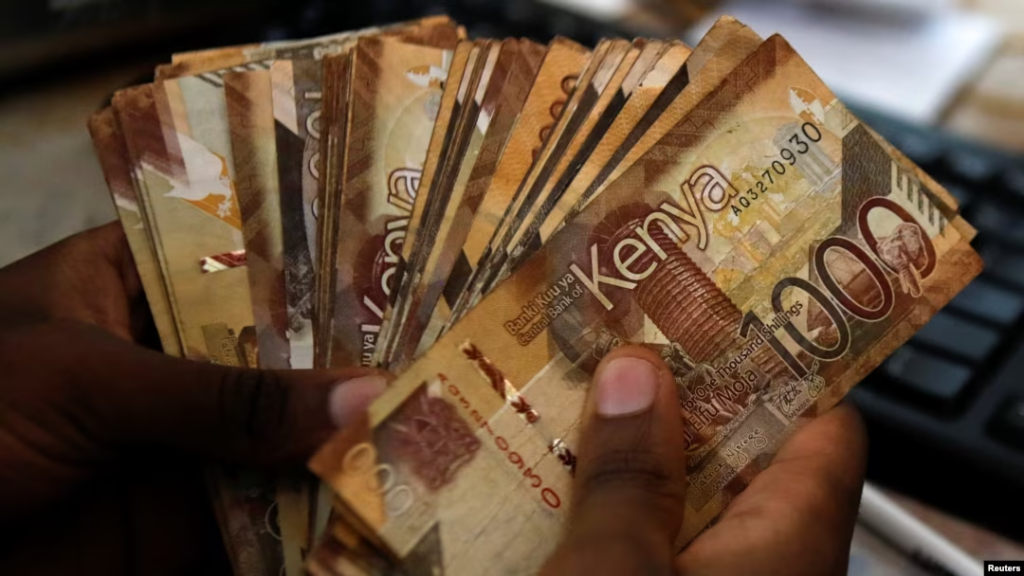
At Busha, we’re also looking at ways you can use digital assets to do things related to your daily life—pay for coffee, pay at an offline merchant outlet. Once people start seeing those actual real-life use cases, they’re able to see that this thing isn’t about putting in $1 and getting $100. It’s something you can actually apply to your daily life. And that kills the myth of “I cannot touch this thing.” I mean, when last did you hold a paper note of Kenyan shillings? It’s been a long time. Everything is going digital.
For us, we’re trying to abstract that complexity. We want you to see it the same way you see your mobile money. Log in to your digital assets wallet. We handle the headache of partnerships with offline outlets, and you pay with your digital asset. The merchant gets their fiat in whichever currency—naira, Kenyan shillings—and you get your coffee. That is how you see real application, and it helps people see it’s not just about doubling your money, but about things you do in your life daily.
What’s the biggest myth global investors have about African crypto users?
The biggest myth global investors have is that it’s for bad actors. And I always blame it on the name “crypto,” because it makes it seem like it’s for criminals. They think it’s only used for illicit things.
But in reality, as we continue to engage and educate people, what everyone will eventually see is that this is the highest level of transparency you can find. Every digital asset, every crypto transaction today is recorded on the blockchain. You cannot change what has been broadcast on the blockchain. Once you have that transaction hash and the wallet address, you put it on the blockchain explorer, and you see the value, the date, the amount—pretty much everything about that transaction. So, tell me why a bad actor would find that their preferred way to launder money? A bad actor will still most likely stick to cash because, at the end of the day, cash is not really traceable if they spend it in a location.
The biggest myth is that it’s for bad actors. And over time, I’m sure that’s being corrected with different technologies, transaction monitoring tools, and KYC processes. Another myth is probably that exchanges on this side of the world don’t do proper KYC, AML, or transaction monitoring. They probably think we don’t have proper procedures. But as we continue to engage with people globally, we show them we use the same tools they do for transaction monitoring and onboarding clients. Even before we got regulated, we were already doing bank-standard KYC on all our customers: ID verification, proof of life, and address verification. We’re constantly doing continuous transaction monitoring.
Do you see regulators as partners in building financial infrastructure, or as necessary obstacles?
No matter the industry one is working in, you can never see your regulators as obstacles. You need to see them as partners. If there’s no law or regulation, we’re going to have chaos. And that’s where the notion that ‘bad actors use this thing’ would also come from, because the regulators have no visibility. I have never seen regulators as obstacles. I see them as partners, as friends. But what needs to happen is constant education.
I would say there are three things that happen generally with new technology: innovation, education, and then regulation. Blockchain technology and digital assets are a new kind of innovation, similar to the internet when it started, or the AI craze now. When innovation comes, what you need to do is educate yourself on it. To do that, you have to partner with the regulators. You have to reach out and say, even though you’re not regulating this space yet, these are the tools we use.
As part of our CSR, we can offer some sort of training for regulators on how to learn about the blockchain. Because even someone working in a bank today—20 or 30 years ago, most transactions were paper-based, cash-based, and manual processes. Today, systems are monitoring these things. I’m sure at the initial stage, there was pushback then, too.
Regulators need to be constantly educated, engaged, and partnered with. They need to see that this space is an open book. They can come in, see what is happening, learn about it, and see how it can coexist with the existing infrastructure.
Has there been a moment where policy decisions genuinely scared you about Busha’s future?
If you’re working in fintech, digital assets, or crypto, absolutely. You can be sleeping, and one morning, you hear of a policy that has sort of decimated your operations. At that point, you have to start thinking on your feet, start thinking of ways to manoeuvre and let whoever created that policy know that we’re not bad actors, we’re not the evil ones. We need to exist together to create peace and harmony, and see how this new technology can coexist with traditional financial institutions.
The biggest fear was in 2021 when the Central Bank of Nigeria banned all banking services towards crypto-related institutions and individuals. I lost access to banking personally. My personal bank accounts were closed simply because I’m a founder of an exchange. Corporate bank accounts were closed. It was crazy. But what did we do? We came together as a group and started looking for ways to engage with the regulators, to explain what we’re doing. Even though we had been doing that before, it was in silos. But for the first time, all the players in Nigeria came together, created a group, and started lobbying, reaching out to say, “This is what we’re trying to do.”
If you were the finance minister in any of the markets you operate in for a year, what would you do differently about digital assets?
Before creating a policy, I would ensure I try to identify the top players in that industry and engage with them. I’d speak with them to understand how this new technology, this digital asset industry, works. After that, I would see if I could bring someone from their company to our side, so that when we’re creating policies, laws, or regulations, we’re creating them from a point of knowledge, not from a point of guessing. I’d identify people—not just locally, but even globally—and bring in people who understand this space to train those within my ministry on how this new technology works. So that when we say we want to regulate, we’re creating laws from a point of strength, from a point of knowledge, with the experts in the field. Not slamming standard traditional finance rules onto crypto assets, because that’s what happens in some jurisdictions today. That doesn’t work effectively; it creates unnecessary bottlenecks.
If you engage with experts, whether local or foreign—a perfect blend of both—you get the best outcome. The foreign experts bring knowledge of what’s happening in other jurisdictions, and the local ones bring knowledge of what’s happening locally. Every market has its own peculiarities, unique challenges, and unique problems that need local knowledge to navigate. I’d have a decent balance, set up a technical working committee or employ them as consultants in the ministry. From there, we’d be able to set proper regulations that go hand-in-hand with what they’re actually building.
What has growth changed about your friendship or working relationship?
My friends say I don’t check on them. There have even been times I actually forget the birthdays of some of my friends. It’s not intentional, but every day depends on how it starts. Some days it’s all chill, relaxed. I can even sneak and watch a movie because I feel like today is chill, no pressure. But some days, it’s like firefighting from morning till night. If a friend is unlucky that their birthday falls on that kind of day, it becomes a problem. I might remember in the morning, but I’m fighting for my life, so I say I’ll text them later. Then suddenly it’s 1 a.m., and I realise I have forgotten. Or maybe at 1 a.m. I check social media and think, “Oh my goodness, that person’s birthday was today.” They’re already upset.
My attention span is sort of short for certain kinds of conversations, except on a weekend when there’s not much going on. But even on weekends, I’m working. I’ve literally never been on leave since I started this company. I don’t know what that is. I can try to sleep in, and maybe when I’m not feeling too well, but even then, I’m still trying to check what’s going on and respond to messages.
It’s difficult to maintain the same level of friendships. I think the only way I can try to make up for it is if you’re available at night, when work is gone, by 11 p.m. If you can catch me there, maybe we can have a nice catch-up. Apart from that, it’s always difficult, but I still try my best to be there for my friends.
Between you and your co-founder, who is tougher in negotiations and who is more likely to compromise?
It depends on the kind of negotiation. In certain instances, my co-founder is tougher. In others, I am. It’s a balance. It depends on what kind of negotiation we’re having. Is it a business negotiation? Policy negotiation? Hiring negotiation? It really depends on the dynamic at that point in time. There are times when I say, “Nope, we’re not going to do this,” or “I’ll play the long game.” Other times I say, “Let’s get this thing done, move it out of the way.” And there are instances where my co-founder would say, “No, we need to push a bit tighter on this,” and I think it’s not really worth our time. It’s sort of dynamic.
In ten years, do you imagine Busha as a crypto company or a full financial services firm?
We see a lot of traditional finance companies beginning to find ways to incorporate stablecoins into their businesses. For us, in 10 years, we don’t see ourselves as just a crypto company, but as a money app. Crypto is going to be the foundation, the layer, the engine that’s powering a lot of things. Stablecoins are already powering cross-border transfers in different jurisdictions, inspiring supplier payments, merchant payments, and all those things.
For us, we’re going to have the necessary partnerships to ensure there’s a proper handshake between the digital assets industry and the traditional finance industry. Busha will be a one-stop shop for every financial need you have. Are you trying to acquire digital assets? You can get them from us. Want to get interest on your fiat? We’ll have partnerships with licensed entities to offer that yield. Trying to get loans? We can have partnerships that allow you to get loans backed by something. Trying to trade stocks? We’ll have partnerships with people licenced to trade stocks, to give you a fraction of those stocks in a tokenised form. Trying to pay for airtime, data, or your expressway toll payment here in Nairobi? You can do that with the Busha app.
Once we incorporate all those things into your daily life, you’ll see that we’re not just a digital asset or crypto platform. We’re your one-stop financial app, your money app for everything money-related in your life.
Would you rather be known as pioneers of African crypto or builders of Africa’s next major bank?
I would rather be known as the builders of the future of finance, the builders of the future of money. Because, of course, it started as crypto. But eventually it evolves from being a platform to buy and sell crypto to being your one-stop financial, your money app.
Is there a point at which you would sell the company, and what would that number have to look like?
Walk away from the company? It is our baby. If we have an irresistible offer, maybe. And that number keeps changing. It keeps changing with inflation and everything. Last year, it was a different number. This year I’m thinking of a different one. Even if I were offered that, it would still be nice to have some sort of advisory capacity, or maybe a board-level capacity, if that’s on the table. The only thing that would make me walk away completely—meaning I can’t even be in an advisory capacity—would need to be an offer that I cannot refuse. It also needs to be from someone or a company that I respect within the space. At the back of my mind, I need to feel like this baby that we’ve built to seven years old this month will be taken forward to become a teenager, a proper adult, into something I will be proud of, even when I’ve walked away. I need to have the conviction that the new owners have the same vision and will take it to the same height we would have. If that happens, of course, I’ll walk away and move on to something else. Maybe buy farmland somewhere and become very simple.
What’s the most expensive mistake you’ve made as a Busha founder, financially or emotionally?
The most expensive mistake is hiring the wrong person. The first month, you’re thinking, “Is this a good fit?” The second month, you’re thinking. By the third month, it becomes emotional. You’re thinking, especially if they’re not performing, “Maybe I’ll give them another chance. Maybe I should help them improve.” You keep dragging your feet. What happens is that the workload stays on you. You have to keep micromanaging instead of the person taking charge. And that stunts the growth of the business, depending on which part of the business the bad hire works in.
Has building Busha made you richer but more anxious?
Richer? No. [Laughs] It’s definitely made me more anxious. I’m still looking for the riches. But I’ll tell you, it’s definitely made me more anxious. You’re more anxious about so many things. You’re more anxious about how people see you, how you act in public, and how your brand is seen. About every little thing you do. You need to ensure that even in your free time, you make a conscious effort to remember that the person across from you might actually know you.
Your privacy is sort of gone. You’re walking at the airport, and a random person says, “Hey, I saw you on this podcast, on this tech blog.” And you cannot afford to fault or embarrass yourself, because a lot of people are looking up to you—consciously or unconsciously. At every point, you need to ensure you’re being a good role model. That can make you really anxious.
Do you still feel hungry, or has success softened the edge?
Still very hungry. We are only in two countries right now. That’s too small. We’re only in Nigeria and Kenya today for our retail operations. The goal—we have corporate operations in a couple of other African countries, B2B ops in a couple of others— is to have presence, to be the foundation, the infrastructure that everyone speaks to when they want to do something in Africa. So, I’m still very, very hungry. In fact, it’s like I’ve not eaten at all.
When you think about stablecoins and digital assets in Africa, and the first three names that come to your head, I want Busha to be there simply because we have a presence in a lot of countries. We want to be the bridge that connects Africa to the global economy.
Finally, what’s one belief about money that you held strongly at 20 that you now think was completely wrong?
When you’re younger, you think that money fixes everything. As you become more comfortable and able to satisfy certain needs, you realise that money cannot necessarily fix everything.
Relationships and family are actually very, very important. You can have all the money in the world, but with no family, no friendships, no relationships, you’re just going to be a sad person crying into your bed every day. Family is very important to me.