


Nigeria’s macroeconomic data has always been available. However, what has never existed is a platform that maps how it connects. Every institution making ‘Nigeria-exposed’ decisions, whether lending, investing, advising, or setting policy, has faced the same problem: macro data is fragmented across 13+ official sources, arrives with weeks of delay, and provides no systematic way to understand how one indicator causes another to move.
The Nigeria Macro Monitor solves this. It consolidates live data from the Central Bank of Nigeria, the National Bureau of Statistics, the Debt Management Office, Nigerian Exchange Group, World Bank, International Monetary Fund, World Food Programme, and other official sources into a single platform that maps the causal relationships between over 800 macro indicators.
The result is not only a data dashboard. It is a causal intelligence system; one that tells you not just what Nigeria’s inflation rate is, but why it moved, what drove it, and what it will affect next. Nigeria now has the macro intelligence infrastructure its institutions have always needed. It is built on open data, designed for institutional use, and available today. Nigeria’s Economic data is spread across 13+ official sources, each publishing on different schedules, in different formats, with no standardised methodology. Most institutions, including banks, consultancies, and government agencies, still assemble macro briefings manually, taking 3–5 ‘analyst-days’ per month.
What does the Nigeria macro monitor do?
Within the Nigeria Macro Monitor platform is an AI release named ‘Nkem IQ’. The AI answers macro questions in natural language, is grounded in live NMM data, and generates structured reports, scenario analyses, and transmission briefs. The monitor also has export-ready briefing tools, such as a report builder for long-form research within 5,000 to 20,000 words.
Beyond that, you can also export a ‘Macro Brief’ for one to two pages, EIU-style (Economist Intelligence Unit) curated intelligence notes, which can be formatted as a PDF, Word document, or slides. All data is sourced exclusively from official institutional publications and the platform does not generate or estimate its own primary data.
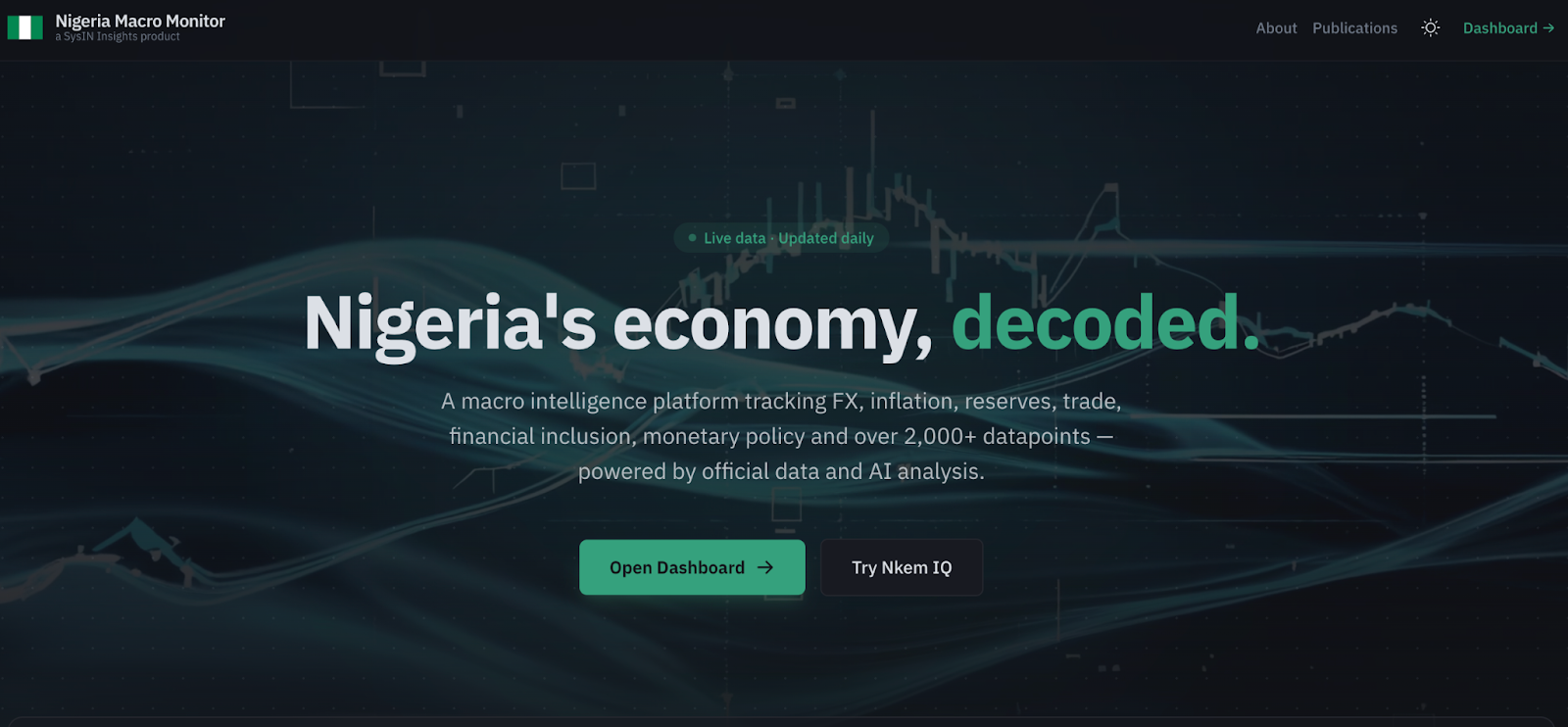
Nigeria Macro Monitor Dashboard. Image source: Nigeria Macro Monitor
The platform is built for commercial banks, asset managers, Private Equity (PE) funds, consulting firms such as McKinsey, Deloitte, the Government, multilaterals like the World Bank, International Monetary Fund, and media outlets such as BusinessDay and Nairametrics.
The team & origin story: Built in Africa, for Africa
SysIN Insights, the intelligence body behind the Nigeria Macro Monitor, has a mission which is: institutional-grade macro monitoring platforms for Africa’s most important economies. In addition, the AI release, Nkem IQ engine, is built to scale. Each new deployment uses the same causal graph architecture, the same AI copilot layer, and the same briefing pipeline adapted to local data sources and regulatory context
.
For Musa Obed, Ex-Fincra’s Strategy Lead and the founder of SysIN Insights, the platform is a proof of concept that institutional-grade economic intelligence tools can be built in Africa, using open data, without the infrastructure budget of a large multinational organisation.
What makes Nigeria Macro Monitor different from anything else in the market?
There are four categories of existing tools, and the Nigeria Macro Monitor is differentiated from all of them. For the founding team of the Nigeria Macro Monitor, Bloomberg and Reuters cover Nigeria as one country, yet their macro data on Nigeria remains at the headline level, as they do not map causal relationships between Nigerian indicators. The Bloomberg Terminal is a financial data and trading platform that provides real-time market data, news, and analytics and costs between $25,000 and $30,000 annually and is not designed for Nigeria-specific causal intelligence.
The Economist Intelligence Unit and Oxford Economics teams also produce quarterly reports. According to the founding team of Nigeria Macro Monitor, when these reports are ready, the macro environment has shifted. They also carry an increased cost of over $20,000 per engagement or annual subscription, are general in their observations, and do not provide a live, interactive platform. These reports also do not afford the readers causal graphs, an AI copilot, and the ability to run custom scenario simulations.
Internal research teams produce high-quality analysis but at high cost (senior economist salaries), slow speed (three to five analyst-days per report), and with inconsistent methodology across analysts and over time, when economists leave, institutional knowledge exits with them.
General AI tools such as ChatGPT or Gemini can generate text about Nigeria’s macro state, but they tend to become broad and not specific enough for case-by-case requests. These tools could also make mistakes about the numbers they generate from official Nigerian statistical publications.
Image source: Nigeria Macro Monitor
The Nigeria Macro Monitor occupies a gap that none of these tools fills.
To access live refreshed data, which is Nigeria-specific, causally-mapped, AI-powered, and export-ready, all at a price point that is accessible to businesses and institutional buyers across the market, visit nigeriamacromonitor.com