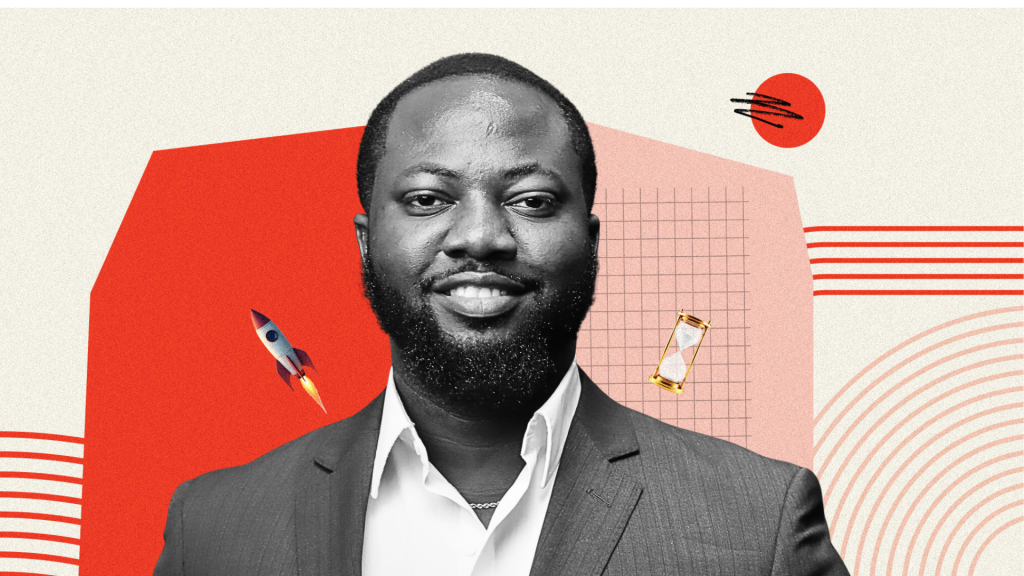
If Orpheus had loved Eurydice with the same conviction that Temidayo Oniosun brought to the space industry, he might not have looked back.
As a teenager preparing for his university entrance exam, he was deeply interested in the space sector.
“I’ve always wanted to start a company in the space industry,” he said.
He meant it then. He still means it now.
In 2011, Oniosun was a student at the Federal University of Technology, Akure (FUTA), in Ondo State, Southern Nigeria, trying to find his way into an industry that barely existed around him. He wanted to study aerospace engineering, but no Nigerian university offered it at the time, so he chose the next closest thing: Meteorology.
He didn’t wait for the space industry to find him; he went looking for it. While at FUTA, he joined global space communities and research circles, started a space club in his second year, and gathered students who were just as curious. Together, they searched for asteroids using software, launched high-altitude balloons, and ran projects that made space feel local.
In 2017, he travelled to Colorado Springs in the United States for a space congress. He already understood how the space world worked, but at that conference, he realised how little that world knew about space activities in Africa.
“There was some space activities going on in Africa, and nobody was talking about them,” he recalled. “The people outside of Africa and most Africans were also very unaware of this.”
He came to Lagos after completing his National Youth Service Corps (NYSC) in Akure in 2017, and in February 2018, started Space in Africa, a space and satellite intelligence company, to make an invisible industry visible.
Day 1: The $3,000 dilemma
Space in Africa began as a website that published articles about Africa’s space industry. On the day Oniosun decided to start the company, he went looking for a domain name and found that spaceinafrica.com—the name that said exactly what he was building—cost $3,000. He bought a cheaper alternative, africanews.space, and got to work. It would take three years before he returned to buy the name he had wanted from the beginning.
On that first day, he built a WordPress website, opened social media pages, and began writing articles on everything he could find about Africa’s space activity, from satellite launches to national space initiatives. Space in Africa was generating no revenue at the time.
“It felt like I was doing something right,” he said.
In October 2018, he hired his first employee. The question of how to make money from what he had built became harder to ignore.
“Just writing and publishing articles was not going to make money, and the traffic was not that much,” he said. “We were getting important views, but that’s not something that would generate a heavy amount from Google Ads.”
He looked outward, studying media companies like SpaceNews and SpaceWatch Global, that served European and American audiences on a subscription model. In early 2019, Space in Africa introduced a paywall with monthly, biannual, and annual subscription plans that ranged from $100 to $150.
The first few months brought in only a handful of subscribers, maybe two or three, Oniosun said. Some paid for the monthly plan and never renewed; the option was scrapped with the hope that longer commitments would stick. But that did not solve the problem.
“One of the lessons that I learned is that subscription business is extremely hard to sell in Africa… it doesn’t matter the product you’re trying to sell,” he said. “The same subscription business that would sell in the US or Europe, and will make you a lot of money, if you try it in Africa, it’s not going to work.”
Still, the subscription plan was not discontinued, and the small revenue it brought in was folded into everything else the team was trying to figure out. By then, it was obvious that the model would not sustain the company; it would have to be something else. The answer came from something Oniosun said no one had done before.
The industry report that changed everything
If people wouldn’t consistently pay for articles, maybe they would pay for something deeper that they could actually use. In 2019, Oniosun and his team began working on their first industry report about the state of Africa’s space sector.
“No one had ever quantified what the African space industry looked like,” he said.
The report detailed which African countries had satellites, the structure of their national space agencies, ongoing space projects, and funding sources, Oniosun said. The report, priced at $2,000 at the time, was built for companies trying to understand the market.
It was a risk because there was no guarantee that anyone would pay that much for information about an industry many people barely knew.
“For some reason, it actually worked,” Oniosun added.
Companies bought it, with some wanting higher-tier packages that included presentations and strategy sessions. A global licence costs $5,000, allowing large organisations to share the report across their multiple offices. At the same time, a premium offering included a two-hour session in which the Space in Africa team would break down the market and answer questions.
According to Oniosun, in 2019, the company generated roughly $20,000 in revenue driven largely by report sales, and positioned Space in Africa as a source of truth about the space sector. “Pretty much everybody in the industry knew about us.” The 2020 pandemic slowed momentum and left the company’s revenue nearly unchanged. Oniosun wasn’t done chasing growth.
In 2021, the company expanded into consulting, using its data expertise, network, and market understanding to advise governments, institutions, and private companies.
Its first major project was a baseline study for the African Union Commission, focused on the establishment and operationalisation of the African Space Agency. That year, according to Oniosun, Space in Africa generated $300,000 in revenue.
“With everything that we were doing, we were basically at the centre of this industry,” Oniosun said. “We controlled a lot of the data and narrative in the industry.”
In 2022, the company launched its annual space conference series, starting in Nairobi, Kenya’s capital. According to Oniosun, the goal of the conference was to bring together space agencies, companies, and stakeholders from across the continent. With that growth, Space in Africa saw its partnerships expand, with collaborations with international institutions such as the African Union and the European Union.
Throughout this, none of Space in Africa’s products was discontinued. “Every single business model we tested is still running simultaneously,” he said.
What building Space in Africa demanded of Oniosun was a willingness to rethink himself. There was no textbook for building a space-focused intelligence company in Africa, which meant every step forward came with uncertainty. Even the question of whether the business could sustain itself lingered.
“I wasn’t sure whether I could make money from the industry,” he said. “I didn’t know that because there was nothing that signalled that.”
That uncertainty shaped how the company evolved, as each new product offering was a response to what was working and what was not. Oniosun said that now that Space in Africa can sustain itself, its focus is on how it continues to grow within an industry that is becoming more defined.
“The work we’ve done over the last eight years has shaped the industry in a way that no one ever thought was possible,” Oniosun said. “… and for me, I am excited; I am fulfilled”