Less than ten years ago, Daniel Idiare was a medical student who believed he understood Nigeria’s education system. He had lived through the JAMB uncertainty, the endless queues, and the frustration of being assigned to a course he never chose. But it wasn’t until he left Nigeria to study medicine in Russia that he truly saw the problem from the outside.
Smaller class sizes. Oral exams that actually tested understanding. Interactive learning that felt less like memorisation and more like discovery. Predictable structures that didn’t leave you wondering if you’d make the cut.
It was everything he wished existed back home.
He found himself thinking: Why can’t we scale this at home?
“I realised our system isn’t just lacking resources,” Daniel says now. “It’s structurally designed to keep people out. The demand is enormous, but the supply hasn’t moved in decades. If this same model existed in Nigeria (without the limits of physical space) our outcomes would be completely different.”
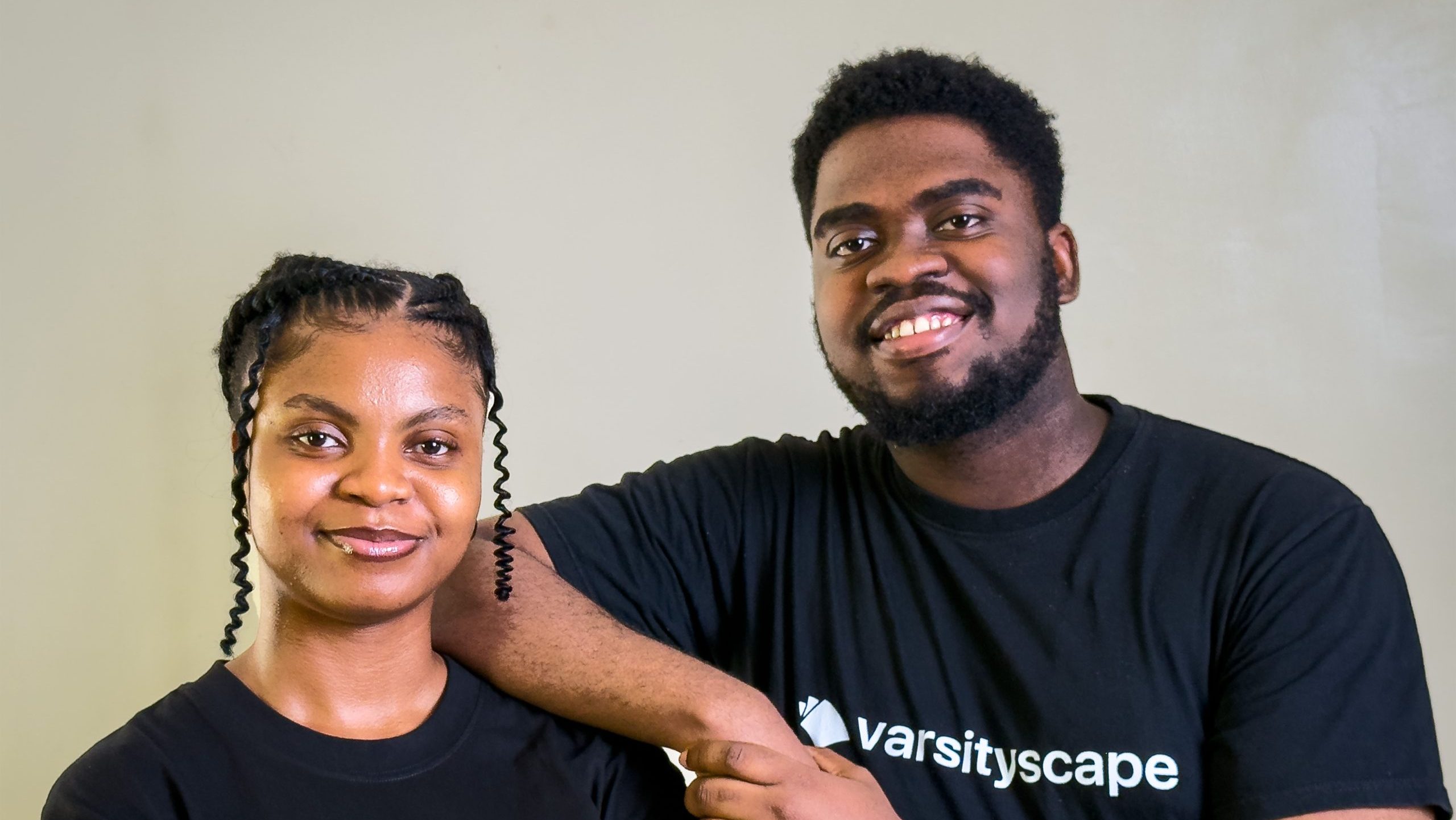
That realisation became the spark. And when he returned to Nigeria, he and his sister Grace Idiare decided they weren’t going to wait for the system to fix itself.
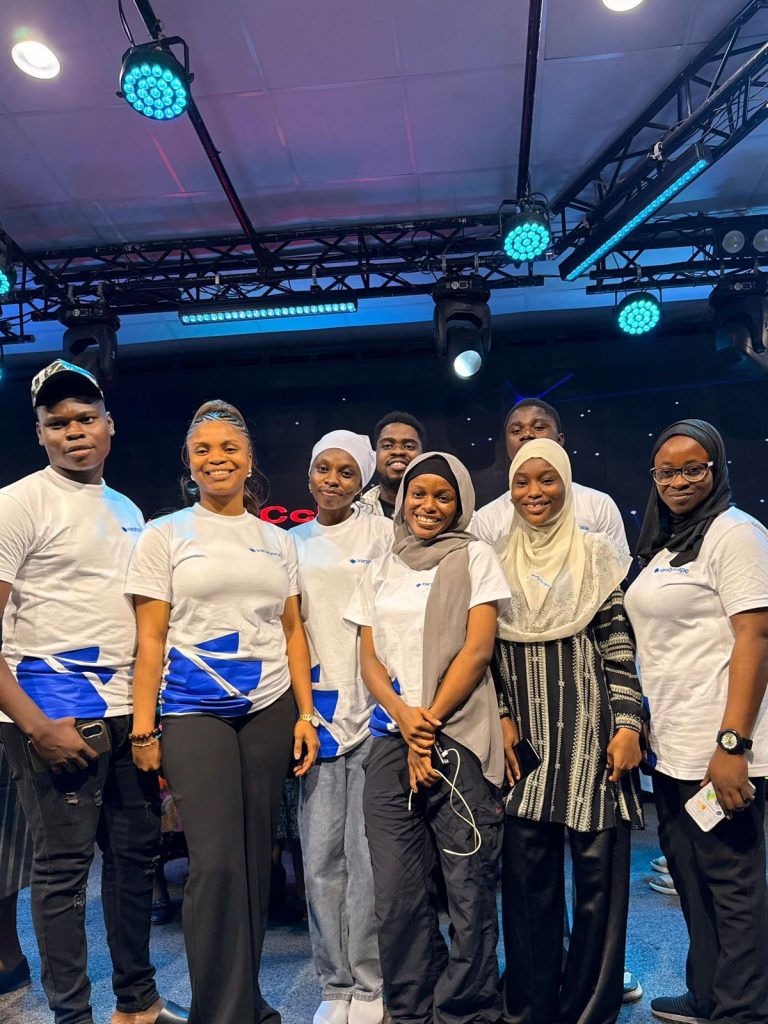
Two siblings who chose to fix the system
Daniel’s path into technology didn’t follow the typical Silicon Valley script.
He first encountered tech while serving in the IT unit of his student fellowship. He loved the logic of building systems, the way code could solve problems at scale. But he never left medicine behind. He kept coding at night while studying the human body during the day: stem cells, neuroscience, the mechanics of the mind.
He completed his medical degree in 2024, but by then, VarsityScape was already taking shape.
“I realised I had two paths,” Daniel explains. “I could study the mind through research, or I could build something that enables millions of minds to reach their potential. I chose the one with the most immediate impact.”
Cofounder and COO, Grace’s path into the story came from a different angle.
She studied actuarial science at the University of Benin, then moved through roles as a data analyst, product designer, community manager, and marketing analyst. She calls herself a generalist with range, and VarsityScape became the place where all of that range finally made sense.
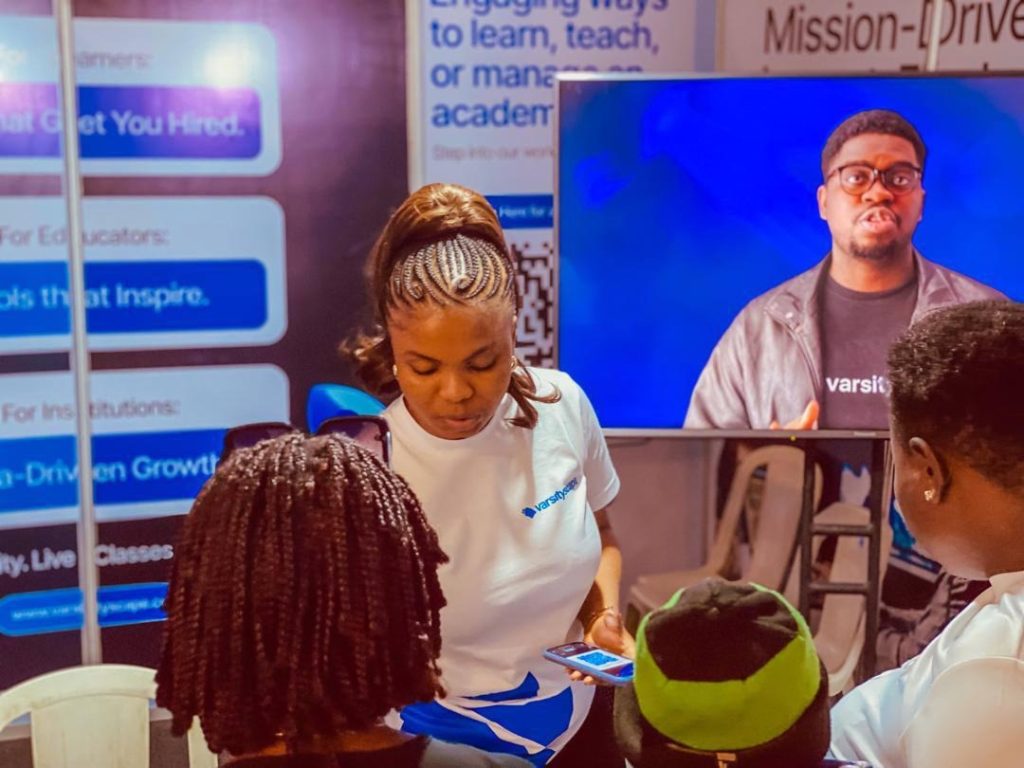
“I’ve always believed I can learn anything I put my mind to,” Grace says. “But I never had a place where all of that range made sense. VarsityScape became that place.”
For Grace, the company wasn’t just about solving a national problem. It was personal. “If learning is designed well and supported by the right tools, people can grow into roles the world doesn’t even see them in yet. I’ve lived that. And I want to build that for others.”
The pivot: from exam cramming to building an Academy OS
VarsityScape didn’t start as the sleek academy infrastructure it is today.
The early version was a library of course materials for university students. Traffic would spike during exam season: students would download notes, memorise formulas, cram for tests, and then they would disappear.
Engagement was inconsistent. Students weren’t learning. They were surviving.
That realisation forced a hard pivot.
Daniel started looking at platforms that were actually working. The ones getting results weren’t just hosting videos or PDFs. They were running structured academies with live cohorts, weekly check-ins, and tight-knit communities. Students showed up. They finished. They got jobs.
While Daniel was studying what worked elsewhere, Grace was on the ground talking to the people trying to build these academies in Nigeria. She spent months running surveys with online learners, sitting in on instructor calls, and watching communities fall apart because the tools couldn’t keep up.
“The problem I kept hearing was the same,” Grace explains. “Online academies were struggling with low engagement, overly theoretical content, and serious operational chaos. The tech stack was scattered. Payments on one platform. Live classes on another. Communities somewhere else. The experience was exhausting for both students and instructors.”
The answer became obvious: Africa didn’t just need another LMS or course platform. It needed an
Academy Operating System.
“We saw the pattern,” Daniel says. “These academies were scaling talent, but they were running their operations across a dozen different tools. No one had built the infrastructure that actually powers the online academy model.”
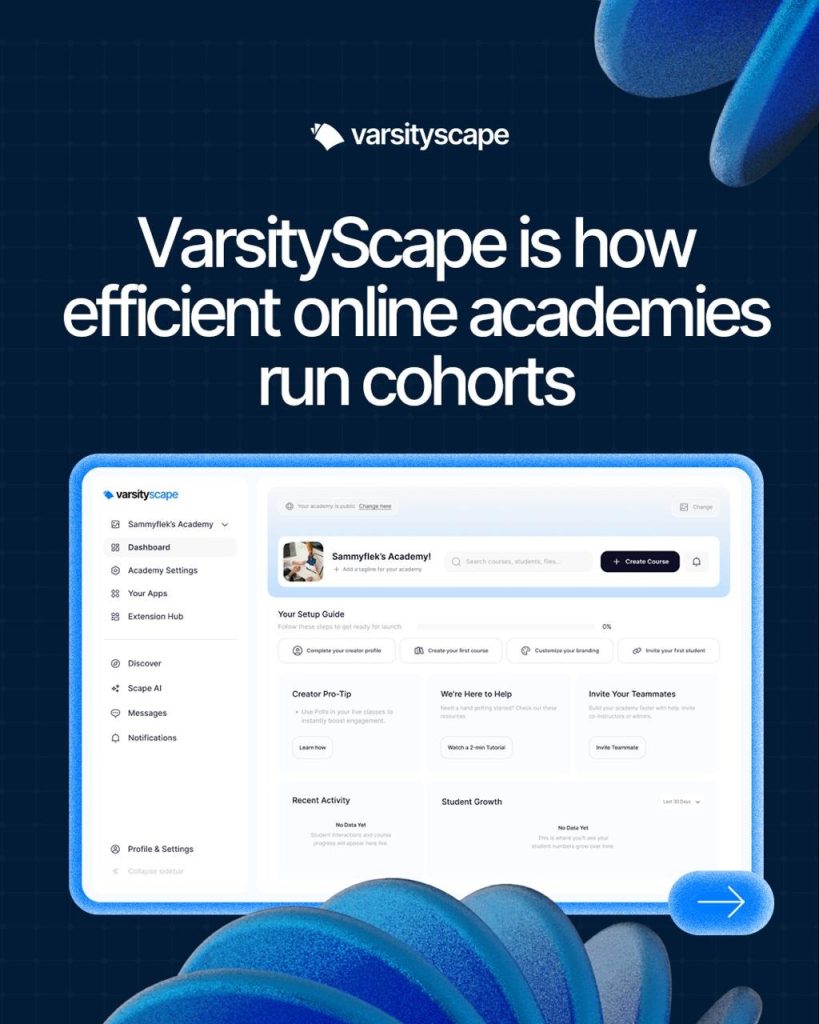
VarsityScape became that infrastructure. A unified SaaS platform for anyone who wants to launch and scale an academy: live classes, AI-powered curriculum tools, payment automation, analytics, community management. Everything in one place.
Grace thinks about it from the operator’s side. “We want an educator to go from idea to full academy without losing their mind in the process. Not just a course. An institution. With structure, community, and outcomes built in from day one.”
The Web Summit Win in Lisbon
In November 2025, VarsityScape placed second at Web Summit’s PITCH competition in Lisbon, Portugal, one of the largest tech conferences in the world. They beat out more than 2,700 startups from across the globe.
Daniel wasn’t able to make it to Lisbon. Visa delays kept him in Nigeria, a perfect example of the access barriers VarsityScape is working to dismantle.
For Daniel, the win meant something specific. “It’s global validation for a local problem. When you’re trying to convince investors or Vice-Chancellors to adopt a new way of thinking, third-party recognition helps immensely. It signals that the problem we’re solving isn’t just ours. It’s recognised globally as a critical issue.”
Grace sees it as proof of concept. “It wasn’t just about us. It was proof that African solutions, built to solve African problems, can compete on any stage. That matters when you’re trying to scale.”
The next move: bridging African campuses and Silicon Valley
Off the back of the Web Summit win, VarsityScape announced a partnership with USA Launching Pad to launch the Global Market Access Program, a co-branded initiative that connects African student entrepreneurs with the U.S. innovation ecosystem.
The program offers a 1-2 week immersion in tech hubs like Silicon Valley, New York, Boston, and Austin. Students attend workshops, meet investors, tour companies, and refine their pitches for U.S. audiences.
For Daniel, it’s a simple economic argument. “Africa controls about three percent of global GDP. The United States controls roughly twenty-six percent. If we want African talent to be globally competitive, we have to expose them to the markets that absorb the most value.”
The program is designed to be offered by African universities as part of their entrepreneurship curriculum, a differentiator that boosts rankings, attracts top-tier students, and signals a commitment to global innovation.
Rethinking capacity for millions of excluded learners
Every year, millions of African students are denied university admission. Not because they aren’t capable. But because physical campuses don’t have the capacity for them.
The system is congested. The infrastructure is fixed. The institutions are constrained.
Daniel and Grace believe the solution won’t come from building more classrooms. It will come from building more academies that operate beyond physical walls.
“In Nigeria alone, millions of students apply for university spots each year. Only about 700,000 make it,” Grace says. “You can’t fix that gap with more lecture halls. You fix it by changing the architecture of education itself across Africa.”
Five thousand academies. One million students.
VarsityScape is now building the infrastructure to launch five thousand academies across Africa within the next three years.
These won’t just be tech bootcamps. They’ll span digital health, renewable energy, logistics, creative industries, and business: sectors that are critical to Africa’s economic future.
“We’re not waiting for permission,” Daniel says. “We’re building the future we can by empowering each academy with all they need to succeed.”
Grace finishes the thought. “If we do this right, a young person in any African city can log into an academy on VarsityScape and start learning skills that the world is ready to pay for. That’s the future I want to see. And that’s the future we’re building toward.”
In many places in Africa today, millions of students will be turned away from universities they’re qualified to attend.
Daniel and Grace are building so that rejection doesn’t have to be the end of the story.