
Startups On Our Radar spotlights African startups solving African challenges with innovation. In our previous edition, we featured five game-changing startups pioneering artificial intelligence, agriculture, clean energy, and finance. Expect the next dispatch on February 6, 2026.
This week, we explore five African startups in the mobility, cryptocurrency, agriculture, and artificial intelligence sectors and why they should be on your watchlist. Here are our picks for today:
BodEr wants to cut carbon emissions with its e-ride hailing platform (E-mobility, Kenya)
Born out of a frustration with Nairobi’s traffic while working in logistics at ShipShap, a shipping company, Martin Lusasi and Kelly Mutugi founded BodEr, a Kenyan ride-hailing platform focused exclusively on electric two-wheelers. It connects urban commuters and small businesses to e-bike riders, aiming to reduce travel time, lower costs, and cut greenhouse gas emissions.
Lusasi says the user journey mirrors regular ride-hailing platforms where users download the app, log in, request a ride, select an e-bike, wait for pickup, and pay either in cash or through the app.
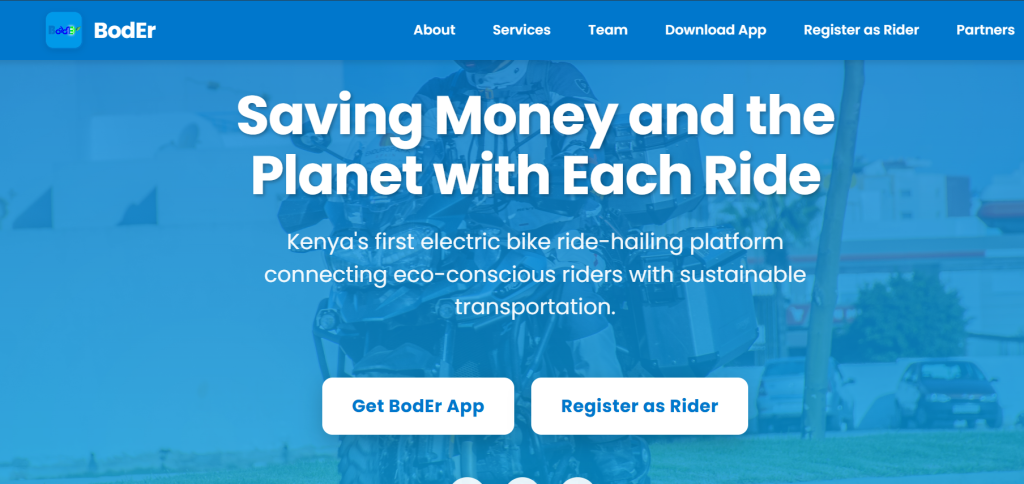
The startup does not manufacture its own bikes; instead, it partners with e-bike manufacturers. For its pre-launch tests, Lusasi said BodEr is working with Roam, an electric mobility company, and is also in discussions with Ampersand, an electric transport energy company, to expand supply. While riders who already own e-bikes can sign up directly on the platform, others who do not can access financing to acquire bikes through partnerships with microfinance institutions.
As of January 2026, BodEr is at its minimum viable product (MVP) testing stage and says it has completed over 200 test rides, with a public launch planned for February 2026.
BodEr operates a multi-stream revenue generation model. On the consumer side (B2C), the startup plans to take a 15% commission per ride, and expects to earn 10% profit on electric bike purchases on the business side (B2B). It intends to offer corporate mobility and delivery services through its fleet and generate revenue from there. The startup also plans to introduce a leasing and subscription model, including daily, monthly, or yearly options, targeted at campus communities.
Why we’re watching: BodEr is entering Kenya’s competitive ride-hailing market with a narrow focus on electric two-wheelers. Rather than competing head-on with platforms like Uber and Bolt, the startup differentiates itself by focusing on an entirely green fleet and targeting secondary cities such as Embu, Kisumu, and Mombasa.
BodEr plans to integrate AI-based route optimisation to help riders avoid traffic, as well as an internet of things (IoT) model that prevents a ride from starting unless the system detects that the rider is wearing a helmet. In 2024, BodEr won Kenya’s TotalEnergies Startup of the Year (Energy category), which came with a $12,000 grant, and secured AUD 100,000 ($70,000) from the KMA Foundation Palladium grant competition to fund app development.
Pyn wants to turn job hunting into a guaranteed outcome (HRTech, Nigeria)
Pyn, a job placement platform founded in 2025 and designed to move away from the manual effort of recruitment for both candidates and businesses, emerged from the personal experience of the founder, Charles Okala, who struggled to secure roles as a candidate and struggled to find the right talent as a founder. In his view, the job market forces candidates into a volume-driven process of sending out countless applications with little feedback, while businesses are left sifting through several resumes to find a handful of suitable candidates.
Pyn’s core proposition is to take away job searching entirely. Rather than acting as a job board, the startup operates a placement system designed to match verified talent with companies and guarantee outcomes. The startup began as an AI-powered service that helped candidates apply for jobs by creating tailored resumes, submitting applications, and tracking responses. Although Okala says that the model attracted over 5,000 users, he realised he could not verify skill levels, which led to Pyn’s current model.
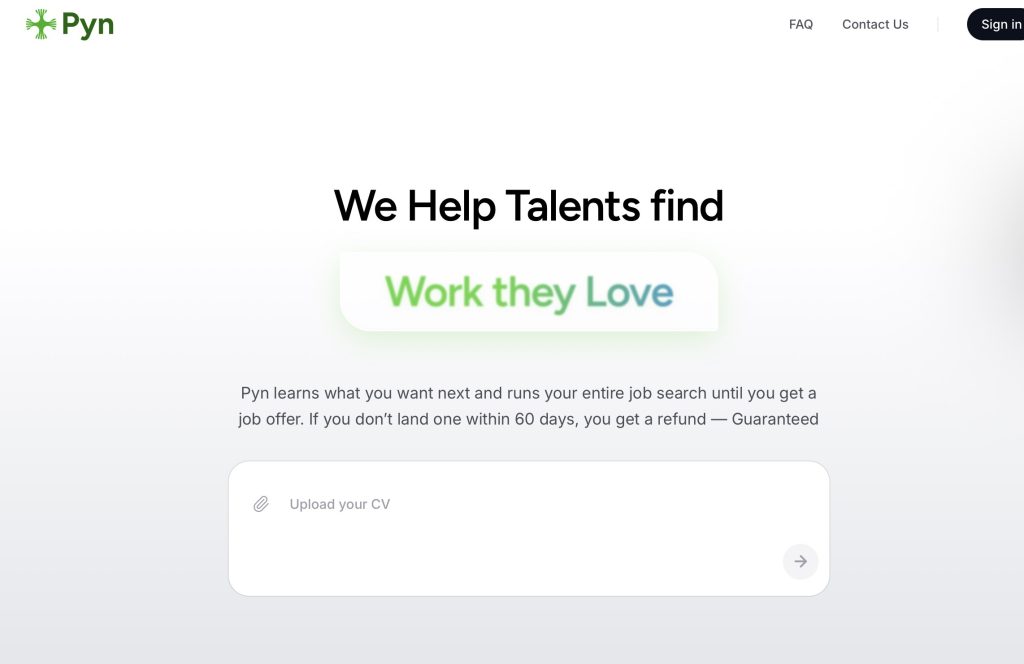
Under the model, candidates submit their CVs, specify the roles they want, and enter a three-day manual verification process. Instead of relying on credentials alone, the startup assesses candidates through real-time proof of work, observing them solve problems live to test factors Okala says cannot be faked with AI-generated portfolios.
Once verified, Pyn guarantees a job offer within 60 days that matches the candidate’s level and salary expectations or issues a full refund. Pricing for candidates to access this service is ₦30,000 ($21.58) for junior, ₦75,000 ($53.96) for mid-level, and ₦300,000 ($215.85) for senior talent.
For businesses, Pyn sells access to verified talent, not CV databases. Companies can request between three and nine candidates, paying per verified profile. Pricing starts at ₦9,000 ($6.48) per verified junior candidate, ₦25,000 ($17.99) for mid-level, and ₦45,000 ($32.38) for senior roles.
The startup reports nearly 10,000 users on the platform so far. Under its earlier model, it claims that about 20% of users secured jobs. In the newer placement-focused pilot, tested with 400 users, Pyn reports a 70% success rate in job placements.
Why we’re watching: Pyn is reframing hiring as a placement and verification problem rather than a search problem. Rather than optimising for application volume, the startup is betting that both candidates and companies will pay for certainty. Its key differentiator is the real-time proof-of-work verification, which it argues is necessary in an era where AI can easily fabricate portfolios.
MyCryptocasa wants to make getting crypto into a social gaming experience (Crypto/Web3, Nigeria)
Dosunmu Damola started building in 2024 MyCryptocasa in response to what he describes as a stagnant cryptocurrency ecosystem in Nigeria, one dominated by repetitive buy-and-sell activity and platforms with little differentiation. After seeing how crypto and Web3 ecosystems operate in Europe and other markets, Dosunmu set out to build a product that allows users to do more with their digital assets, especially without requiring deep prior knowledge of crypto.
MyCryptocasa combines traditional crypto trading features with a Web3 gaming layer, which can also be used independently. Its Web3 offering includes money-backed multiplayer games, inspired by casual games such as iMessage games, but adapted into a blockchain-enabled environment.

Users can log into the app, connect with someone from their contact list or another MyCryptocasa user, and choose a game to play. If both players opt into “real gaming,” the match becomes money-backed and winner-takes-all. Games can be played using NGN (₦) or cryptocurrency, depending on user preference. The startup also allows users to buy and manage crypto assets.
The founder says the platform is designed to onboard users who may otherwise feel intimidated by crypto, using games as both an educational and engagement tool. The startup has partnered with several third-party infrastructure providers to support payments, compliance, and crypto operations, including Quidax and Fincra for deposits, withdrawals, USDT flows, and virtual cards. MyCryptocasa is scheduled to officially launch in Nigeria on February 1, 2026.
Why we’re watching: MyCryptocasa’s differentiation lies in its attempt to move crypto beyond transactional trading and into an interactive activity, using Web3 gaming as the entry point. By integrating social gaming directly with financial assets, the startup aims to increase the utility of virtual currencies.
Crop2Cash wants to digitise Africa’s smallholder farmers without the internet (Agritech, Nigeria & Kenya)
Founded in 2021 by Seyi Alabi and Michael Ogundare, Crop2Cash is an agricultural technology platform designed to bridge the financial and knowledge gap for smallholder crop farmers. The platform started with a goal of reducing post-harvest losses among smallholder crop farmers.
While working on that problem, Alabi says the team uncovered deeper structural gaps, including limited access to finance and weak knowledge of agricultural best practices and financial management. Crop2Cash then evolved into a platform designed to address these issues together.
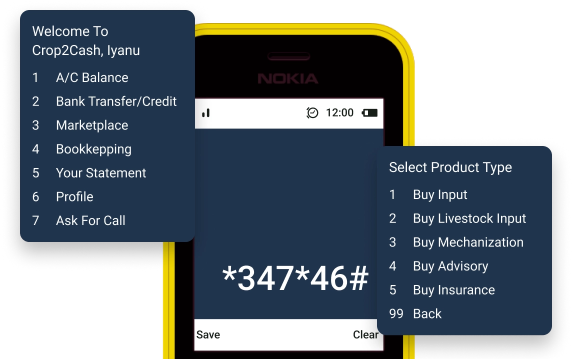
The startup’s core product is its offline-first USSD platform, built for farmers who rely on phones and live in areas with limited or unreliable internet access. Farmers dial a USSD code (*347*46#), select their preferred local language, and follow prompts to create a wallet account using basic personal details, including their bank verification number (BVN).
Once onboarded, farmers can carry out both agricultural and non-agricultural transactions using keypad menus. These transactions include buying airtime, sending money, accessing a built-in marketplace, purchasing farm inputs, ordering insurance, requesting mechanisation services, comparing vendors, and soon, listing crops for sale.
Crop2Cash has two advisory tools: an SMS-based weather advisory service, which sends farmers guidance based on their location and daily rainfall predictions, and an AI-powered toll-free hotline, which functions as a virtual extension agent. Farmers call the line, select their local language, submit questions verbally, and receive real-time advice that is relevant to their location. All services are accessible offline and available in more than local languages, including Yoruba and Hausa.
The startup generates revenue through multiple channels. On its USSD marketplace, Crop2Cash earns margins on farm inputs purchased in bulk and resold to farmers, as well as commissions from third-party providers such as insurers and mechanisation services. It also operates a profit-sharing model with financial institutions by earning a percentage of the interest charged on transactions. Crop2Cash also monetises its data intelligence platform by selling anonymised market insights to banks, insurers, and input providers.
Since its launch, the startup reports over $1.5 million in revenue, says it has unlocked over $3 million in credit for farmers, and serves over 540,000 farmers across Nigeria and Kenya.
Why we’re watching: In 2021, only 38% of Africans were online. Crop2Cash stands out for building an agritech platform that works entirely without internet access, aligning closely with the realities of smallholder farming in Africa. The startup is currently raising a $1.5 million seed round (with $700,000 committed).
KwenuAI wants to make everyday African businesses use artificial intelligence (AI services, Nigeria)
Kamsi Okorafor and Hope David Micheal founded KwenuAI in November 2024 as a services-driven AI consultancy that helps businesses understand, adapt, and deploy existing AI tools in practical ways.
Connecting small and medium-sized enterprises (SMEs) with AI tools typically begins with a discovery and design phase, where KwenuAI studies a client’s workflows, KPIs, constraints, and pain points. From there, KwenuAI either trains teams on how to use existing tools or builds custom AI solutions, including AI agents and integrations.

According to the founders, much of the work involves embedding AI into platforms clients already use, like WhatsApp or Telegram, rather than introducing entirely new enterprise software.
This approach, they say, lowers adoption friction for SMEs that may lack access to more complex tools like Slack or Notion. KwenuAIfocuses on making high-end technology accessible to grassroots businesses by deploying solutions, including a multilingual transcription and translation system that enables real-time voice translation while preserving the original speaker’s voice and video feed.
While their current focus is generalised across sectors, they are moving toward specialised support for educational startups.
Why we’re watching: A 2025 survey by the World Bank, Africa records the lowest AI adoption globally, as no African country has reached 20% AI adoption. KwenuAI is positioning itself as an AI interpreter for Nigerian and African SMEs to close this gap. Its differentiation lies in translating global AI capabilities into locally relevant and low-friction deployments.
That’s all for today. Expect our next dispatch on February 6th. Know a startup we should feature next? Please nominate here.