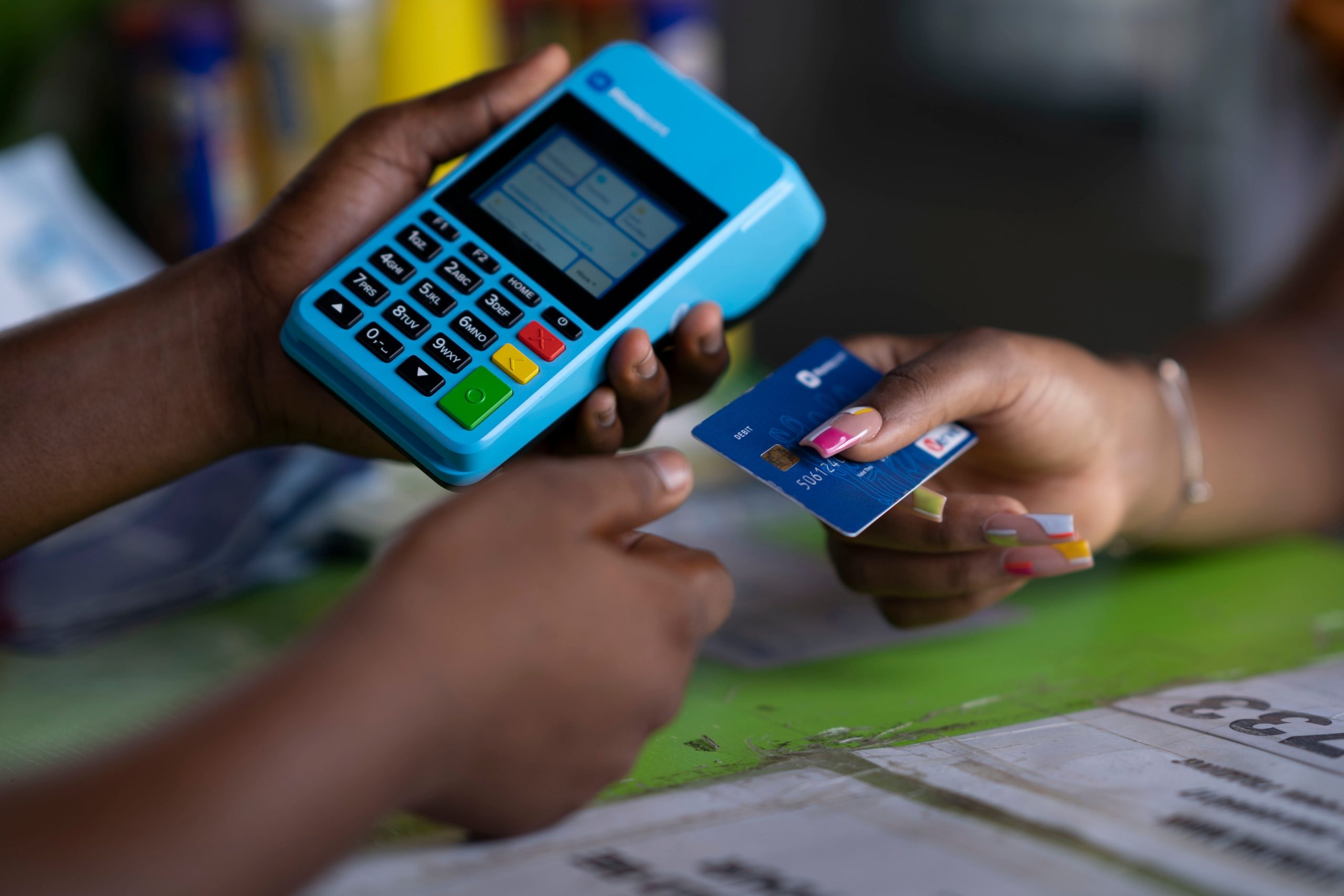
This is the story of a terminal that wants to be more than a cash-collection machine.
INigeria inayo 5.9 abayizigidi ezingu active Point of Sale (PoS) terminals, and since the 2023 cash crisis, they have become instrumental in how Nigerians get cash, make payments, and keep their businesses running.
But what if the terminal that moves Nigerians’ money could also help them invest it? This is what Moniepoint is testing with Dangote Refinery’s ₦2.15 trillion ($1.62 billion) initial public offering (IPO).
The fintech, which has more than one million PoS terminals, wants to use its network across all 774 local government areas to distribute Dangote shares. Nigerians can walk into an agent location, provide their Bank Verification Number (BVN) if they do not have a Moniepoint account, and buy shares without using an investment app or even speaking to a broker.
This is Nigeria’s biggest IPO, targeting Abatshalizimali abayizigidi ezingu-10, futhi kuye kwaba njalo employed fintechs and other innovative ways to reach the last mile. On Wednesday, the Nigerian Exchange Group (NGX Group) said it expanded access to its NGX Invest platform by launching a WhatsApp subscription channel, giving potential investors another way to participate in public offers.
However, experimenting with PoS terminals brings the IPO to Nigeria’s second-largest payment channel.
PoS terminals were used 15.66 billion times in 2025, behind only internet payments at 21.11 billion, according to data from the Central Bank of Nigeria (CBN). Nigerians are almost twice as likely to use a PoS as they are to use an app.
This presents an opportunity to operators such as Moniepoint, which sees the IPO as a proof of concept for what its PoS network could become: a physical distribution layer for financial products that have traditionally lived inside banks, brokerages, and investment apps.
“The financial inclusion game that we are playing is not just to solve payments alone,” Daniel Ojinaka, Product Lead, Consolidated DirectDebit, TeamApt, a subsidiary of Moniepoint Inc., told me on a recent call. “We want to solve any other aspect of the financial space for everyone and to include everyone. We have been working on something, and the opportunity presented itself.”
What else can a PoS terminal do?
Use the hardware keypad on the simulated terminal below to experience how payment infrastructure distributes investment products.
The Dangote IPO is suited to the experiment
Dangote Petroleum Refinery and Petrochemicals is offering 4.1 billion shares at ₦525 ($0.39) each, targeting ₦2.15 trillion ($1.62 billion) if fully subscribed. The offer opened on September 14 and is scheduled to close on October 13, 2026, with a minimum subscription of 10 shares, or ₦5,250 ($3.95).
INigeria okwamanje inazo cishe Abatshalizimali abayizigidi ezingu-2.7, and if successful, the IPO will add at least 7.3 million first-time investors to the market.
To achieve this, the IPO needs to reach as many people as possible, which is where PoS terminals become particularly useful.
PoS terminals were used 2.92 billion times within the first three months of 2026, ngokusho kwe-CBN. Those 90 days amount to roughly 32.4 million transactions per day, or 1.4 million per hour.
If half of those transactions are unique, it means the terminals interact with at least 16.2 million people daily. If one in every 10 of these people who use a PoS terminal buys the IPO, that translates to 1.62 million potential IPO investors.
Of course, this is illustrative. A transaction is not necessarily a unique person, and the number of people reached by Moniepoint’s network will differ from the national total. But it shows why the physical network is attractive for an IPO trying to bring millions of people into the capital market.
How many new investors could PoS reach?
A simple scenario showing how Nigeria’s enormous PoS usage could translate into potential IPO reach.
This assumes half of daily PoS transactions represent different people.
This is an illustrative conversion assumption, not an expected participation rate.
But this is a scenario, not a forecast. A PoS transaction is not necessarily a unique person, and Moniepoint’s network represents only part of Nigeria’s total PoS infrastructure.
Scale comparison
Another way to see the physical reach
Based on Nigeria’s population and the article’s one-terminal-per-28-people comparison.
(237m ÷ 28)
eNigeria
Moniepoint says it is already seeing growth in the channel.
“The rate at which POS is growing since Wednesday versus mobile, the POS is growing at a faster rate. Right, if we do everything right, everything we are planning to do right, we hope the POS will surpass the mobile at a faster rate,” Ojinaka said.
Another big advantage of PoS channels is their physical reach. With an estimated population of 237 abayizigidi ezingu, Nigeria has about i-terminal eyodwa ye-PoS kubantu abangu-28. If even one in every 28 Nigerians who interacts with a PoS terminal became a stock investor, the network could theoretically expose more than 8 million people to the capital market, nearly three times Nigeria’s current 2.7 million retail investors.
On ₦100,000 and fees
Subscribing for an IPO on a PoS terminal is currently capped at ₦100,000 ($75.27) per person. That means the terminal is deliberately being designed for small-ticket investment.
“A lot of people with a lot of money already are sitting down in their houses, and they have apps,” Ojinaka told me. “The people we are talking to probably have just earned ₦50,000 ($37.64) in cash that day. And then they are like, okay, let me use it to buy this.”
The limit is also partly a safety measure. Because the PoS channel can involve cash, Moniepoint said it does not want the investment channel to become an easy route for moving or laundering large amounts of money.
“We do not want that to be a channel where people are not using it to clean up their cash,” he said.
If someone wants to invest more, Moniepoint says they can use its other channel.
Currently, fintechs, including Moniepoint, are charging customers ₦0 for processing Dangote’s IPO. Dangote, however, has earmarked an estimated ₦ 41.49 billion ($31.23 million) for offer expenses, covering costs for issuing houses and other professional parties involved in the offer. Fintechs will get a slice.
But agents are not doing this for free. They still charge their usual commissions on transactions.
I tried using a PoS terminal to subscribe for 10 units of the shares and was charged ₦100 ($0.075).
The transaction itself was ₦5,250 ($3.95), with Moniepoint not adding any additional fees. But for agents, this is another financial transaction, and there are few incentives to offer it for free.
How much will your Dangote IPO shares cost at a PoS?
Enter the cash you want to invest to see how many shares you can buy, how much cash you need, and what an agent fee adds.
An extra ₦100 ($0.075) or ₦200 ($0.15) across multiple transactions per day can add up to a meaningful source of revenue over a month. Agents operate businesses.
Moniepoint said it is intensifying agent awareness and will roll out incentives to ensure customers can buy shares without additional fees on certain days. While the fintech has rolled out its investment product for free, the last-mile distribution layer still has its own economics.
The terminal was already doing more than cash
PoS machines started out doing a couple of things well: processing payments for businesses and becoming a cash source for the average person.
But Moniepoint said it had spent years testing ways to turn its terminals into an offline access point for financial and non-financial services.
“We have our lending product as well that we run for personnel and even through the merchants’ network, and we have been experimenting with tax payments through what we call Monify offline products for a while. So, there is a culture. We have known that for a while, and been building on that use case and expanding it,” Ojinaka said.
The company said people had been using Monify offline to pay directly into their Cowrywise accounts, for instance, at agents’ locations, showing that its terminals can be more than just payment or cash machines.
The terminals were already configured for direct debit.
“We decided to see how we can make subscription payments or recurring payments a thing. How do we open it up to get activations done in an offline space?” Ojinaka said.
“When Direct Debit presented itself, of course, Direct Debit is a one-time purchase. We have also had similar patterns, like your bill payments. Today, you can go to an agent location and pay for your DSTV. All you need to do is enter your IUC number, validate it, and make your payment. So it is not different from the same experience.”
For the Dangote IPO, the company redesigned this use case with an extra layer of complexity.
“The technology has always been there,” he said.
Buying shares through an app is relatively straightforward. You open an investment account, complete your KYC, fund the account, and place an order.
A PoS transaction has to compress much of that experience into a few minutes on a device with a small screen and a short timeout, usually operated by someone who is not a financial adviser.
For the Dangote IPO, Moniepoint said it had tried to solve several problems at once.
A customer who is not already a Moniepoint user still needs to be identified. Their BVN has to be captured and matched. Their investment details must be linked to the appropriate securities account, and the transaction must go through the relevant capital-market infrastructure.
Customers can top up their shares until they reach the ₦100,000 ($75.27) PoS limit, and the service is not limited to agents. It can also be accessed on merchant terminals.
Moniepoint is not the stockbroker because a customer can buy shares at its terminal. The company is a distribution or receiving channel.
It said Vetiva, a Pan-African financial services firm, is the sponsor broker for the arrangement and that Moniepoint has the relevant agreements with the broker and NGX, including its own regulator. The company is also integrated with Chapel Hill, a Nigerian investment banking, securities trading, and investment management firm, and Renaissance Capital, an Africa-focused investment banking and markets franchise.
“There were conversations with the Dangote team in February. We have a verified broker who partners with us. Being a regulated body, we had to get some consent from our regulators, also to notify them of what we were about to do,” Ojinaka said.
The investment option is currently limited to Dangote’s IPO, but the company said it has helped it build capacity.
“Left to us at Moniepoint, we want to be the ones to democratise access to the capital markets. If it is possible that we can possibly sync to the NGX and users can just go to our PoS, select the stock they want to top up, and do it, that is the goal for us. But obviously that is going to take steps, a lot of steps, and it will take some time before that happens,” Ojinaka said.
Dangote’s IPO gives PoS terminals a new product, a large addressable audience, and a test to see whether people who already trust an agent with their cash will also trust that same physical interface with an investment.
If it works, the PoS terminal stops being merely a place where money moves and becomes a place where financial ownership can begin.
The agent is the next interface
Nigeria has spent years building a human layer around digital financial infrastructure.
People who may never visit a bank branch know where to find the nearest agent. The International Monetary Fund estimates there are 1,600 PoS operators per square kilometre in Nigeria.
But this rapid growth has also raised concerns about fraud and compliance, with agents sometimes unknowingly serving as entry points for illicit activity. The CBN is working to limit PoS terminals to an operating radius.
Investments involve even more sensitive information, including BVN.
When I tried the service, the terminal displayed my full BVN during identity verification, but it blurred part of my name and mobile number.
The same physical proximity that makes PoS terminals useful for financial inclusion can also create new questions around privacy, fraud, agent conduct, and investor protection.
The Dangote IPO currently has the scale to power Moniepoint’s “PoS can be more” experiment. What happens after the IPO will paint a clearer picture of whether Nigerians can trust the agent who helped them withdraw ₦10,000 ($7.53) yesterday to become the person who helps them buy or top up their shares tomorrow.
Izimfuno zesilinganiso sangempela zidlulela ngale kokuhlanganiswa kwezinga eliphezulu ziye ekusebenzeni okuqinile. Sihlunge umsindo we-Moonshot 2026, senza ingqungquthela ibe ngcono kakhulu ukuze ixhumane kahle phakathi kwabasunguli bezinkampani ezintsha, abaqhubi bezimali bomhlaba wonke, abaholi bamabhizinisi kanye nabantu abaxhuma kabusha izinhlaka zobuchwepheshe zase-Afrika.
Thola isaphulelo esingu-20% kumathikithi e-Early Bird isikhathi esilinganiselwe.