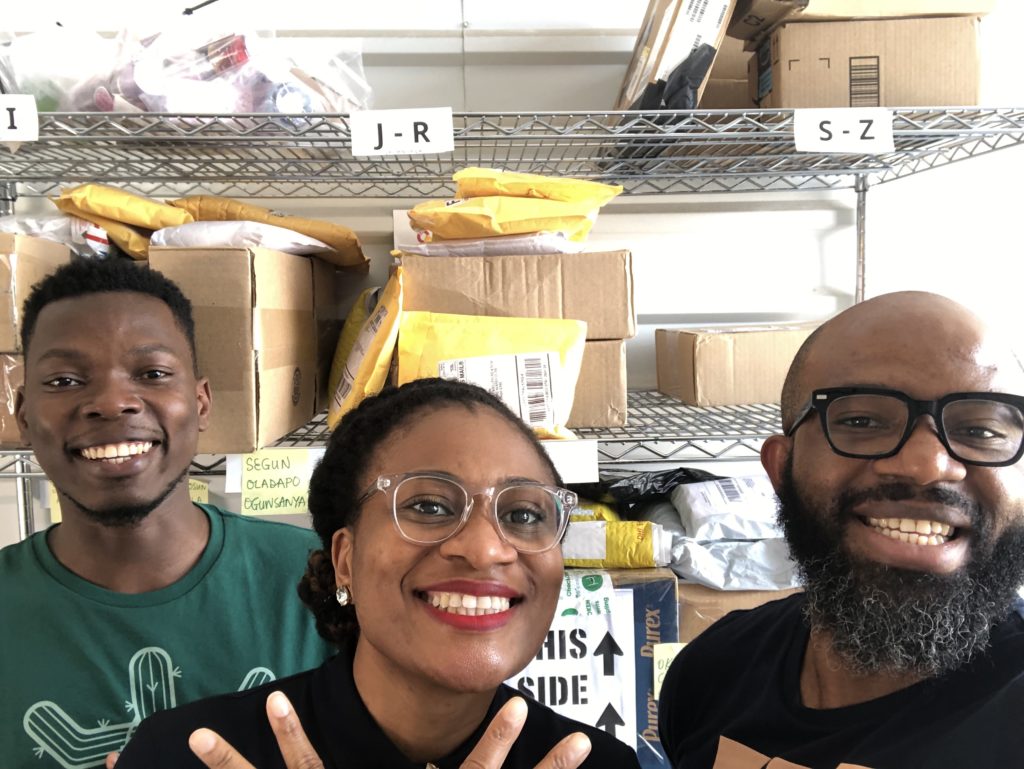
Most Nigerians who live abroad or travel frequently are familiar with the experience of being used as personal shoppers. Friends and family in need of locally unavailable products would usually have travelers make purchases to bring home. However, not many people would think about turning this into a business like Osinachi and Chinyere Ukomadu.
After moving to the United States, they were inundated with requests from friends and family who needed help with buying and shipping products from the United States. Initially, they didn’t see it as a business but as a way to help friends with their shopping; however, the demands from their jobs and keeping up with an ever-increasing demand from people led them to jokingly threaten to charge their friends and family members for their services.
To their surprise, they agreed to pay for the service, and what would later become the brand, Heroshe was born. Rather than launch immediately, the founders spent a long time studying their customers to get a good understanding of their needs and in 2019, the startup officially launched.
Connecting Nigerians to global commerce
You may ask, what exactly does Heroshe do? In simple terms, Heroshe helps Nigerians shop safely from e-commerce stores in the United States and have their purchases delivered to Nigeria. They provide customers with a U.S address ensuring that they are not limited by geography. The purchases are then shipped from the U.S to Nigeria with shipping costs determined by the weight of products purchased. When the packages arrive in Nigeria, customers can either pick them up from the company’s Lagos warehouse or pay for them to be delivered anywhere in Nigeria.
However, this is not all that Heroshe offers to its customers, they also provide a payment wallet and infrastructure to ensure that their customers are not limited by constricting debit card limits imposed by most banks in Nigeria.
In its early days, payments and logistics were a major headache, and Heroshe had to figure out how to receive payments from customers in Nigeria in order to ship their products. Even after receiving the money in their Nigerian bank account, they had to figure out how to send it to their US bank accounts.
“Even then in 2012, payment was still a problem. We had to figure out a way to get paid into our GT bank account then and try to figure out a way to get the funds out to the U.S in order to shop for customers and then pay everyone in between,” Osinachi Ukomadu explained. Years later, the entry of Paystack and Flutterwave in the Nigerian fintech industry solved some of these problems, however, they still had to contend with the challenges of logistics.
Shipping products to Nigeria is a nightmare for many, and logistics is the most challenging part of Heroshe’s business model. After packages have been shipped to Nigeria, dispatching deliveries is a significant challenge because of the poor addressing system and inefficient logistics infrastructure present. The founders explained that in its early days, a staff of Heroshe would travel around Lagos in a taxi to deliver packages. With increased demand today, the startup utilizes third-party logistics providers.
Although there is unpredictability in the logistics business, Heroshe focuses on providing its customers with the best quality of service.
“A lot of what we do is out of our locus of control. For example, we depend on courier partners to deliver the right items customers ordered to our warehouse. We also depend on our air carrier partners for the first-leg logistics into Nigeria. And lastly, we depend on last-mile logistics partners to get packages delivered to customers. At any of these points, anything can go wrong and they often do; our job every day is to make sure we connect these moving parts efficiently to ensure we deliver delight”, Osinachi explains.
With a passion to provide opportunities for millions of people who are looking to start and scale their businesses, the startup currently serves over 40,000 users, 40% of which are businesses, who have now been provided with a platform that enables them to access quality products and logistical capabilities which results in customer satisfaction.
“Our current focus is to solve eCommerce logistics, access, and payments challenges thoroughly in Nigeria. When we have achieved this, we will begin to look at adjacent markets. Our initial plan is to take the solution we have developed to other African countries with similar challenges. Once we have solved for Africa, we can then focus our attention on other frontier markets where our solution can have a significant impact. We believe everyone should have access to the best quality products they can affordably access anywhere in the world”, Osinachi reiterates.
Driven by the belief that everyone should have access to the best quality products regardless of where they are, Heroshe plans to expand into other African markets.