Picture a ten-year-old boy, perched at a wooden desk, pencil in hand, carefully tallying figures from his father’s accounting books, a faint smile on his face. He imagines himself one day becoming an accountant like his dad or teaching finance at a prestigious university like Harvard. Fast forward to 2025, and that boy, now a man, is a tech founder instead. He sits across from me on a virtual call, saying matter-of-factly that his goal is to enable settlement of $6 billion in cross-border payments across Africa through his payment platform.
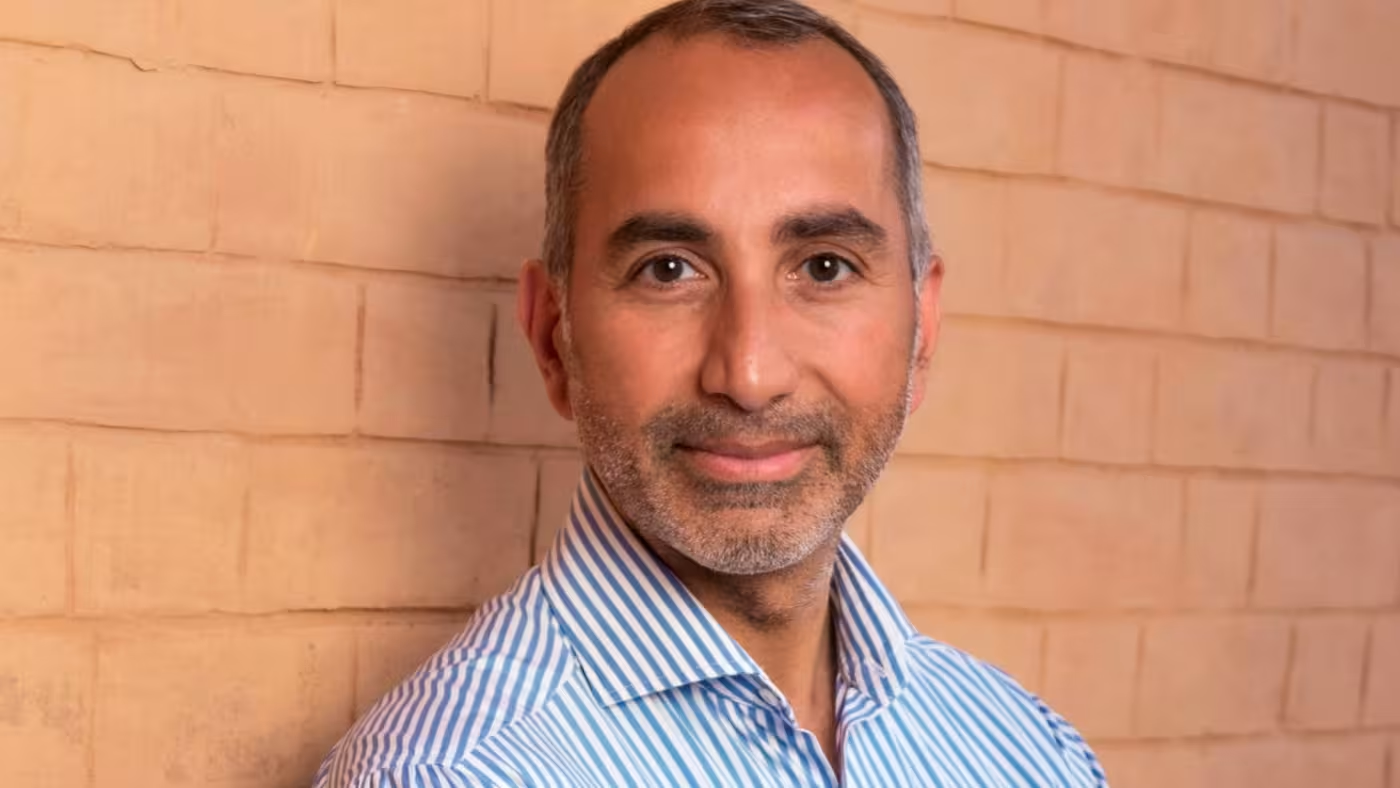
He’s Oreoluwa Adeyemo, co-founder of Starks Associates, a four-year-old fintech startup that has enabled the settlement of cross-border payments worth nearly $3 billion spanning 18+ jurisdictions and 20+ currency pairs. He claims he has serviced over 50 clients, including heavyweights like unicorn fintech, Flutterwave, the Pan-African Payment and Settlement System (PAPSS), and IHS, a global communications infrastructure provider.
“Our goal is to double the amount in one year,” he tells me. “We’re hoping to consummate over $6 billion in 2025.” I stare at him quietly, wondering when I last heard anyone use the word “consummate” in place of “process”. I don’t ask about his word choice here, instead, I ask how a kid raised on ledgers becomes a tech entrepreneur tackling one of Africa’s thorniest challenges. With over 40 currencies governed by a tangle of financial regulations, cross-border payments in Africa is a tough nut to crack. Most are done via third-party currencies like the dollar or euro, jacking up costs. In 2023, to send $500 from Tanzania, you had to pay a staggering average transfer fee of $168.
Oreoluwa’s story is winding. “My dad was a ‘catch them young’ kind of guy,” he chuckles, recalling those early days when his dad taught him the basics of business accounting in a bid to set him on the same path. “Luckily for him, I also enjoyed it,” he says. But despite his passion, math, beyond basic arithmetic, wasn’t his strong suit. He says it was one of his friends who became his math tutor between 2010-2011. “She was giving me assignments, questions, tests,” he says. Day after day, he tackled problems during his self-study. The effort paid off. He soon got into the University of Ibadan (UI) to study economics—Adeyemo boasts that the school had one of the best curricula on the subject in West Africa at the time.
However, it was outside the classroom that he gained the education that changed the course of his life. “I just wanted to get a first class, pursue a master’s, a PhD, and write [canonical] papers on econometrics and game theory,” he says. An introvert, he craved a quiet career away from the public eye. Entrepreneurship wasn’t on his radar until his second year, when a lightbulb moment changed everything.
Someone offered him ₦4,000 to ghostwrite past questions and answers (coveted study aids for exam prep). He was excited because that was a lot of money for a young kid at the time, especially since it involved doing what he had always done, studying. But after a mentor pointed out the value of his intellectual property, he encouraged him to work on the book himself and earn more money.
With funding from his dad, Adeyemo printed his book, adding an introduction to game theory. He convinced photocopy vendors to sell it to student customers, and went door to door across faculties and halls of residence, selling the book. He sold copies worth over ₦120,000. He also gained recognition among lecturers. More importantly, it was a turning point. “That’s what opened my mind to, ‘I can make this kind of money.’ I wanted to be an employee, a lecturer, but I realised I could make money for myself.”
The experience reshaped him. “I need to be more outspoken, outgoing, daring,” he realised. “I need to sell myself, be marketable, dress well. I can’t be timid.” This newfound boldness led him to run for president of the economics department in his third year. “I was still a bit shy, but my mindset was, ‘I have to come out of my shell, talk to people, get things done.’” He won, marking his transformation from introvert to leader. Adewole Adedeji, who joined the departmental executive team as treasurer, went on to become the co-founder and backbone of his fintech startup, Starks Associates.

Adeyemo’s journey to founding Starks Associates was a winding road of hands-on experience and unexpected pivots. After his university years, he aimed for investment banking, targeting prestigious firms like Goldman Sachs and Merrill Lynch. He went through rounds of interviews, tailored his CVs, prepared case studies, and pitched himself, but the offers didn’t come. During his one-year mandatory youth service program for university graduates, he worked as an accountant for a farm, balancing ledgers, tracking expenses, and managing payroll. Next, he joined a boutique investment bank on Lagos Island, where he dove into deal analysis, researched market trends, and supported client pitches, learning the nuts and bolts of finance.
His first big break came when he landed a role at Access Bank. There, Adeyemo worked as part of the corporate banking team, structuring loans for businesses, analysing credit risks, and building financial models to assess client viability. He collaborated with account officers to monitor client portfolios, ensuring timely repayments, and sat in on strategy sessions to expand the bank’s reach to SMEs. “We were roughing our way, understanding finance,” he recalls.
The spark for Starks ignited on a post-NYSC trip to Egypt with his team, including co-founder Adedeji. They’d planned a short retreat to relax, but an extended stay depleted their dollar cash. They’d forgotten their USD cards in Nigeria, leaving only Naira cards. At the hotel lobby, Adeyemo swiped his card, hoping to withdraw funds. It failed. Frustrated, he asked, “How do we get money? If I had my USD card in England or Spain, I could withdraw euros or pounds without issue. Why can’t African currencies swap like that—Naira to Cedis, Rand to Shillings, as liquid as dollars, pounds, or G10 currencies?”
Back in Nigeria, Adeyemo gathered friends and experts in a room to sketch out a product— an app for individuals to swap African currencies. They debated features, mocked up ideas, and pitched to potential advisors, but the plan faltered. “There was a lot of noise, no coordination,” Adeyemo says. “We couldn’t nail the go-to-market strategy.” They shifted focus to enabling companies to exchange African currencies.
They didn’t chase every client, Adeyemo says. First, they targeted fintechs which already serviced merchants moving goods and services across borders, “low-hanging fruits” like unicorn fintech Flutterwave and the Pan-African Payment and Settlement System (PAPSS).
Next, they roped in commodity traders, MSMEs needing fast payments, and big institutions like IHS, a global communications infrastructure provider, handling vendor payments or subsidiaries. “We are very agnostic about the businesses we support,” Adeyemo says, listing fintechs, arts and crafts, even banking clients. The company has processed close to $3 billion in volume since.
Next level? $6 billion in cross-border payments
Their ambition burns hotter: hit $6 billion in 2025, doubling four years’ work in one.
I lean in on our call. “How do you plan to pull that off?” I ask. In his laid-back way, he said a lot of what can be summarised as “ right partnerships and grit.” It’s a mantra shaped by his path, after all.
“African commerce has started to lift off,” Adeyemo observed. The company is also looking to expand services beyond settlement and offer financing to business owners who do cross-border trade.
To elaborate on the demand for financing, Adeyemo shared that the previous week, at a conference, he met a Nigerian exporter of building products to East Africa. “Her business had expanded very rapidly,” he said excitedly. “She’s not one of my clients yet, but she needs financing to ship more.” In February 2025, he visited a Kenyan supermarket, chatting with locals—women in the beauty space, hungry for Nigerian products. “They see all these things on social media—Nigerian girls use them, look fine, pretty, and all that,” he says, chuckling at their enthusiasm. Access was the hindrance. “There’s a demand for our local beauty products in Nigeria, in Kenya, or in East Africa,” he noted, and he believes Starks could help fill that gap by providing financing and cross-border settlement.
Trade between African nations reached $208 billion in 2024—up 7.7% from the previous year, according to the African Export-Import Bank (Afreximbank). “If I’m saying I want to do $6 billion, I’m not even thinking about it properly,” he said. “I have to think bigger.”
I appreciate that the opportunity is big, but many startups have tried and failed to sustain operations in that sector. He acknowledges the endeavours of other founders but also admits that he can’t pinpoint why others failed. “I can only speak to what our plan is, what our challenges so far are,” he says. “Partnership is very key in finance and in this business where you want to connect Africa,” he explains.
“You need to understand the culture, their temperament, how they relate, how they want you to articulate your solutions, the length of time it will take to consummate a deal,” he says. There is that word again.
It can get frustrating: a deal might close fast in one country, then drag for months elsewhere, tangled in red tape or trust-building. “It’s a big problem, but we’ve managed to solve it in these past few years,” he says. His team has learned the ropes, and their vision has only become stronger— to become a bank, that is, borderless.
“Everything we’re going to be doing at least for the next five strategic years that we’ve mapped out is to achieve that and ensure seamlessness,” he says.
I ask him how many investors he has managed to get onboarded to finance this vision. “We’re trying to raise at the moment, but we are not in a hurry,” he says, cautious about deals that may shortchange his company, honed by years as an investment banker. “We don’t want to just jump into anything.”
He says multiple VCs have tabled offers, and some Development Finance Institutions (DFIs) have given approvals in principle. “We’ve gotten confirmation in principle that they like our business, they like what we’re doing,” he shares. “They’re going to make an offer, but we have to get to a certain level or balance sheet size,” he explains. He also stresses that the company is not just looking at the money, but wants investors who understand the dream, the goal.
As 2025 rolls on, Starks’ five-year map stretches ahead: Adeyemo and his team’s efforts are focused on deepening the network, scaling volume—deal by deal, currency by currency, to bring the continent closer and make commerce borderless.
Mark your calendars! Moonshot by TechCabal is back in Lagos on October 15–16! Join Africa’s top founders, creatives & tech leaders for 2 days of keynotes, mixers & future-forward ideas. Early bird tickets now 20% off—don’t snooze! moonshot.techcabal.com.