

On the night of June 13, 2025, nearly 200 residents of Yelwata, a rural community in Benue State, were slaughtered in their sleep. Terrorists armed with machetes and fuel stormed homes, setting them ablaze in a brutal attack that unfolded without warning.
Beyond the element of surprise, the killers’ advantage was a culmination of multiple failures: chronic insecurity left unchecked, ineffective government intervention in persistent communal tensions, inadequate local emergency response, and vulnerable telecom infrastructure.
A day before the attack, a severed telecom fibre line had plunged parts of the state into a total communication blackout. In a state already devastated by continuous violence, this kind of vulnerability can be fatal.
This digital vulnerability is unfolding in tandem with a relentless wave of violence. Between January 2023 and February 2024, Benue State recorded at least 135 armed attacks—primarily by suspected herdsmen—resulting in more than 2,600 deaths, including children, women, and the elderly. Over 50 communities were affected, with widespread reports of displacement, sexual violence, kidnappings, and the destruction of homes and farmland. In 2023 alone, the Catholic Diocese of Makurdi documented 119 such attacks, leading to at least 414 deaths and hundreds of injuries and abductions.
This violence has only intensified. Amnesty International reports that between May 29, 2023, and May 2025, at least 6,896 people were killed in similar attacks across Benue. These numbers are staggering, but no event in recent memory has highlighted the scale of the crisis in emergency response and the widening security vacuum as clearly as the June 2025 attack on Yelwata.
Yelwata is guarded by a police station and at least three joint security checkpoints. In a statement on June 14, 2025, the National Emergency Management Agency (NEMA) confirmed that two military officers and one civil defence officer were killed trying to repel the attackers. With no functional ambulance service, first aid is usually administered by poorly equipped local clinics or chemists. Government agencies, such as the Benue State Emergency Management Agency (SEMA), typically arrive long after the fact—if at all—often meeting survivors only at Internally Displaced Persons (IDP) camps where they’ve taken refuge.
According to multiple eyewitnesses who spoke to TechCabal, no centralised or well-coordinated emergency response systems exist in the state concerning these attacks. First responders are typically locals themselves, often aided by neighbouring communities that send volunteer vigilantes or police officers from nearby checkpoints.
A frontline location to kill for
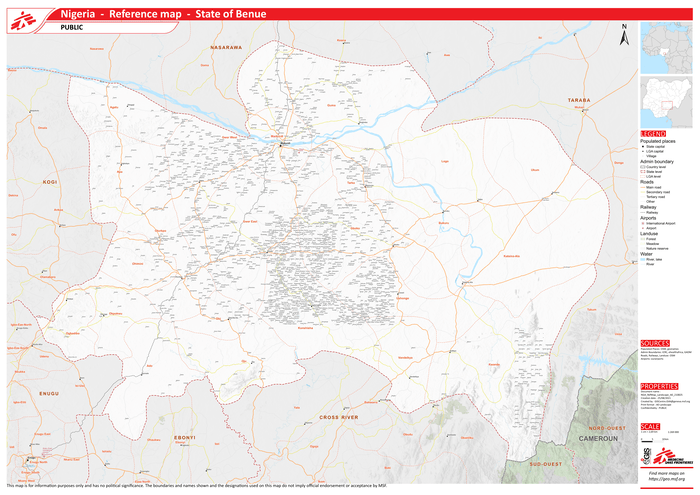
Located along the Benue–Nasarawa–Abuja highway in Guma Local Government Area and predominantly inhabited by the Tiv ethnic group, Yelwata was both a bustling commercial hub and a vulnerable frontline. To many Tiv residents, Yelwata was considered more of a town than a village due to its central market, Catholic parish, divisional police post, and concentration of schools and other social infrastructure.

Culturally, Tiv communities have long avoided fencing their homes, as openness is deeply valued. “A Tiv person wants to sit under a mango tree to eat and invite anyone passing by. Fences would prevent that,” explained Johnstone Kpilaakaa, a Tiv-born journalist with HumAngle who has covered Yelwata and similar communities. “Fenced houses are more typical in larger towns like Makurdi, Gboko, Katsina-Ala, or Otukpo.”
Jairus Awo, a journalist based in Makurdi who has also reported extensively on the Benue conflict, affirmed this cultural norm. “When you fence your house and lock the gate, it keeps people out—friends, neighbours, even your children’s playmates. Until now, rural people didn’t feel a need to secure themselves from others,” he said.
But that openness made them easy targets. When the attackers struck around 11 p.m., the community was unprepared. Armed with machetes and petrol, the assailants torched homes and killed residents in their sleep.
“It’s hard to imagine anyone calling for help or posting to social media when they’re asleep and not expecting an attack,” Awo added. While eyewitnesses say the attackers were Fulani herdsmen, it has been difficult to determine the motivation for the attackers. In the past, violence had erupted because of disagreements between the farmers in the community and nomadic herdsmen whose cows destroyed crops on the farms. The attack in Yelwata did not happen as a result of these disagreements.
“There is no provocation for the recent one, at least none that many people know about in recent times,” said Awo, who has been visiting families affected by the attack in Yelwata. “And if so, it could be concentrated on a community, but it is going round the state. The attackers are taking turns.”
In the aftermath of the Yelwata attack, more than 6,500 people from 1,069 households were displaced. Many are now waiting for space at the overcrowded, under-resourced IDP camp at Makurdi International Market. Of Yelwata’s estimated 10,000 residents, only a few have remained—either to care for wounded relatives, protect what’s left of their homes, or seek refuge with extended family elsewhere. Some families are still searching for missing loved ones, unsure who survived.
A cycle of violence, a deepening digital gap
The cycle of violence in Benue is further exacerbated by the fragility of its telecom infrastructure. Between May and June 16, 2025, the state experienced at least 16 major network outages. While most fibre cuts were eventually repaired, the standard fix—fibre cable splicing—does not restore the cable’s original performance. Each splice results in minor signal degradation and creates new points of vulnerability, especially in volatile, high-risk areas. Although MTN, Airtel, and Globacom dominate telecom coverage in Benue, 9mobile relies heavily on leased infrastructure from MTN, resulting in slow and, in many cases, indefinite service restoration in crisis-affected zones due to persistent security threats.
Restoring connectivity in rural conflict zones like Yelwata is not only dangerous but also prohibitively expensive. In Nigeria, the average cost to repair one kilometre of fibre optic cable is about ₦4.44 million (approximately $3,000 at ₦1,480/$1), based on figures from operators like MTN. In hard-to-reach, violence-stricken communities, the cost rises significantly. Challenging terrain, armed conflict, and the urgent need for connectivity often require additional spending on private security, mobile infrastructure, and specialised technical teams.
The human cost of this digital disconnect is painfully evident. “Many communities in Benue do have internet access, but it depends on your exact location,” said Jude Allagh, a native of Mbachough in Tarka Local Government Area, about 60 to 70 kilometres from Yelwata. “Most people rely on WhatsApp and Facebook to stay informed. But during attacks, base stations often go offline. And when residents are forced to flee, telecom companies rarely return to restore service.”
In some cases, the infrastructure isn’t even vandalised—but the engineers responsible for maintenance stay away out of fear, leaving towers unmanned and generators without fuel or servicing. What results is a compounding tragedy—not just lives lost to armed violence, but lives endangered by silence.
Allagh believes a decentralised, community-driven early warning system could help residents stay alert to nearby threats. “Nobody is giving these people timely information. Where do you run when your village is attacked? Who tells you it’s coming?” he asked.
Some locals are trying to fill this gap through grassroots digital initiatives. Daniel Dooteramo Orbunde, a Makurdi resident, runs a Facebook page by the same name where people share real-time updates about attacks, danger zones, and safety tips. “My goal is to make sure people are informed in time—so they can either get out or help someone else do so,” he said.
Still, this kind of community-driven digital support remains out of reach for many rural areas in Benue, where poor internet access, expensive devices, erratic electricity, widespread poverty, and even state interference limit connectivity. In many villages, feature phones without internet capability far outnumber smartphones, several residents told TechCabal. And for those who do own smartphones, the lack of reliable power poses an even greater obstacle. With most homes off the national grid, residents often walk long distances to community markets to charge their phones at commercial charging stations.
“I remember visiting a village where people could identify each other’s phones at the charging centre,” said Kpilaakaa. “There’s usually no electricity in these places. The market, often the only area with a power source, becomes the digital lifeline.”
Power isn’t the only constraint. Decades of violence have plunged once-thriving farming communities into economic despair, making digital access even harder.
“These were vibrant agrarian communities that can no longer farm safely. Now, they’re grappling with extreme poverty,” said Ndi Kato, executive director of the Dinidari Foundation, which advocates for women and children in Nigeria’s violence-prone Middle Belt. “Technology can help, yes—but how useful is it when people can’t afford data, phones, or even basic essentials?”
Kato recalled that some rural communities had previously built improvised early warning systems—simple but effective alarms designed to alert neighbours of impending attacks. Yet in at least one case, she said, government authorities dismantled the setup without providing any explanation or offering an alternative. In her view, what these communities truly need is the means to defend themselves.
“Technology can help,” she noted, “but without the right to protect their lives, residents remain vulnerable.” However, government policy has consistently opposed civilian armament. Security agencies have reportedly clamped down on local vigilante efforts, arresting individuals who attempt to organise civil defence groups.
Benue State Governor Hyacinth Iormem Alia, a suspended Catholic priest, remains firmly opposed to calls for self-defense, even as his administration offers little clarity on what measures are being taken to protect residents from future violence. Residents said the government has promised to provide some financial incentives to cushion some of the financial burden the attack has heaped on them.
In the aftermath of the Yelwata attack, many Benue indigenes have taken to digital platforms to organise aid, raise awareness, and push for change. Orbunde plans to expand his digital activism with tools like crowdsourced mapping of conflict areas, livestreaming from affected communities, and building a platform for donations, shelter, and volunteer support.
Others are stepping up, too. Terhemba Eugenia Asue, a resident of Makurdi, has repurposed her Facebook page to fundraise for displaced victims, sharing real-time updates and critical needs.
“We’re trying to build something more lasting,” said Orbunde. “A stronger digital resistance that’s not just about awareness, but about action. Relief coordination, public pressure, accountability—we want to use every tool we have to protect our people.”