Every Thursday, Delve Into AI will provide nuanced insights on how the continent’s AI trajectory is shaping up. In this column, we examine how AI influences culture, policy, businesses, and vice versa. Read to get smarter about the people, projects, and questions shaping Africa’s AI future. Let us know your thoughts on the column through this form.
Africa’s AI market is projected to hit $16 billion in five years. But the continent holds only 1% of global AI talent, leaving a widening skills gap as industries from farming to finance rush to adopt the technology.
At this year’s Tokyo International Conference on African Development (TICAD) in August, the Japanese prime minister, Ishiba Shigeru, made a bold pledge: The country will help develop 30,000 AI industry personnel in Africa over the next three years. The Japan International Cooperation Agency (JICA), the government’s overseas development arm, is tasked with delivering this goal.
Why talent?
When it comes to the AI race, African countries face two interrelated challenges: the lack of infrastructure and the shortage of skilled professionals able to turn the continent’s digital ambitions into reality. At first glance, infrastructure might seem most urgent; data centres, computational resources, and reliable connectivity are all critical. Africa still has less than 1% of the global data centre capacity, despite our growing population. But without the talent, it is difficult to reap the benefits of the needed infrastructure.
In a recent interview, Nigeria’s minister of communications, digital economy, and innovation, Dr. Bosun Tijani, said: “We may not have the compute and infrastructure, but we do have the talent.” Officials at JICA also have a similar view.
“We believe that talent is a key point to create value for the society and economy,” says Ryosuke Myashita, deputy director for digital transformation at JICA. “Without talent, we can’t create infrastructure, we can’t create a strategy.”
This informs the thinking behind the nation’s pledge. Computational resources matter, but without the engineers, researchers, and analysts to apply them, even the most advanced facilities risk lying idle and underused. The idea is to develop the human expertise that can power the continent’s growing AI ecosystem.
Access to infrastructure remains a problem that cannot be overlooked. Only 5% of Africa’s AI talent has access to the computational power and resources needed for complex research tasks. The development agency is hoping to expand its efforts to promote AI development beyond the talent space.
“Resource permitting, we would also like to work on other components, together with our partners,” says Atsushi Yamanaka, senior advisor for digital transformation at JICA in an interview with TechCabal.
The broader goals
In an August report on Africa’s AI talent, JICA notes that it is “not merely supporting Africa’s AI journey — it is building foundational systems to scale it.”
JICA’s plan has two broad goals: build a deep AI talent pool by supporting African universities and regional research networks, and expand bilateral cooperation with Japanese firms through internships, exchanges, and joint academic programs. Training will extend beyond computer science students to include policymakers and non-STEM faculty, embedding AI literacy across sectors. Collaborative projects will tackle pressing challenges in health, manufacturing, agriculture, and education, while hackathons provide practical outlets to apply learnt skills.
For Japan, the talent development program could also help out with its growing shortfall— around 450,000 IT professionals by 2030. Japan’s ability to remain competitive and productive in the long term will depend on how it addresses its digital skills gap. By fostering business and academic interactions between Japanese universities, firms, and African talent, this could create opportunities for meaningful “co-creation and co-innovation.”
“I think this innovation actually coming from Africa or other Global South regions is going to really make a difference globally,” Miyashita says in an interview with TechCabal.
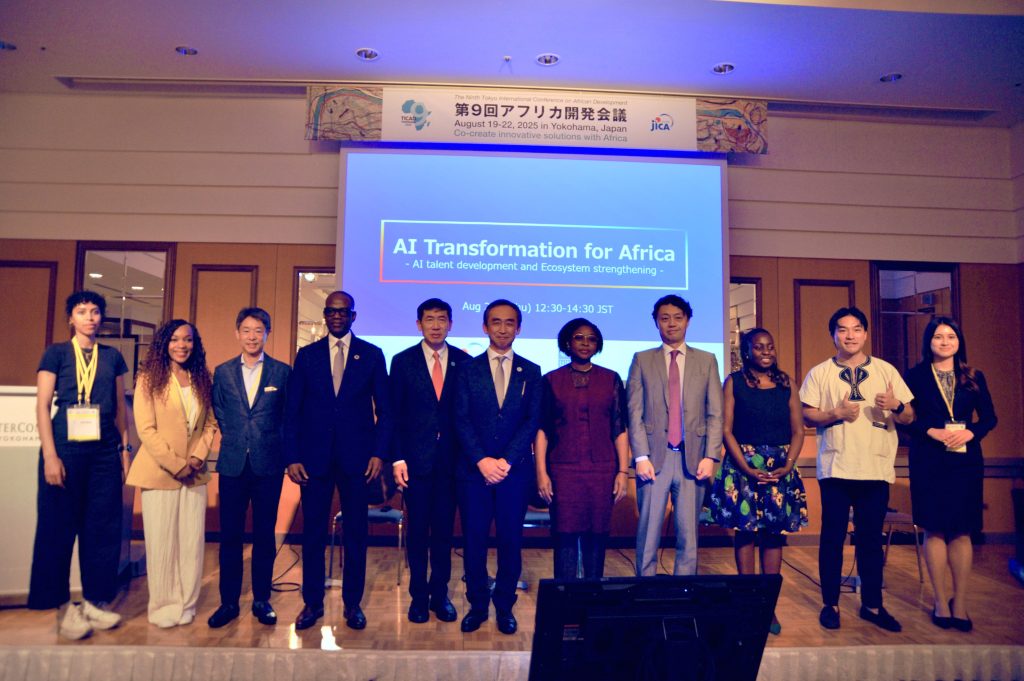
Image Source: JICA
Research partnerships and the brain drain risk
Yet JICA itself has cautioned that Africa’s AI research agenda must move beyond applied solutions to local challenges. Sub-Saharan Africa currently produces 0.02% of the granted AI patents in the world. While innovations in health, agriculture, and education are essential, long-term technological leadership will require African institutions to contribute to global breakthroughs in foundational AI research.
JICA is looking to partner with African academic institutions and research centres such as the African Institute of Mathematical Sciences (AIMS), University of Nairobi in Kenya, Stellenbosch University in South Africa, and Mohammed VI Polytechnic in Morocco. The broader aim is to support ‘centres of excellence’ that develop AI-training curricula, conduct impactful research, and train the next generation of AI professionals. The University of Tokyo’s Matsuo-Iwasawa Lab, one of Japan’s leading AI research hubs, is also co-developing online content for students across Africa to expand their reach.
“We have a big target for the next three years,” Yamanaka explains. “We are going to really want to expand to many different universities at different levels of engagement. But we would actually like to engage with many universities.”
Still, the risks remain. Creating employment opportunities for the locally trained talent could support the growing AI ecosystem on the continent. Without strong local industries and research labs ready to absorb trained talent, Africa could become a training ground for foreign employers.
A crowded AI development field
Japan is not the only global player interested in Africa’s AI space. Countries like Germany, Canada, the United Kingdom, and Sweden have also been contributing to the space through their own overseas development agencies. International NGOs like the Gates Foundation have also announced million-dollar pledges to support applied AI innovation in fields like healthcare and agriculture on the continent. Big Tech giants like Google also have an additional $9 million contribution to support African universities in their research efforts.
Rather than building everything itself, JICA wants to leverage partnerships with these groups to coordinate efforts better. “We have been operating in this kind of silo,” Miyashita says.
“Different actors are doing things. We didn’t actually have the big picture. We didn’t have a complete picture of what’s actually going on. And that actually is very, very unfortunate, because, you know, resources are limited.”
This has forced a rethink: “Everybody wants to do things, but you cannot actually do them if you don’t understand, or if you don’t know what’s going on. [JICA] may actually duplicate or reinvent the wheel. And we can’t afford to do that anymore. I think this was a rude awakening for us, showing us the need to coordinate.”
The call for coordination does not rest with development partners alone. With limited resources, African nations themselves are increasingly urging greater collaboration to address structural gaps that could otherwise slow the continent’s AI progress.
“Africa has no shortage of needs”
Ultimately, the goal is to promote stronger exchange and innovation opportunities between Africa and Japan. JICA also hopes its efforts will help foster a stronger startup ecosystem on the continent. “We also have the facilities to provide funding for the venture capital as well. So we have different ways of supporting,” notes Yamanaka.
While Africa has long attracted investment interest from the US and Europe, Japan is positioning itself differently, not only by opening pathways for business partnerships with its companies, but also by emphasising collaboration that aligns African demand-driven innovation with Japanese technical expertise.
In this framing, Africa’s pressing social and economic needs are not seen as deficits, but as fertile ground for innovation that can generate shared value for both sides.
“Needs drive innovation,” Miyashita says. “And Africa has no shortage of needs.”
We would love to know what you think about this column and any other topics related to AI in Africa that you want us to explore! Fill out the form here.
Mark your calendars! Moonshot by TechCabal is back in Lagos on October 15–16! Join Africa’s top founders, creatives & tech leaders for 2 days of keynotes, mixers & future-forward ideas. Early bird tickets now 20% off—don’t snooze! moonshot.techcabal.com