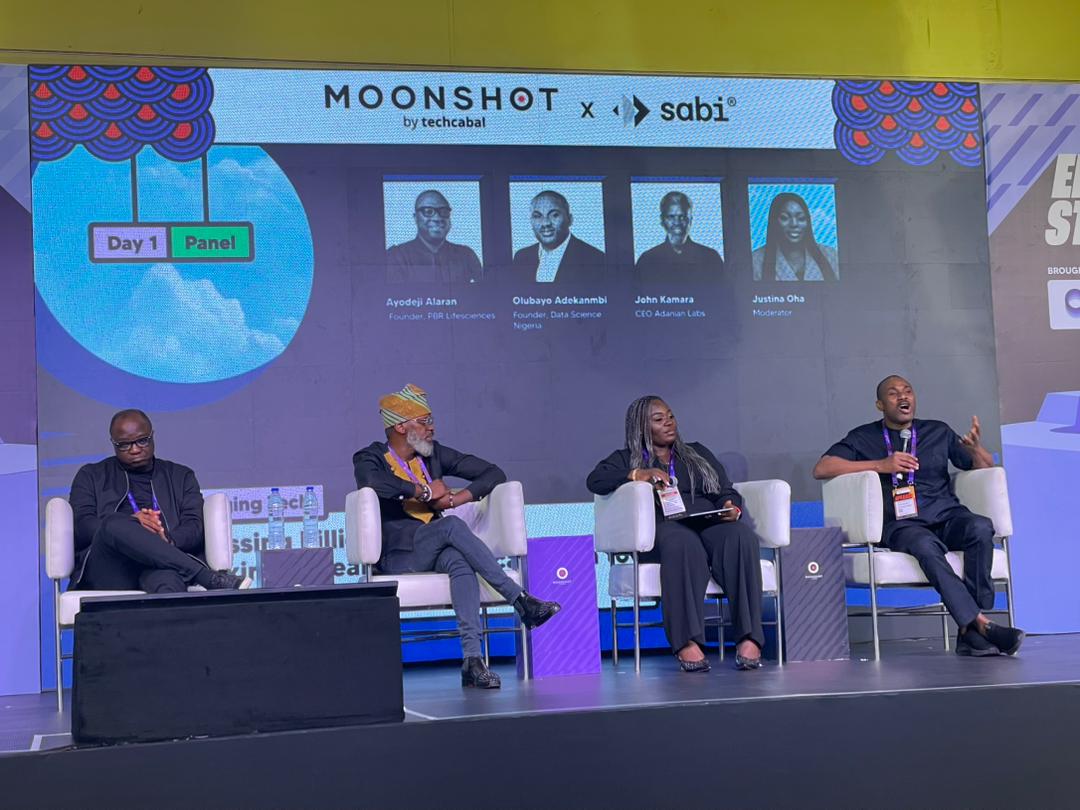
There’s a massive gap in African research, both in studies about Africa and in those led by Africans themselves. During a Moonshot 2025 panel on Rethinking Research for Africa’s Tech to Grow, Ayo Alaran, founder of PBR Lifesciences, emphasised the need for tighter collaboration between academic institutions and commercial innovators as a solution.
Arguing that research must move beyond papers and journals to drive real-world impact in technology and industry, he said, “The challenge is that people don’t really know what the problem is. There’s not enough obsession with the customer problem or the industry problem.”
“We must think of problems that bring both industry and researchers together so that when they solve that problem, there’s an incentive for both sides,” he added.
In 2024, the World Economic Forum (WEF) reported that Africa had the world’s lowest researcher-to-population ratio — just 20 researchers per million people, compared to Europe’s 246. This stark gap framed one of Moonshot 2025’s most insightful discussions: Rethinking Research for Africa’s Tech to Grow.
The panel featured John Kamara, CEO of Adanian Labs; Bayo Adekanmbi, founder of Data Science Nigeria and EqualyzAI; and Ayo Alaran, founder of PBR Lifesciences. The session was moderated by Justina Oha, CEO of Digital Equity Africa, who guided a candid conversation about how Africa can bridge the divide between academic research and commercial innovation to fuel homegrown technological progress.
Adekanmbi, founder of Data Science Nigeria—a company that co-led the development of Nigeria’s National AI Strategy through extensive research, workshops, and strategic planning—emphasised the need for stronger policies that improve access to data.
“We need more platforms jointly powered by government and the private sector because the outcome is a public good that drives economic growth,” he said. “There should be policy incentives that allow, for example, 0.5% of certain taxes to be converted into open-source platforms that researchers and startups can build on.”
“In Kenya, companies are now mandated to channel part of their CSR into platforms that support startups. That’s the kind of policy framework we need to catalyse innovation and get more people thinking differently,” he added.