If you live in Lagos, Nairobi, or Accra, and earn working for foreign companies, you are constantly flushed with options when receiving money: global banking rails bank rails (such as card schemes, international bank accounts, and FX desks), and alternative payment means, including crypto, which entail USDTs, peer-to-peer (P2P) desks, and over-the-counter (OTC) swaps. For years, African financial institutions have been run on the legacy systems of traditional banking. Today, with the rise of modern payment infrastructures populated by stablecoin rails and peer-to-peer (P2P) markets. Doux, a Nigerian digital currency neobank, exists to bridge these legacy systems and modern payment rails. According to the Chainalysis 2025 Global Report, Nigeria was ranked as one of the top six countries in crypto adoption.
Yet, sometimes, the average Nigerian is forced to act as the bridge between legacy bank systems and modern crypto payment rails. Such as instances where formal P2P platforms are complex to navigate, and crypto buyers end up exploring alternatives, such as making purchases from a ‘trusted contact’ who sells cryptocurrency. The “average Nigerian” here effectively functions as a clearing house, verifying their funds and settling trades that their banking software is blocked from doing automatically. While these are structural limitations, Doux exists to establish more seamless payment pathways.
Why legacy banking architecture cannot support global spend
1. Centralised foreign exchange (FX) treasury desks
In a traditional bank or fintech, FX is not automated; it is managed. A dedicated team predicts how much foreign currency their customers will spend that day and pre-funds their correspondent accounts in London or New York. However, when customers spend more than predicted, or if there are volatility spikes, the treasury is affected and runs dry.
2. Daily settlement windows
The global banking system works only during business days, with a longer settlement period compared to digital currencies, crippling convenience. This delayed settlement causes intermediaries, such as processors, schemes, and correspondent banks, to demand massive collateral to cover the risk during the gap. During weekends (out-of-office hours), if the local currency, such as the Naira, drops over the weekend, the bank loses money on pending transactions. To protect themselves, banking institutions might turn off international spending or impose limits until markets reopen on Monday, making banking with legacy systems slow.
3. Legacy card-processor limits
Most tier-1 Nigerian banks still limit international Naira card spend to $200–$500 monthly, forcing users who want a higher volume of transactions to parallel markets.
4. Regulatory throttles and programmatic compliance
In January 2024, the Central Bank of Nigeria (CBN) issued a circular mandating that banks cannot hold excess foreign currency. They must sell off excess dollars to the market to stabilise the Naira. You might have $5,000 in your account, but because the bank has hit its monthly FX quota, you cannot spend it. If a bank hits this aggregate “institution-level” ceiling, it is legally barred from processing more outgoing FX transactions until it rebalances its books.
These legacy systems require human treasury management for round-the-clock flows, yet Crypto markets settle in minutes, not days. This removes the settlement bottleneck, eliminates the weekend gap, and allows liquidity to flow as swiftly as the internet itself.
The liquidity-aware wallet
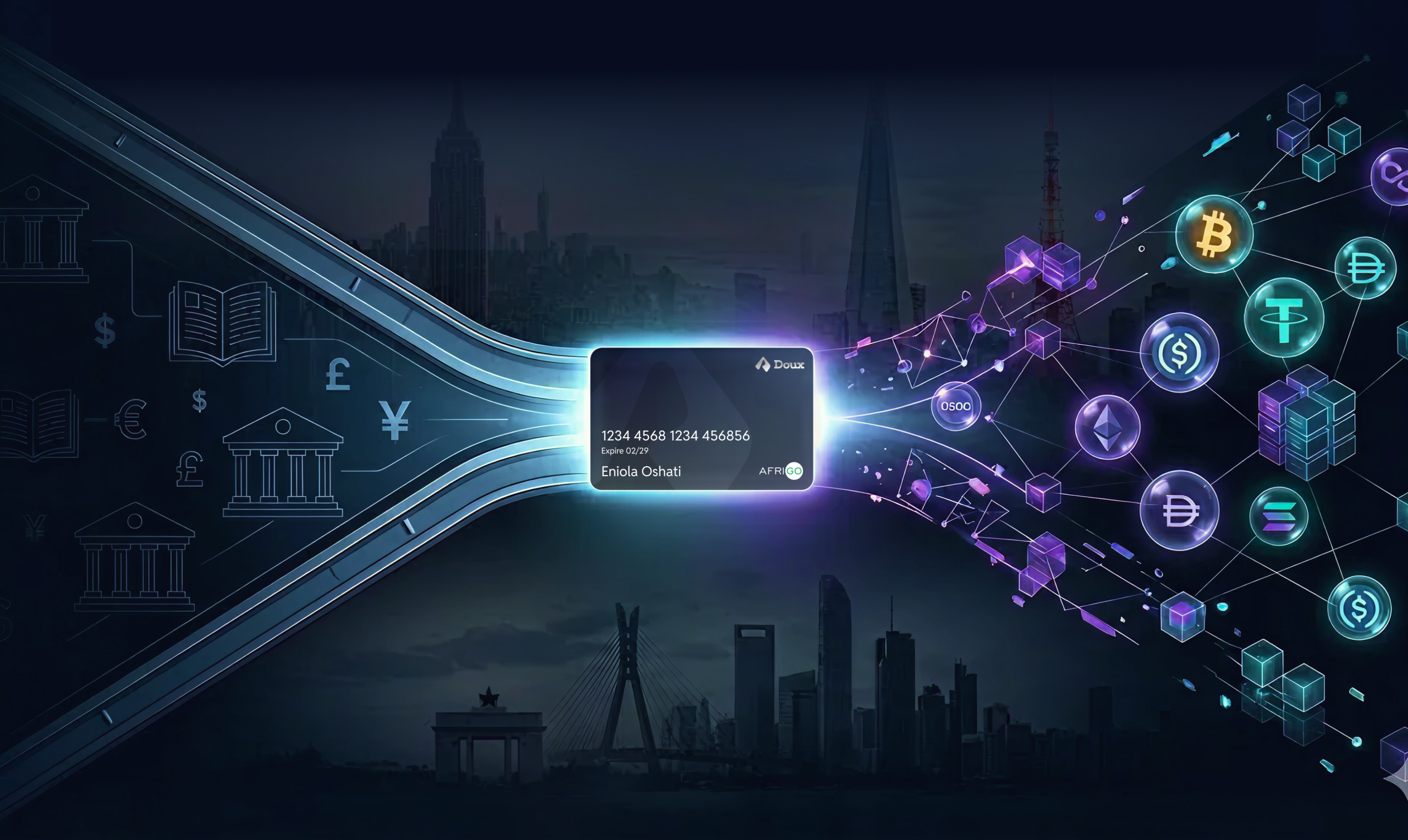
This is the thesis behind Doux: a ‘liquidity router disguised as a lifestyle wallet.’ This implies that instead of manually toggling between exchanges and bank apps, Doux acts as the missing interface between Africa’s two financial rails. It positions cryptocurrency as the most efficient rail to move value. With their physical and virtual cards, you get access to more currencies in only a few minutes.
With Doux, you are interacting with a system that includes:
- Stablecoin micro-liquidity: Leveraging stablecoin micro-liquidity (USDT/USDC) as a core settlement rail for instant value movement, independent of traditional FX desk hours.
- Real-time pathfinding: Instantly finds the most efficient route to settle a merchant transaction, whether that requires fiat rails or crypto collateral.
- Global settlement: Leveraging the always-on nature of blockchains to ensure that your capacity to pay isn’t dictated by banking hours.
Technical competence as a feature
For the high-intent user, the remote engineer paying for AWS, the traveller booking hotels in Dubai, or the founder paying for SaaS subscriptions, UX is not just about pretty colours. UX is reliability. Doux is built for the user who understands that “money” has changed. It is for the African who is tired of the friction between earning globally and spending locally.
With a growing waitlist, Doux ultimately believes the distinction between “crypto wallets” and “bank accounts” will give way to self-described liquidity-aware wallets. Doux isn’t just bridging older and more modern payment rails; it’s creating a newer financial operating system built for the way modern Africans earn and spend.