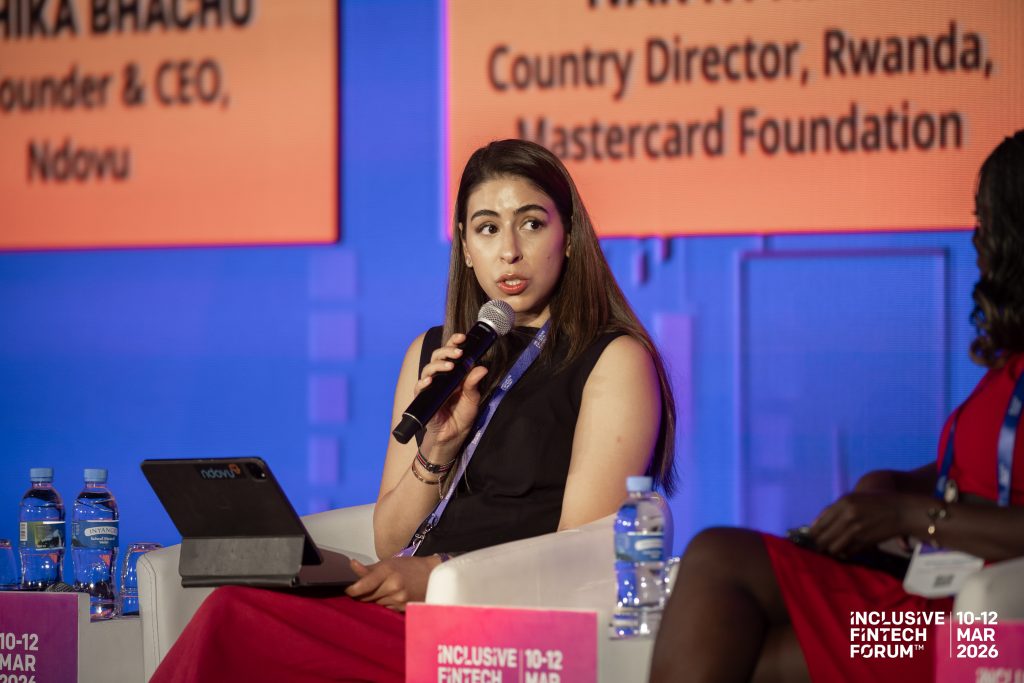



Chigozirim Ugochukwu does not fit her idea of a tech executive. She is not loud. She does not dominate rooms by her sheer presence. In fact, she’s so accustomed to being underestimated that when a male team member once challenged every instruction she gave simply because she was a woman, she did not even notice until her manager pointed it out.
Ugochukwu tells the story with humor. When she had finally asked him what his problem with her was, he replied with, “I don’t understand why a woman would manage me.”
Her response was direct. “Would you rather be without a job? Because I can make that happen now.” He eventually became the best person she ever managed. That same team member later reached out for a glowing recommendation after leaving the country.
This is how Ugochukwu operates: quietly, strategically, and with an effectiveness that speaks louder than any boardroom performance. Today, as Chief Operating Officer (COO) of GetEquity, a Nigerian fintech platform that operates as a digital marketplace for private capital, she has built a career navigating Nigeria’s tech ecosystem not by changing her introverted nature, but by leveraging it.
The accidental tech journey
Ugochukwu’s path into tech was not planned. She studied law at the University of Abuja in Nigeria’s capital as a tribute to an uncle she loved.
“He had told me, ‘If you’re not going to study medicine because you want to rebel against your parents, then just do law,’” she recalls. When he died in the middle of her West African Examination Council (WAEC) exams in 2005, she honoured his wish.
Ugochukwu’s path to tech was lit in 2011. She met someone who would become the managing director of BetKing, a Nigerian sports betting company, Gossy Ukanwoke. He hired her on the spot to help build what was meant to be Nigeria’s first online university, Beni American University. Ukanwoke had been instrumental in her decision to go to law school after graduating.
Ugochukwu used the interim period between graduation and law school to consider her post-graduation options before choosing to attend law school in 2013, three years after graduating from university.
During her National Youth Service Corps (NYSC), a mandatory one-year service program for Nigerian graduates, in 2015, she worked as a legal officer at the National Human Rights Commission, a government agency tasked with safeguarding human rights in Nigeria.
“I saw things that made me realise if I continued, I would have been constantly depressed,” she says. She had retained her employment with Gossy and Beni American University while she was in law school.
The project later pivoted to executive e-learning, offering courses like project management and entrepreneurship. But Ugochukwu had already found her calling.
“I hated how I learned in university,” she explains. “I loved the idea of online learning, creating access to things people wouldn’t normally have access to.”
At Beni American University, she saw the power of technology firsthand. It enabled people already in the workforce to earn degrees and gave those who could not afford traditional universities access to education.
Within weeks of completing NYSC in 2016, she was in Lagos meeting with Bunmi Akinyemiju, the chief executive of Venture Garden Group, an investment holdings company for Nigerian fintech companies, interviewing for a Head of Programs and Partnerships position.
The VGG school of hard knocks
At Venture Garden Group, Ugochukwu learned what it meant to build in tech. “Everything I know about work ethics, about viewing companies and businesses, I learned there,” she says. Her boss, Gossy Ukanwoke, threw her into the deep end, let her make mistakes, and taught her to think in systems.
The first time she heard the term Standard Operating Procedure (SOP), she didn’t know what it meant. But when asked to streamline processes, she instinctively explained how things should work. “They said, ‘Oh yeah, that’s exactly what a process is. Document it.’”
During audit season, if finance was in the office, she stayed in the office. She learned to build teams, create efficient processes, and manage people not through rigid task management but by communicating outcomes and letting people figure out how to achieve them.
“Tell me what you want to achieve,” she explains. “Let me figure out how to get there.”
She also learned something crucial about failure: “It’s okay for things to break. As long as we haven’t lost a lot of money in the process, how do we fix it?”
VGG shaped her philosophy on partnerships, too. “It’s not all about what I can get. It’s what value can I provide to you so that you can give me this partnership?” That thinking extends to her entire approach to work and life—give value to receive value, even when they’re not commensurate.
The compliance translator
After leaving VGG in 2021, Ugochukwu moved to Outsource Global, a business process outsourcing company, as a Compliance Manager. “Someone on Twitter had reached out, saying I seemed to have ‘the temperament for the role.’”
She’d never done compliance before, but she understood something essential: compliance isn’t about stopping people, butprotecting them.
In her first week, she met with every department. “Walk me through your entire process,” she asked. She’d slept in the office with tech teams at VG when deadlines loomed.
“I told them, ‘I’m not saying don’t do what you need to do, I just want to understand how you work so you don’t get into trouble. There are regulators we need to deal with.”
Instead of saying no to proposed new features and ideas from teams, she’d present scenarios showing the possible risks, then let teams come up with solutions themselves. “How about we do it this way? You achieve what you want to achieve, and we are in the safe zone.”
The key was making people see compliance not as a roadblock but as a necessary partner.
At GetEquity, where she’s now COO, the approach is the same.
“Nigerian regulators are not people to be played with,” she says matter-of-factly. Because the company doesn’t yet have its full licence, advertising is limited. “There are times the growth team will do an ad. If I’m lucky enough to see it before they push it out, I’m like, ‘Change this. If someone from the Securities and Exchange Commission (SEC) sees this, you’re going to be in trouble.’”
She has Google alerts set up for GetEquity. “I have to see what it’s about. I do not want GetEquity painted in a bad light at any point.”
For her, reputational risk is the one that never drops below amber in any risk register; it’s the thing that keeps her up at night.
Building GetEquity, one decision at a time
Ugochukwu joined GetEquity first as a consultant in 2022, then as COO in 2023. The culture shock was immediate. She’d never worked remotely before. She loved being around people, feeding off their energy, even if she didn’t talk much.
But the bigger shock was encountering what she calls ‘self-proclaimed superstars who are really not good at their job.’ People who were all talk on social media but couldn’t execute.
The experience taught her to look deeper: “Ask them questions. Dive deep into everything they’re saying. Don’t take what they say at face value.”
When GetEquity faced financial troubles in 2023 and needed to let people go, Ugochukwu wrestled with the decision. “I love when people grow with me,” she says.
But she also understood risk management. She looked at her risk register—the worst that could happen if they kept people they couldn’t afford, versus the reputational damage of layoffs.
“What scares me most is reputational risk. A bad reputation can ruin a company,” she says.
Eventually, the math was clear: “The cons of still having people on the team outweighed the pros of letting them go.” They had a town hall, explained where the company stood, and made the cuts.
GetEquity became profitable in 2025. She still doesn’t feel good about the fact that they had to let people go to get there.
What gets measured
Every morning, Ugochukwu logs into her computer and checks GetEquity’s dashboards. She’s never satisfied: “I’ve never looked at our numbers and thought, ‘Oh, this is good. We’ve done well.’ I’m always thinking: how do I move this number up a little bit at the very least?”
It’s both a blessing and a curse. “I think it’s a thing of me not being able to relax and enjoy certain achievements,” she admits. “But that’s just what it is—always thinking of how to put the numbers up.”
Her mission is clear: democratise access to investments. Not venture capital specifically—that was the original plan, but Nigerians’ relationship with investing made them pivot. “We treat investments as loans,” she explains. “Return on capital beats return on capital. You want to get your principal back.”
The challenge is trust. “We’re a very low-trust society. How are you sure you will not run away with my money?” GetEquity now focuses on alternative investments—commodities, commercial papers, fixed income—where timelines are clear, and returns are predictable.
But the deeper work is education. “Nigerians think of investments as Ponzi schemes. MMM and the likes have ruined people. Somebody is looking for, ‘If I drop ₦100,000 ($74), I want to receive ₦500,000 ($370).’ I’m like, how exactly is that going to happen?”
The operator’s operator
Ask Ugochukwu where she sees herself in a few years, and the answer is immediate: helping other founders build systems.
“I like to think of myself as a process optimisation specialist,” she says. “I want to be able to offer that skill to founders at scale—help them institute processes, document them, manage and grow their team.”
She’s made mistakes. She knows what works. “If you don’t have processes down pat, you can’t scale. Even when it looks like you’re scaling, things will always break.”
For female founders specifically, she’s passionate about dismantling gatekeeping.
“The biggest gatekeeping we have is a lack of information. Nobody wants to share because they think, ‘Oh, this person will be bigger than me.’ Please be bigger than me. I honestly don’t care.”
She points to a former team member now heading quality assurance at a major fintech. “Every time I see her news on LinkedIn, I feel this pride. When I was leaving VGG, she wrote me a letter: ‘I’m here because of you. If you did not encourage me, if you did not train me and teach me, I probably wouldn’t have gotten here.’”
That’s the legacy Ugochukwu wants to build, not through loud declarations or social media performances, but through the quiet, relentless work of making systems better and people stronger.
As an introvert in a loud industry, she’s tried to prove that you don’t need to change who you are to succeed. You just need to be exceptionally good at what you do, and unshakeable about doing it your way.