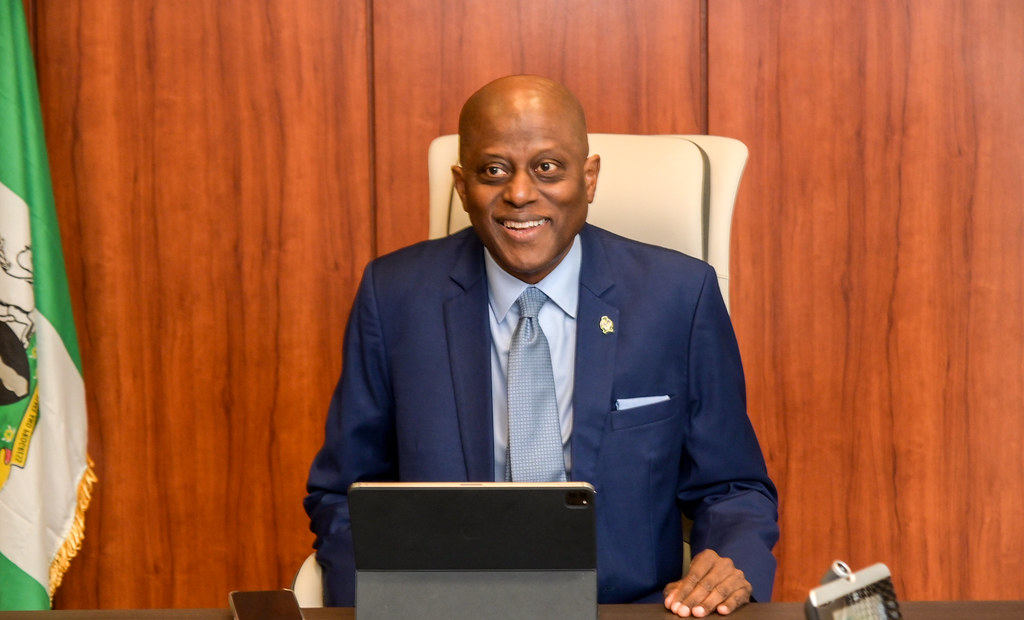
Eddie and Paul Ndichu arrived together, as they usually do.
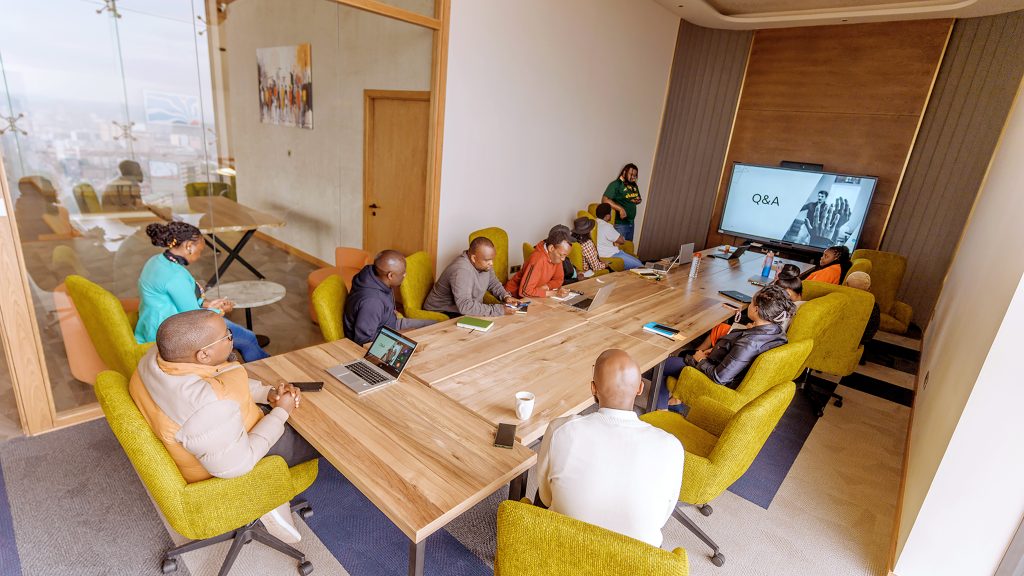
We met at their company’s new headquarters in Westlands, high above Nairobi at the Broadwalk Residence.
The office stretches along the building with glass on almost every side. From the windows, you can see the city moving slowly below: cars threading through the mid-morning traffic, construction cranes scattered across the skyline, and a faint outline of Ngong Hills in the distance.
They were working when I arrived. It felt more like stepping into the middle of an ordinary day for founders who have been moving at this pace for over five years now—two self-described “restless souls, hungry dreamers” who still carry the urgency that first pushed them into building.
This, they tell me, is the first time they’ve given a media interview together.
The story they begin telling stretches back much further than their shared vision at WapiPay. Eddie and Paul trace it back to a moment of grief that arrived early in their lives.
The twins grew up in a household where the rule was that children’s job was to study and work hard while their parents put food on the table, provided clothes to wear, and a roof. A typical Kenyan middle-class home.
That world was crushed when they were 18. The brothers had just arrived in Australia for university when their father passed. Two months into their first semester, the financial support that had brought them there disappeared. So they did odd jobs to stay in school.
They would return home with undergraduate degrees from Curtin and Murdoch Universities, before proceeding for postgraduate studies that shaped their thinking: Eddie in technology leadership, blockchain and AI at MIT, and Paul in innovation and business strategy at Harvard.
I spoke to the identical twins about career, grit and brotherhood that shaped their lives and the vision behind WapiPay.
This interview has been edited for length and clarity.
What did money mean in your household growing up?
Eddie: Like most households, there wasn’t any disposable income. The understanding was simple: if you had a roof over your head, clothes on your back, and food on the table, that was enough. Your job was to go to school and work hard; you weren’t supposed to have money.
The reality of what money truly means didn’t hit until university. We left home at 18 for a strange place in Australia. For a week, we were the only Black faces we saw. You quickly realise you’re different, but more importantly, you realise you have to take care of yourself.
The real wake-up call came just two months into our first year. Our father, the key source of income back home, passed away. We started our tertiary education with the death of our father and no money coming in. We had to figure out, very quickly, how to survive—pay bills, and even more scarily, pay tuition.
Paul: We did all sorts of odd jobs just to pay school fees. That struggle taught us the true value of money. It wasn’t easy.
Eddie: “Odd jobs” is an understatement. We cleaned mall floors, worked in factories… It was backbreaking. We realised that was too much hard work for too little pay—maybe $2 or $3 an hour. So, we upskilled. Paul became a security guard, and I became a professional bartender. We moved up to making $12 to $15 an hour.
Paul: At one point in my security job, I even got to $40 an hour because I had to undergo extra training.
Eddie: The strange thing was, we started focusing more on making money than on the education itself, since nothing was coming from home. Our mother did send whatever she could, which was amazing, but we knew we had to survive.
If we asked your mom what you were like at 15, what would she say?
Eddie: Curious, mysterious, but respectful. Our mother was a strong pillar of faith at home and in our lives.
Paul: There was definitely some cheekiness—you’re a teenager in a disciplined household with a very supportive mom. So you want to break the rules, but must also take responsibility for it. I’d say we were largely very restless souls and hungry dreamers.

When WapiPay started, what specific problem were you trying to solve, and how has that evolved?
Paul: I was at Stanbic Bank Kenya, heading digital transformation, and Eddie was next door at Standard Chartered doing the same, then later at KCB Group. I also spent time shaping digital and payments strategy across several institutions—at Cellulant as Chief of Business, Safaricom as an advisor and briefly in the startup world as managing director at Jumia Group and Managing Director of Interswitch EA. Eddie’s path was also deep in banking and fintech. He built mobile and digital channels at Standard Chartered across Africa, led digital financial services and mobile payments at KCB Group with products like KCB-MPESA and Fuliza and later served as managing director and vice president for fintech in Africa at Opera Software (Opay). That deep history in payments and banking at top management level led us to identify a massive gap in cross-border payments.
Eddie: Our jobs were all about transforming banks—building mobile and online banking channels. To lead that change, you have to be persistent in selling your vision. I think that’s where we discovered our entrepreneurial skills; it was innate.
Paul: Because we studied in Australia, many of our peers were from Southeast Asia. Seeing that, and then working in African banking, we noticed a huge gap. Moving money between Africa and Asia took 2–3 days through old, expensive rails. You’d lose 10-15%. That was the gap we saw.
Eddie: Locally, payments were being digitised thanks to M-PESA. Everyone had a wallet. But getting money in and out of Africa was still archaic—think physical trips to MoneyGram or Western Union. We wanted to digitise that, to make sending money out as easy as sending mobile money.
We quickly learned that the only way to do it was through banks and the SWIFT network, which was a painful, slow, and expensive process. We asked: how do we make this instantaneous and affordable, just like a local peer-to-peer transfer? That was the opportunity.
Looking back at your first moments building WapiPay, what’s the earliest memory that told you “this could work”?
Eddie: The opportunity cost was huge. We quit stable, high-paying jobs and spent our own savings. What motivated us was the belief that we were entering a space no one else was playing in.
I remember our first transaction was very physical—we took cash from someone sending money to China and had to figure out how to get it there without a bank. It was a hard lesson that made us think, “Maybe this isn’t going to be easy.”
But then I spent time in Shenzhen and got the API (Application Programming Interface) documentation for WeChat Pay. It was in Mandarin, so I had it translated. I remember having the M-PESA docs on one side and the WeChat docs on the other. We built a gateway. I’ll never forget walking around the room with my two-year-old son to get him to sleep, and I successfully moved money from M-PESA to WeChat and back. That was the coin-drop moment. I thought, “This could actually work.”
Paul: But it didn’t. We quickly realised our customers—traders—didn’t want money in their WeChat; they needed it in their bank accounts. We had missed that. So we had to reconfigure the whole model to pay into bank accounts in China. That’s when the real journey started.
The real “aha” moment wasn’t the tech, though. It was getting the first customer. Then the second, third, and fourth. That validated us. It also forced us to pivot from a B2C to a B2B model.
We were fortunate to have learned from large organisations how to build a culture and an operating rhythm. We set our values early, especially one: operational excellence. For us, that starts with being highly responsive—replying to an email in three minutes, picking up a call on the second ring. It’s hard to get people to do that, especially when there’s a problem. That, combined with solid tech and liquidity management, has been key to our growth.

Do you still have your customer number one?
Paul: Yes. His business in Kenya slowed down, but he’s doing more in other parts of Africa. We’re still with him.
What part of building WapiPay feels most personal to you?
Paul: Overcoming hurdle after hurdle. It’s not easy building a business, especially in Africa. It took us four years just to get our licence in Kenya. Being patient enough for that, and then getting approvals in Singapore, Uganda, Nigeria, and beyond… that journey has been very personal. Learning from mistakes, facing the fear every day that it could all end, but still focusing on excellence. That fear keeps you going.
Eddie: For me, two things. First, building this with my brother. We’re so fortunate. We can bounce off each other. When my anxiety is through the roof, he steps in, and vice versa. We’re on the same page 99% of the time. Our team is sometimes surprised by it, but most of the time, we’d make the same decision without even talking.
Second, it’s that idea of the “hungry dreamer.” Through faith, creating something that didn’t exist before is powerful. The digital remittances space is full of experiments right now. But in any tech-driven industry, eventually one platform steps up to become the leader. What feels personal is the drive to be that platform. To completely reshape how money moves around the world. “Wapi” means “where” in Swahili. We’re asking the world, “Where in the world do you pay?”
What did you learn from your first startup experience that you deliberately brought into WapiPay’s culture?
Paul: The more things change, the more they stay the same. I focus a lot on the operating rhythm—how people work and think. Even though we’re a team of 50, I try to instil the discipline and structure of a 3,000-person company. I bring my whole self and my experience from those large organisations.
Eddie: Myself [laughs]. I bring persistence and high expectations. I have the ability to transform a vision into reality, and I push our team to see what they can really achieve.
How has your work in strategy and policy shaped your approach to product development?
Paul: We started as a pure-play remittance business between Africa and Asia. Now, we move money across the entire Global South and the rest of the world. Getting to a $5 billion balance sheet requires constant evolution. The famous saying is true: zero to one is significantly harder than one to ten.
The key is being decisive—launching products and, just as importantly, switching them off when they don’t work. No one can truly predict this industry. You have to use your experience, map out opportunities, and be ready to pivot from “if” to “when.”
Eddie: We break it down into tactical and strategic. Tactical is execution. Strategically, in a battlefield full of experiments, knowing what not to focus on is just as important as knowing what to double down on.
Relationships are also key—with policymakers, partners, and even competitors. We call them competition, but maintaining those relationships is vital. As Paul likes to say, “Where there’s mystery, there’s margin.”
In one sentence, what is WapiPay’s North Star?
Paul: This business is guided by God. We are just enablers of His plan.
Eddie: To add to that, our True North for our teams and customers is to be better tomorrow than you are today. If you incrementally improve every day, you’ll make progress and achieve God’s transformation.
Which product are you currently pushing that you are most proud of?
Paul: I’m only proud of a product when I see customers using it, and it makes them happy. I get random texts from people who received money through us, and that’s the real validation. Right now, there are many products in the works, but the proof is in customer satisfaction.
Eddie: We ship two to three products a month, so I can’t pick just one. I push more for our core values: operational excellence, high responsiveness, and uptime. What I really push for within our teams is to be FCC: Fearless, Creative, and Cautious.
For example, our team took that to heart. We have a database of receivers. They asked, “Can we do more with this data?” They noticed that many people receive money consistently every month. This money is used for sustenance, but it’s never considered “income” for credit scoring, even though it shows an ability to pay.
We built RemitScore. It’s a tool that helps lenders see that consistency and offer better credit, moving a person from just surviving to being financially included. Is a remittance company supposed to build a credit score? The lines are blurry, but that doesn’t stop us from driving financial inclusion.
Walk me through your revenue model. What’s the path to profitability?
Eddie: Our model is simple: customer and operational excellence. Period. Keep your customers happy, and the profits will follow.
Paul: More importantly, we are already profitable as we speak. The question now is one of scale.
What’s a mistake you made that, in retrospect, was essential to the company’s success?
Eddie: Quitting our jobs and starting this [laughs].
Paul: Yeah, that’s it. Going from being used to a steady paycheck to having to figure out how to pay everyone else’s. That stumble was essential.
If you could wave a magic wand and change one thing about the African fintech ecosystem, what would it be?
Paul: More genuine collaboration. We talk about partnerships, but on the ground, there isn’t enough intentionality or honesty in it. If we all truly collaborated, we could solve the big problems together.
Eddie: Staying committed and aggressive to your purpose. It’s easy to get distracted by overconfidence. Fintech, at its core, is just an API between two ledgers. You can’t build that in a silo; you need collaboration, especially with the incumbents you might be trying to “replace.” Working with traditional banks is essential, and we don’t see enough of it.
Where do you place WapiPay in the next five years?
Paul: We’re already a global financial services business, but I want us to be a truly scaled global company built out of Africa. Africa doesn’t often build global technology companies; we tend to consume them. If we can change that in five years, that’s success.
Eddie: In five years, I see us completely reshaping our technology stack around two key technologies: blockchain and AI. Using compute for knowledge work and creating better network effects than just connecting APIs. I see us shipping a whole new stack and helping incumbents do the same, making us all more productive and effective.
What’s your perfect weekend?
Paul: Solitude, spending time with my daughters, reflecting, reading books, playing the saxophone, and listening to my vinyl records. That’s the dream.
Eddie: He’s lying [laughs]. Work never really stops. It’s always there in your mind. But a relaxing weekend for me is a good game of chess with my sons, spending time with them, listening to music, and reading. I also try to run a full marathon every week, spread out. Also recall climbing Mt. Kilimanjaro. Now I’m training for another marathon, even after breaking my ankle last year.
Paul: I’m not doing any of those activities [chuckles]. My last adventurous thing was skydiving.