

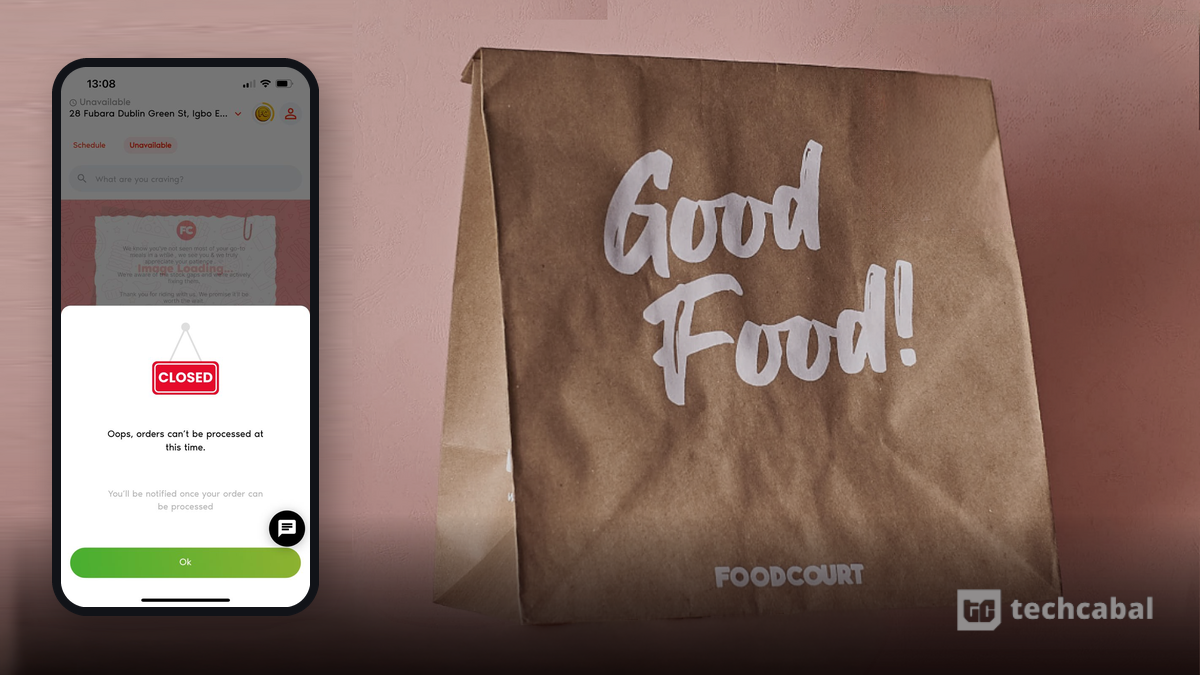
On March 4, 2026, some customers of FoodCourt, a Y Combinator-backed Nigerian cloud kitchen, noticed they could no longer place orders on the app. When they opened it looking to get a meal, they found the same line where the menu used to be: orders cannot be processed at this time.
Unknown to customers, the cloud kitchen had stopped delivering orders because the people who cooked the food, supplied it, delivered it, and ran its branch in Lekki, an affluent commercial and residential area of Lagos, had not been paid in months and went on strike, according to documents and internal messages seen by TechCabal.
The app was switched off by the startup’s leadership so that customers’ orders would stop coming in, according to internal messages seen by TechCabal. Beyond staff salaries, the company also owed money to vendors.
By April 19, the last FoodCourt branch had temporarily shut down after the second Lagos location paused operations, while the startup’s finance department raced to settle outstanding payments in anticipation of new funding by the end of April.
“The recent suspension of operations has been a difficult period for everyone connected to the business, including our employees, vendors, riders, customers, investors, and management team,” Henry Nneji, FoodCourt’s chief executive officer, noted in an emailed response to TechCabal.
“It’s important to clarify that the decision to pause operations wasn’t driven by one single issue. We reached a point where it became clear that continuing to patch those issues while operating wasn’t the right long-term decision,” Nneji added.
“The objective is to build a stronger business than the one that existed before the suspension. We fully intend to bring FoodCourt back,” he said.
Founded in 2021 by Nneji and Paul Adokiye Iruene, its chief technology officer, FoodCourt is the consumer app of CoKitchen, a Y-Combinator-backed foodtech company. The startup runs a full-stack cloud kitchen. Instead of listing other restaurants, CoKitchen cooks the food itself under several virtual brands from its kitchens, and customers order through FoodCourt in a business model that is optimised for speed and lower costs.
By the end of 2024, Nneji shared on LinkedIn that the startup had raised $1.7 million, delivered over 1 million meals, and achieved $4.3 million in annual recurring revenue (ARR). The closure came as a surprise to customers, as FoodCourt had shared that it was profitable in 2024 and opened new branches in Abuja, Nigeria’s capital, and another Lagos branch within 18 months.

Become a TC Insider for free to finish this story.
Sign in to read the full story and stay ahead of Africa's tech ecosystem.