

By NIYI TAYO.

In an economy racing to digitise, Verraki (a member of Andersen Consulting) has quietly begun building the kind of human capital Nigeria cannot afford to wait for. Launched formally at Andersen Place on July 10, 2025, the Verraki Academy is more than a training initiative; it is a deliberate systems response that marries industry rigor with practical learning to close the yawning gap between classroom coding and client- ready delivery.
The logic behind the Academy is stark and urgent. Globally, the digital skill gap has become a defining theme – contributing to missed opportunities, reduced innovation, social inequality, and slow economic growth. The World Bank estimates that by 2030, as many as 35 – 45% of Nigerian jobs will demand digital competencies. Without targeted, industry-aligned interventions, the country risks lost productivity, widening inequality, and dependence on imported expertise. Verraki’s blueprint situates the Academy as a scalable corrective: a platform that moves beyond short, theory-heavy courses to immersive, project-based development tailored to employer needs.
This need is sharpened by the disconnect between what educational institutions teach and the demands of the business world. While new fields such as AI, cloud computing, cybersecurity, and data science are emerging rapidly, tech education and training in Nigeria have been slow to adapt. Each year, Nigeria produces thousands of graduates, yet many lack hands-on skills in new technologies or their valid application to business problems. The result: graduates with certificates but insufficient workplace readiness.
What sets the Academy apart is its synthesis of technical depth and professional craft. The pilot Technology stream, which welcomed its first cohort in May 2025 and celebrated a formal launch in July, combines specialised technical tracks (Backend,
Java and .NET; Frontend, Angular; Mobile, Flutter; and Quality Assurance) with enterprise-centered disciplines such as enterprise architecture, agile delivery, solution design and business applications. Crucially, participants do not only build code; they learn how software solves business problems, how teams deliver at pace, and how to manage client expectations from day one.
Verraki has designed the Academy around three practical pillars: real-world projects, mentorship from seasoned consultants and engineers, and structured coaching in leadership and client management. The result is graduates who are not only technically competent but also consultative, impact-driven professionals – and importantly, at no cost to participants. This removes a major economic barrier and signals Verraki’s long-term intent to seed a broader talent pipeline rather than simply fill immediate hiring needs.
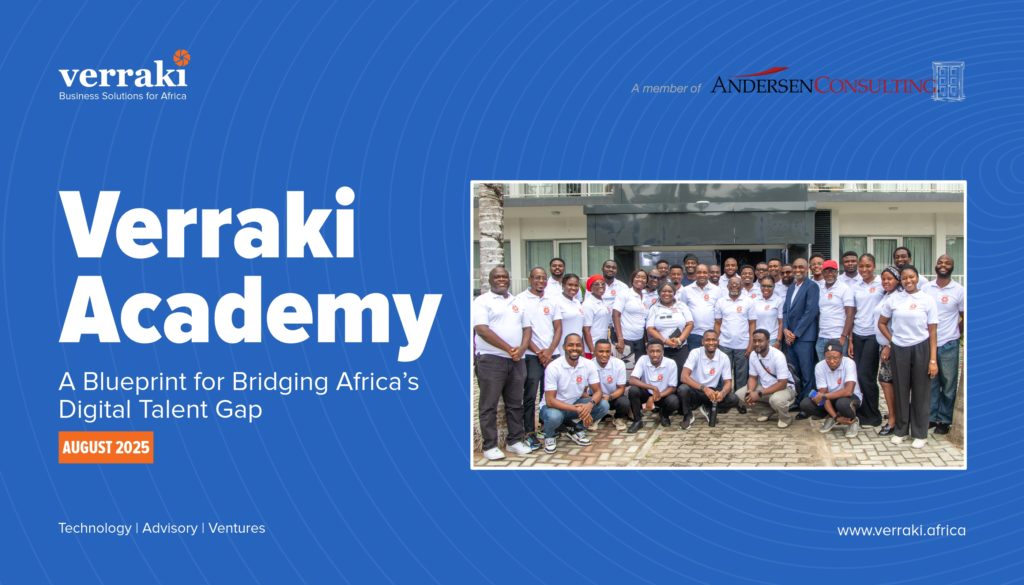
The Academy also nests inside a wider strategy. At Verraki, we continue to deliver advisory support, executive expertise, and strategic industry partnerships to respected institutions, driving capacity building and sustainable impact. As part of this integrated approach, Verraki took a bold step in 2024 with the launch of the Verraki Academy – a platform for shaping the next generation of African problem-solvers. The Academy represents a scalable model for inclusive growth, one that can be replicated to help drive productivity and innovation across the continent.
The firm is already collaborating with universities and schools – from Lagos Business School and the Nigerian University of Technology & Management to secondary institutions – while its Ventures arm backs startups such as Skilladder, Flexit, Primerli and Craydel that tackle skills intelligence, financing, microlearning and student navigation. Together, these strands aim to correct curriculum misalignment, lower learning costs, and expand access beyond urban tech hubs.
That broader framing is necessary because the Academy is operating in a challenging ecosystem. Nigeria still contends with outdated curricula, underfunded tertiary education, shortages of skilled instructors, infrastructure deficits in power and broadband, and the high cost of quality training that puts pathways out of reach for many. Equally worrying is talent migration, with skilled graduates seeking work abroad, shrinking the domestic pool and raising the bar for firms that wish to scale local operations. The Academy, in this light, is a pragmatic, market-led experiment in retention and capacity building.
Strategically, Verraki is positioning the Academy not as an endpoint but as a replicable model. The Technology stream is the pilot; Advisory and Ventures Academies are already in development. By integrating talent development into Verraki’s service lines, the firm intends to create a feedback loop where clients’ needs inform curriculum, graduates find deployment pathways inside real projects, and lessons from delivery refine the programme. It’s an ecosystem play: train, deploy, invest, and iterate.
For employers, the value proposition is immediate: a source of entry-level talent that understands business context, can contribute to delivery from early stages, and is schooled in professional behaviours often absent from traditional training. For young Nigerians, the Academy promises something rarer than a certificate: a credible route into meaningful, high-impact careers powered by mentorship and hands-on experience. For the nation, it signals a private-sector willingness to invest in structural change rather than temporary fixes.
Ultimately, we are motivated by the conviction that unlocking the continent’s vast potential depends on reimagining how people acquire knowledge, skills, and values to thrive in a rapidly changing world. Verraki’s Academy is an assertion: that closing the digital skills gap is not just about teaching languages and frameworks, but about aligning education with enterprise, and equipping people with the judgment to convert technology into measurable business outcomes. If Nigeria is to convert its demographic dividend into economic growth, initiatives like this – designed to be both rigorous and inclusive – will be central to that story.
For further information about the Verraki Academy and the full blueprint report, please visit www.verraki.africa