

Paystack, the Nigerian fintech acquired by Stripe, has restructured its operations under a new holding company, The Stack Group (TSG), which now houses Paystack, its consumer payments app Zap, Paystack Microfinance Bank (MFB), and a venture studio, signalling a more structured expansion beyond payments.
While Stripe’s $200 million acquisition made Paystack a wholly owned subsidiary, TSG introduces a different ownership model: it is jointly owned by Paystack’s chief executive officer, Shola Akinlade, Stripe, and existing Paystack employees known as Stacks.
“The beauty of this model is that it rewards the people who are building the company, while also maintaining the global backing of one of the leading payments companies through this foundational partnership with Stripe,” said Amandine Lobelle, the chief operating officer of TSG, declining to share the breakdown of the cap table.
The launch also coincides with group-wide profitability and positive monthly cash flow, after Paystack grew payment volumes more than 12x since the Stripe acquisition. “TSG signals a larger scope of ambition for us and sets the tone for the next decade of our company,” said Akinlade.
The restructuring continues a shift that has been underway within Paystack for the past year. With the launch of Zap and Paystack MFB, the decade-old company has slowly expanded beyond processing payments for businesses to consumer payments and banking, pursuing greater control over the funds it processes and new revenue streams.
TSG formalises this expansion by separating Paystack’s merchant payment business from its other new verticals, allowing the new verticals to compete in Nigeria’s tightly contested financial services market without diluting focus from Paystack’s core payments franchise, which remains the group’s primary revenue engine.
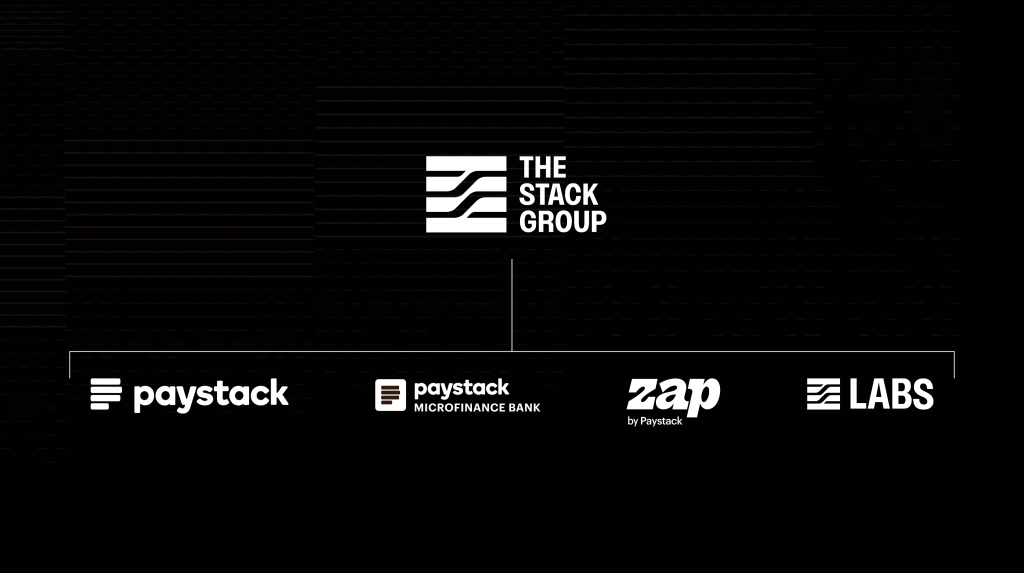
Paystack can remain a pure merchant payments player, while Zap and Paystack MFB pursue their own roadmaps without confusing merchants, regulators, and partners, while still retaining some of Paystack’s goodwill.
“What we realised is that we’re evolving from being a single-product company to a multi-brand technology group,” said Lobelle. “That means moving from payments alone to multiple brands and multiple types of technology, more of a group or conglomerate structure.”
The holding company structure also simplifies regulatory oversight as payments, banking, and consumer financial products carry different risk profiles and regulatory expectations. Housing them under a holdco allows licences, compliance, and risk to be separated by business line and geography. If Zap’s ₦250 million ($190,000) regulatory fine happened after TSG, the impact on TSG’s other businesses would be non-existent.
From Paystack Inc to TSG
Paystack launched in 2016 as a cheaper alternative to Nigeria’s existing online payment processors, and it quickly became one of the most important Nigerian startups ever after being the first to get into Y-Combinator, the world’s largest startup accelerator.
Within four years, Paystack found product-market fit (PMF) in Nigeria and delivered one of the largest exits in Nigerian tech, selling to US payments giant Stripe for $200 million. The years that followed were spent scaling across the continent and deepening its payments infrastructure. Today, the company operates in five African countries and offers a broad suite of payment products that now process trillions of naira monthly.
A decade after it launched, the company’s profitability has given it the balance sheet strength to experiment beyond its core business without affecting Paystack’s unit economics, leading to initiatives like Paystack MFB, Zap, and TSG Labs, its venture studio focused on building new products using emerging technologies, both within and beyond fintech.
“We’re not moving away from financial technology,” said Lobelle about TSG Labs. “We’re expanding our scope. Emerging technologies could include AI or stablecoins. The mandate is to solve both fintech and non-fintech problems that are critical to Africa’s digital future and development.”
For now, the holding company will not impose leadership structures on individual businesses. Instead, each subsidiary will develop its own leadership based on its stage of maturity and operational needs.
“The Stack Group is designed to let each business operate with the level of autonomy and leadership it needs to succeed, while benefiting from shared governance, culture, and long-term direction at the group level,” Lobelle said.
TSG also does not plan to transfer employees across subsidiaries in the near term. However, it will introduce an optional secondment programme that allows staff to work across different businesses when driven by business needs.
At the governance level, the holding company will have its own board, separate from those of its subsidiaries, continuing an existing practice of maintaining multiple boards across the group, in line with good governance standards and regulatory requirements.
Paystack joins a list of Nigerian tech companies like Moniepoint and Interswitch that have created holdco structures to reflect a multi-business ecosystem and create room for more businesses. These companies have since grown exponentially after becoming holdcos, as the structure makes it easier to acquire or build new companies and shut down experiments without damage to the flagship companies.
Standing out
Despite entering consumer payments and banking markets crowded with well-funded incumbents that have spent nearly a decade shaping Nigerian consumer expectations, Paystack says it is unfazed by competition. Lobelle told TechCabal that the company does not frame competition as a zero-sum contest.
“You can think of competition as a finite game, us versus another player, or as an infinite game, where it’s us versus our ambition,” she said. “We operate with the mindset of an infinite game. The only real limits are our vision and the problems our merchants face. Competition changes over time. If we obsessed over it, we’d make short-term, myopic decisions.”
Paystack plans to leverage its decade-long experience working with African businesses, but its strength in one domain does not automatically translate to another. Scaling consumer-facing financial products requires a level of offline distribution that differs sharply from online payments, an area where Paystack’s track record is short. Beyond Paystack Terminal, which failed to replicate the company’s dominance in online payments, the company lacks a deep physical distribution network.
Whether Paystack’s parent group, TSG, can successfully execute these new bets remains uncertain. Still, its decision to split operations into distinct entities may help sharpen focus, while the moonshot projects incubated under TSG Labs could open new revenue streams over time.
“Having worked with thousands of businesses across the continent since 2016, it’s clear there are significant opportunities to support African companies beyond payments,” Akinlade said. “TSG gives us the structure to tackle those challenges more directly.”