

How do you jump a military trench on a motorcycle? For commanders in Islamic State West Africa Province (ISWAP), the answer came from prompting generative AI. From dedicated prompt-engineering cells to encrypted satellite links paid for by central Islamic State cadres, former insurgents reveal how Boko Haram offshoots turned consumer software into a tactical weapon. In this edition of Delve into AI, ADONIJAH NDEGE, writes about how off-the-shelf algorithms are giving terrorists a dangerous edge, and why regional governments are being outlearned on the battlefield.
Around military bases across northeastern Nigeria, deep defensive trenches serve as a low-tech bulwark against militants from Islamic State West Africa Province (ISWAP), a Boko Haram breakaway faction. Because motorcycles cannot easily cross these ditches, the perimeter defences give soldiers crucial minutes to react.
Stymied by the obstacle, ISWAP commanders turned to artificial intelligence.
Former ISWAP members revealed to University of Cambridge researchers that commanders used commercial AI models to brainstorm tactical workarounds, including using motorcycles to jump trenches and breach fortified perimeter gates. Other insurgents leveraged the tools to troubleshoot captured government weaponry, refine attack logistics, engineer explosives, and bolster operational security.
These revelations point to a terrifying evolution: a lethal insurgent movement accelerating its problem-solving capacity at negligible cost. That reality presents a formidable challenge for governments across the Sahel and East Africa.
What happens when non-state actors that have survived decades of costly, multi-nation counterterrorism campaigns gain cheap, frictionless access to expert-level problem-solving software? And are state security apparatuses adapting fast enough to match them?
Until recently, security analysts framed the threat of generative AI largely around automated propaganda, translating manifestos, fabricating deepfake videos, generating synthetic imagery, and multiplying recruitment output with minimal human capital.
The Cambridge findings, however, expose a far more perilous shift: AI has moved from the marketing department to the battlefield.
Specialised AI militants
Fieldwork conducted by researcher Antonia Juelich—who interviewed 27 former Boko Haram and ISWAP members in northeastern Nigeria, including high-ranking commanders and technical operators—reveals that AI is becoming deeply embedded in insurgent infrastructure.
According to the research, both factions have systematically queried off-the-shelf, commercial AI platforms, including ChatGPT, Claude, Gemini, Grok, Meta AI, and DeepSeek.
Former commanders detailed the creation of specialised AI cells comprising five to 20 trusted operatives. Access strictly guarded, with designated prompt engineers trained to bypass safety filters, query models, and synthesise tactical intelligence for battlefield commanders.
The technology transfer began around 2023 when central Islamic State cadres provided ISWAP with hardware, encrypted satellite links, and paid software subscriptions, alongside technical instruction in jailbreaking, prompting techniques designed to bypass safety guardrails against generating dangerous instructions.
Far from casual experimentation, the group has spent years institutionalising AI as a core operational capability. That trajectory ought to alarm security chiefs in Abuja, Nigeria’s seat of power, while raising immediate flags across Nairobi, Mogadishu, and other African capitals contending with asymmetric insurgencies. Boko Haram was lethal long before incorporating digital tools. Since intensifying its insurgency in 2009, the group and its offshoots have killed tens of thousands of civilians and displaced millions around the Lake Chad Basin.
The group bombed the United Nations headquarters in Abuja in 2011 and orchestrated the 2014 mass abductions of 276 schoolgirls from Chibok, turning an insurgency in northeastern Nigeria into a global story.
According to a 2024 Amnesty International report, more than 80 of those schoolgirls remain in captivity.
Over 15 years, Boko Haram fighters have consistently overrun fortified outposts, seized heavy armaments, and adapted tactics in direct response to countermeasures deployed by Nigerian and regional coalition forces.
The broader conflict has claimed roughly 43,000 lives, displaced 3.1 million people, and pushed over four million into severe food insecurity across the Lake Chad Basin, according to data cited in the Cambridge study.

East Africa’s looming threat
Thousands of kilometres away in East Africa, Al-Shabaab poses a strikingly similar operational risk.
Emerging from the Islamic Courts Union in the mid-2000s, the Somali-based group evolved into one of Al-Qaeda’s most resilient and deadly franchises. It has weathered decades of sustained military offensives by Somali forces, the United States, Kenya, Ethiopia, and successive African Union peacekeeping missions.
Kenya has borne the brunt of its capabilities over the years.
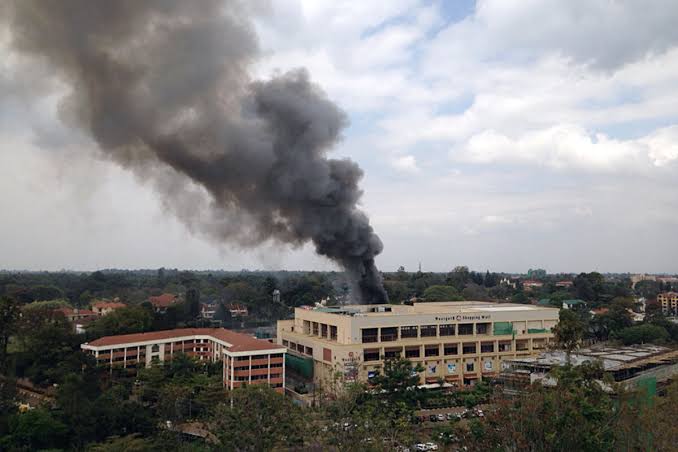
Al-Shabaab militants attacked Nairobi’s Westgate shopping mall in September 2013, killing 67 people. Two years later, gunmen stormed Garissa University College and killed 148 people, mostly students. In January 2019, another team attacked Nairobi’s DusitD2 complex, killing 21.
The immediate danger is not that AI turns amateur recruits into military geniuses. It is that an experienced organisation that has fought guerrilla warfare across borders becomes better at things it already knows how to do.
The Cambridge researchers call the effect an “uplift”: improving the capability of an existing actor without requiring a comparable increase in resources. That could mean faster attacks, better precision, improved operational security, or more sophisticated operations.
That creates an unusual asymmetry between militants and the states pursuing them. Consider what it takes for a Boko Haram commander to adopt a new AI model.
Someone needs a smartphone or laptop, internet access, and perhaps a subscription. The group experiments. If the technology proves useful, commanders can tell more fighters to use it.
Now consider what it can take for a government security agency to deploy AI.
Budgets have to be approved. Systems may have to be procured. Sensitive data needs to be protected. Personnel have to be trained. Different agencies must decide who can access what. Legal questions emerge around surveillance and privacy. Military commanders must establish when AI-generated intelligence can be trusted.
Many of those constraints are necessary. Governments should be more careful than terrorists. But they also create a potentially dangerous mismatch.
The Nigerian military has vastly more money, weapons, intelligence, and personnel than Boko Haram. Kenya and its partners similarly possess capabilities Al-Shabaab could never match.
Yet a militant organisation may still be able to experiment with a commercially available technology faster.
The question, then, is not whether African states can outspend militant groups. They obviously can. It is whether they can outlearn them.
A fast-moving threat horizon
ISWAP’s activities documented in the Cambridge study reflect AI capabilities from 2024. Today’s multimodal models are far more sophisticated, capable of analysing satellite imagery, processing vast datasets, synthesising real-time audio and video, and executing complex reasoning tasks.
Therefore, security agencies face a moving target. A counterterrorism strategy that was designed around what generative AI could do in 2024 is now obsolete.
To be sure, public evidence of operational AI deployment is far more robust for Boko Haram and ISWAP than for Al-Shabaab. The Cambridge findings rest on direct testimonies from former fighters detailing structured cells and specific battlefield applications.
Evidence surrounding other African militant groups is less detailed. It would be premature to assume Al-Shabaab has replicated Boko Haram’s AI operation.
But the core vulnerability remains unchanged: the barrier to entry is virtually non-existent. No proprietary hardware or specialised intelligence network is required. The exact commercial models utilised by software developers in Lagos, university students in Nairobi, or corporate executives in Johannesburg are accessible to anyone with a browser and an internet connection.

It is what prevents them from doing it next. Very little technology infrastructure is required. The same models used by programmers in Lagos, students in Nairobi and businesses in Johannesburg can be accessed almost anywhere with an internet connection.
Boko Haram and Al-Shabaab have survived for decades by proving perpetually agile in the face of superior state force. Now, cheap, ubiquitous AI models have entered the theatre of war.
That is what should concern governments from Abuja to Mogadishu and Nairobi.
The ultimate danger is that commercial AI quietly grants seasoned insurgencies an incremental edge, making them smarter, faster, and harder to dismantle, while state actors remain paralysed by bureaucratic inertia, fragmented intelligence sharing, and chronic shortages of technical expertise.
True scale demands moving beyond surface-level integrations to robust execution. We’ve filtered the noise out of Moonshot 2026, optimising the conference strictly for high-calibre connections between startup founders, global financial operators, enterprise leaders and individuals rewiring Africa’s technical frameworks. Get 20% off Early Bird tickets for a limited time.