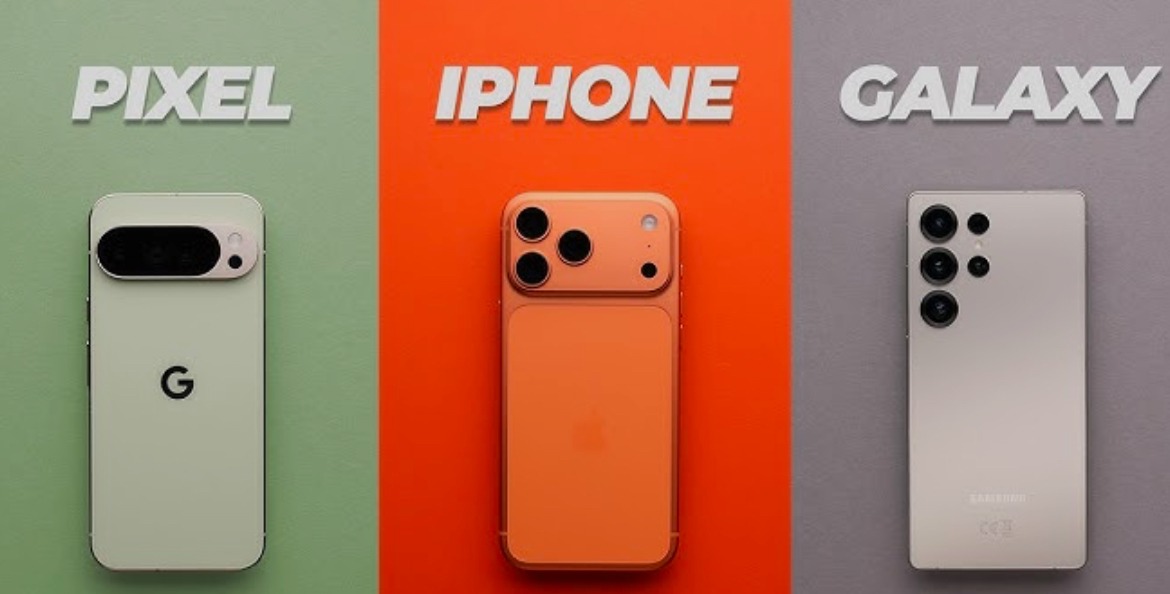
Apple’s iPhone 17, Google’s Pixel 10, and Samsung’s S25 are all pushing boundaries in performance, AI, and camera technology. But which smartphone is the best to buy in 2025?
For this article, we have analysed their specs, design, displays, battery life, and AI features.
Design and display
- iPhone 17: Apple refines its aerospace-grade titanium frame with slimmer bezels and a Dynamic Island 2.0. The 6.9-inch ProMotion OLED with adaptive refresh rates up to 120Hz hits 3000 nits peak brightness—the brightest iPhone yet. The flagship smartphone also features a 2868‑by‑1320-pixel resolution at 460 ppi.
- Pixel 10: Google introduces a flatter edge design and an eco-friendly aluminium back. Sports a 6.8-inch 1344×2992 LTPO OLED at 486 PPI. With a full 24-bit depth for 16 million colours and a 3300 nits peak brightness.
- Samsung Galaxy S25: Samsung’s 6.9 full rectangle 3120 x 1440 (Quad HD+) with a dynamic AMOLED 2X remains a visual treat with adaptive 1–120Hz refresh and HDR10+. The smartphone also features a 16M colour depth and S-Pen support.
Verdict — Winner
- Galaxy S25
Performance
- iPhone 17: Powered by Apple’s A19 Pro Bionic chip, built on a 3nm architecture, 6-core CPU with two performance and four efficiency cores. The iPhone 17 series also features a 6-core GPU with neural accelerators, a 16-core neural engine, and hardware acceleration. It leads in raw single-core performance and energy efficiency.
- Pixel 10: The new Tensor G4 focuses on AI – real-time translation, advanced photo correction, and smarter Assistant integration. The smartphone also features a Titan M2 security coprocessor.
- Samsung Galaxy S25: The device is powered by Qualcomm Snapdragon 8 Elite. It also features an octa-core processor, built on a 3-nanometer process with two high-performance Oryon cores and six efficiency cores, supported by an Adreno 830 GPU to support Galaxy’s AI and demanding tasks.
Verdict — Winner
- iPhone 17
Camera battle
- iPhone 17: A triple-lens system equipped with a new 48MP wide sensor and upgraded Ultra Fusion Engine for better low-light shots. The flagship also enables a 12MP optical-quality 2X Telephoto, a 48MP Fusion Telephoto, 12MP optical-quality 8x optical-quality zoom in, 2x optical zoom out, 16x optical-quality zoom range with a Deep Fusion, Smart HDR 5, ProRAW, photo geotagging, and Cinematic Pro mode up to 4k Dolby Vision at 30 FPS.
- Pixel 10: Google refines its computational photography, with AI-driven Scene Optimizer 2.0 and a 50MP wide | 48MP ultrawide with Macro Focus | 48MP 5x telephoto lens | Pro Res Zoom up to 100x and optical quality ranging from 0.5x to 10x. The flagship also sports a 42 MP Dual PD selfie camera with autofocus, and a 4k video recording at 24/30/60 FPS.
- Samsung Galaxy S25: Samsung levels up with a 200MP main sensor, 3x and 5x optical zoom, 2x and 10x optical-quality zoom, and a digital zoom up to 100x. It also features a UHD 8k (7680 x 4320) at 30 FPS.
Verdict — Winner
- Pixel 10 (photography)
- iPhone 17 (video)
Battery and charging
- iPhone 17: Built-in rechargeable lithium-ion battery, up to 50% charge in 20 minutes with a 40W adapter. The 2025 flagship smartphone is equipped with a 4,482 mAh battery capable of up to 39 hours of video playback and 35 hours of video playback (streamed).
- Pixel 10: Google Pixel 10 comes equipped with a 5,200 mAh battery, offering up to 100 hours of battery life with the Extreme Battery Saver option enabled. It can fast-charge to 70% in 30 minutes using a 45W USB-C charger.
- Galaxy S25: Comes with a lithium-ion 5,000mAh battery with 65W SuperFast charging, going from 0–50% in 12 minutes with up to 31 hours of video playback.
Verdict — Winner
- Pixel 10 (endurance and reliability)
AI and smart features
- iPhone 17: Apple Intelligence is designed to work within your device while keeping your information private. Most of its processing happens directly on your device, so your data stays secure and doesn’t need to be sent elsewhere. It prioritises privacy while allowing Siri to understand “personal context” by cross-referencing your emails, calendar, and messages. With system-wide writing tools for summarisation and tone adjustment, it acts as a privacy-focused assistant rather than a flashy chatbot.
- Pixel 10: For the Pixel 10, AI is the operating system, not just a feature. With Gemini Nano and Live integrated at every level, the phone is proactive rather than reactive. Tools like Call Assist for spam screening and Circle to Search handle utility tasks autonomously, using AI to solve fundamental frustrations such as bad photos and intrusive calls better than other flagships.
- Galaxy S25: The Galaxy S25 uses a combined approach, bringing together Google’s Gemini and Samsung’s Galaxy AI tools to create a flexible, all-round system. It’s built to support advanced tasks such as real-time translation, voice cloning, and AI-powered editing.
Verdict — Winner
- Pixel 10
Gaming performance
- iPhone 17: Delivers console-grade graphics at 120 Hz, utilising built-in Metal 3 optimisation. The A19 Pro GPU handles titles like Resident Evil 4 effortlessly.
- Pixel 10: Slightly behind in raw power, but it’s Tensor G4 pro prioritises sustained thermal efficiency and has few throttling issues in extended gaming sessions. Also features better heat distribution to make longer sessions comfortable.
- Galaxy S25: Snapdragon’s Adreno 750 GPU and upgraded vapour cooling system sustain peak frame rates (120 fps) for hours with minimal heat rise, with top-tier frame rates across all major titles.
Verdict — Winner
- Samsung Galaxy S25
Final verdict
| Category | Winner |
| Display and design | Galaxy S25 |
| Performance | iPhone 17 |
| Camera | Pixel 10 (photography), iPhone 17 (video, )Samsung Galaxy S25 (all-rounder) |
| Battery and charging | Pixel 10 (endurance and reliability) |
| AI features | Pixel 10 |
| Gaming | Galaxy S25 |
The smartphone market keeps getting competitive, but each flagship device stands out in its own right. Apple’s iPhone 17 Pro Max dominates in performance and video quality, while setting a standard benchmark for processing power and efficiency.
Google’s Pixel 10 Pro XL continues to lead in AI adaptation, offering a smart user experience intelligence feature that fits easily into everyday use. Meanwhile, Samsung’s Galaxy S25 Ultra, like its predecessors, remains the champion of display quality, excels in good gaming experience, and offers versatile camera options.
Ultimately, the device you choose depends on what you value most and what you prioritise in a smartphone. The good news here is how smartphones are getting smarter, faster, and better than ever before.