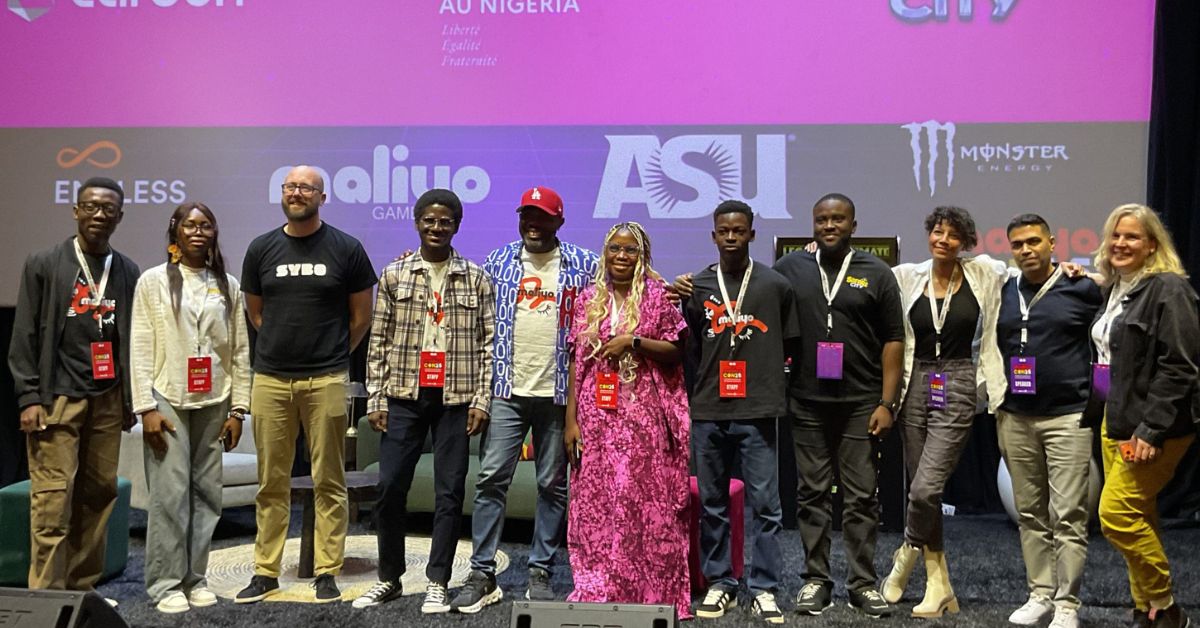
If you wanted to understand the passion it truly takes to build a game in Africa, you only needed to witness the morning of MaliyoCon25, the inaugural gaming conference hosted by Maliyo Games, the game developer behind Safari City, Whot King, and Disney’s Iwájú: Rising Chef. The rain poured down heavily on Thursday morning, December 11, and the notorious Lagos traffic that might typically cripple an event. But that chaos only seemed to fuel the resolve of the attendees, as the room sat full. Nothing was going to hold back the people building Africa’s gaming future.
The room was packed with game developers, founders, creators, and executives, including Hugo Obi, founder of Maliyo Games; Mathias Nørvig, CEO of SYBO Games, the studio behind Subway Surfers; Bukola Akinagbe, founder of Kucheza Games; and representatives from SuperCell, all drawn together by a shared belief that African-made games can stand confidently on the global stage.
MaliyoCon25 was a checkpoint to evaluate how far the industry has come and to confront the hard truths of what must be done to develop the gaming ecosystem in Nigeria and across the continent.
Navigating a “stop-start” ecosystem
Amidst the applause, the conversation shifted to the reality of what it actually takes to run a studio in Africa. While the global gaming industry might face its own headwinds, the African context introduces a layer of friction that requires a unique kind of fortitude. Christopher Adomako, the Lead Product Manager at Maliyo, described the development lifecycle here as a start-stop process.
“I don’t think I’ve ever worked on a project where we’ve started something, gone from brainstorming to game design, and everything just went straight to the hands of players. It has definitely been stop-start,” he said.” Whether it is battling poor internet connectivity or power outages, Adomako described the workflow as one that is rarely smooth. Creators must know exactly when to pause and when to resume, turning game development into a test of patience as much as skill.
This environment demands a specific temperament from founders. Echoing a sentiment introduced by Deborah Mensah-Bonsu, global social impact lead at SuperCell, about the necessity of grit, Hugo Obi reinforced that to survive here: “You have got to be scrappy.” There is no room for waiting for perfect conditions or ample resources. Obi spoke openly about the structural issues that sit behind the work, the absence of industry data, weak monetisation systems on the continent, the pressure to train talent from scratch, and the constant battle to build while simultaneously keeping the lights on.
“The challenge that we have is that all of the data that we have is third-party; it is somebody else’s data,” he said. “Nothing we do is easy. The funding is not easy, the production is not easy, the personnel management is not easy.”
Talent remains the beating heart of this conversation. There are brilliant creatives across the continent, but developing them into production-ready professionals takes time. Data from the 2024 Africa Games Industry Report reveals that roughly 63% of local game developers have less than five years of experience in the industry. Reflecting on the early days of the industry, Obi shared his realisation about the attrition rate in the African gaming space.
“Everyone I started with was gone,” he said. “ People had put years into this thing… at some point, I was the last man standing.”
The ecosystem was trapped in a cycle where ambition wasn’t matching output because there was no pipeline to produce skilled developers. This realisation birthed Game Up Africa, a training programme for people interested in developing games.
There also lies the challenge of the audience. Obi noted that African creators are building for a market that is still forming its identity, with spending power that fluctuates and user behaviour that global benchmarks don’t capture. Layered on these challenges is the struggle for funding. While third-party data suggests the African gaming market is generating significant value, with revenue of about $7 billion in 2024 across the Middle East and Africa, capital flows to studios remain restricted.
According to data from the 2025 African Game Developer Survey, only 3% of game studios have ever received government funding, underscoring how limited funding flows are for early-stage creators. Some exceptions highlight what is possible, as South African game developer Carry1st raised a $27 million round in 2023. This reality, where only a small fraction of developers secure meaningful investment, reinforces that fundraising is a persistent pain point in the game development industry.
The future of game development in Africa
MaliyoCon25 also made it clear that Africa’s game development is already taking shape, regardless of the difficulties. With programmes like Game Up Africa feeding talent into studios, partnerships forming across borders, including interest from institutions like Arizona State University, and creators gaining confidence in telling African stories. One of the recurring themes was that Africa’s strength will come from building with the continent’s own identity and structural realities in mind, rather than replicating what exists elsewhere.
“I want us to be a net producer, as opposed to a net consumer of games. Nothing else matters. As long as Africa is not producing the games that Africans are playing… this needs to be done,” Obi declared, going so far as to call local game production “a matter of national security.”