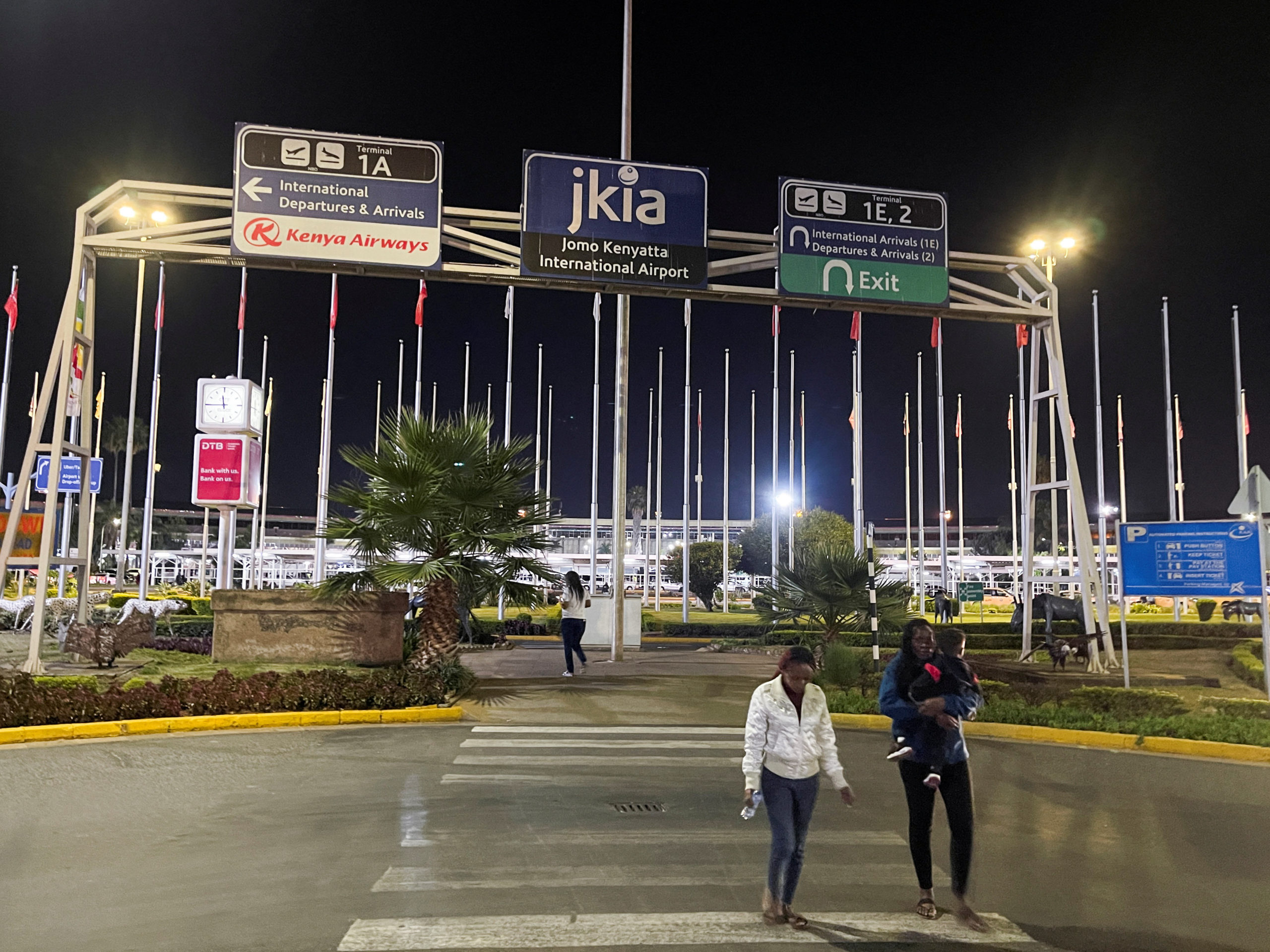
Kenya’s aviation infrastructure came under strain on Monday after a labour dispute disrupted flight operations at the state-owned Jomo Kenyatta International Airport (JKIA), raising questions about the resilience of one of East Africa’s most critical transport and logistics hubs.
The Kenya Aviation Workers Union (KAWU) called the industrial action one week after it announced plans to strike over implementation issues tied to a collective bargaining agreement signed between the union and authorities. The union’s Secretary-General Moss Ndiema told local newspaper Daily Nation that the industrial action began at 6 am (GMT +03.00) on Monday. The workers are demanding better working conditions, as well as improved pay and benefits.
“Kenya Airport Authority (KAA) wishes to inform the public of delays affecting departing flights at Jomo Kenyatta International Airport (JKIA) due to an ongoing labour dispute between Kenya Aviation Workers Union (KAWU) and the Kenya Civil Aviation Authority (KCAA),” the agency said in a statement released on Monday.
JKIA is a critical hub for time-sensitive tech imports and other cargo imports. Disruptions can ripple across supply chains, delay ICT and electronics, and slow the movement of talent that drives Kenya’s digital economy. As the country plans to expand air freight capacity for international trade imports, the strike exposes the manual lever that still throws a wedge in its ambition.
In a statement on Monday, the Kenya Civil Aviation Authority (KCAA), the country’s airspace regulator, said it has “activated its operational continuity measures” and plans to “engage relevant [airline] stakeholders in line with applicable labour laws and court directions.”
The union has accused the regulator of stalling salary negotiations, delaying union remittances and failing to resolve long-running labour grievances.
On February 13, KCAA moved to court seeking orders to halt the strike, and a labour court judge suspended the action pending further directions expected this week. Despite that, workers proceeded with the strike on Monday morning.
Several airlines with connecting flights, including Jambojet, iFly, and Kenya Airways, have notified customers about delays affecting departures and arrivals. However, there is no specified date for when normal flight schedules will be restored. According to data from flight-tracking platform Flightradar, scheduled Monday afternoon departure flights from JKIA were delayed.
Beyond passenger inconvenience, the disruption highlights the fragility of aviation as digital infrastructure. JKIA transported 8.6 million passengers in 2025 and functions as a gateway linking East Africa and Europe, North America and the Middle East. It is also a critical cargo corridor, supporting time-sensitive exports such as horticulture and facilitating imports of high-value goods, including electronics, which are often shipped by air freight.
Kenya imported $1.1 billion worth of electrical and electronic equipment in 2024, most of it sourced from Asia. While bulk shipments move by sea through Mombasa, high‑value electronics and ICT hardware typically fly into the country via JKIA and a handful of other airports, making disruptions a direct risk to just‑in‑time deliveries of devices and network equipment.
According to the KAA, Kenya plans to raise JKIA’s freight capacity to one million tonnes by 2030.
For Kenya’s digital economy, JKIA is more than a passenger terminal. It is a mobility and logistics node for startups, venture capital investors, multinational tech operators and cross-border talent movement. In December 2025, about 313,944 passengers landed at the airport, a 16.5% increase from the previous month, underscoring the airport’s gateway role in easing mobility.
Prolonged instability at the airport risks ripple effects across supply chains, business travel, and regional integration efforts under the African Continental Free Trade Area (AfCFTA).
The strike also revives tension seen in September 2024, when KAWU opposed a 30-year lease deal involving India’s Adani Group and the reported takeover of JKIA. The union opposed the concession over fears of job losses and governance issues, and the proposal was later withdrawn.