Since entering Nigeria in 2019, asset financing company M-KOPA has deployed more than ₦231 billion ($170.34 million) in credit to over one million customers, positioning smartphone financing as one of the fastest-growing entry points into formal credit for low-income Nigerians.
According to the company’s latest impact report, women account for 33% of borrowers, and 52% of them are accessing credit for the first time through its platform. The lending spans financed smartphones and cash loans, underscoring the company’s evolution from its original solar home systems business.
Across Nigeria, embedded finance models are expanding access to consumer credit outside traditional banks. By tying loans directly to financed assets and repayment behaviour, companies like M-KOPA are testing whether technology-driven lending can succeed where conventional retail credit has struggled with defaults and high borrowing costs.
M-KOPA initially entered Nigeria, financing solar home systems, a model it pioneered in East Africa. But customer behaviour quickly revealed a larger opportunity.
“Once you finance solar home solutions, you start to ask yourself what you missed,” Babajide Duroshola, M-KOPA Nigeria’s general manager, told TechCabal. “That is when you figure out that everybody needs to be in the digital economy, and access to a smartphone solves this.”
Smartphones have become the primary gateway to the internet for millions of Nigerians, yet affordability remains the biggest barrier to adoption. Nearly six in ten Nigerians remain offline largely due to device costs, according to GSMA, the global telecom industry body.
Device financing companies are increasingly targeting this gap, offering installment payment plans designed for informal workers who lack traditional credit histories.
M-KOPA’s model removes several barriers associated with formal lending. Customers do not require collateral, guarantors, or proof of income. Instead, they make an initial deposit alongside providing identification, after which repayments are structured as daily micropayments.
“What you start with is what you are ending with,” Duroshola said. “Even if the loan was six months and you pay in six and a half months, we do not add extra charges. It is not an interest-based model.”
Risk management relies heavily on embedded technology within financed devices. Phones can be remotely restricted if repayments stop, limiting functionality until payments resume while still allowing emergency calls.
Customers facing financial hardship may also return devices and receive refunds on their deposits, a mechanism the company says helps maintain single-digit default rates in Nigeria.
The approach shifts collections away from traditional debt recovery toward asset control and behavioural repayment tracking.
📱 Can I Afford This Phone?
Daily repayment calculator
Impact on Your Wallet
0%
of incomeEnter your income above to see if you can afford this.
You will have … left for food & transport.
Betting on informal Nigeria
The company’s most popular devices include Samsung’s A06 smartphone and its proprietary M-KOPA M10 device. Prices are not publicly listed online, as prospective customers are directed to WhatsApp agents.
The Samsung A06 retails for around ₦118,607 ($87.46) on Jumia.
The company says it has distributed more than one million smartphones in Nigeria so far, including 290,000 devices to first-time smartphone owners.
For M-KOPA, device ownership is only the starting point. “The smartphone becomes a transformative financial tool,” Duroshola said.
According to its report, 77% of customers use financed devices for income-generating activities, while 75% report increased earnings after purchase.
Partnerships with original equipment manufacturers and telecom operators such as MTN have also aligned smartphone financing with broader industry goals to migrate users onto faster mobile data networks.
“We are Samsung’s largest retailer in the country,” he said.
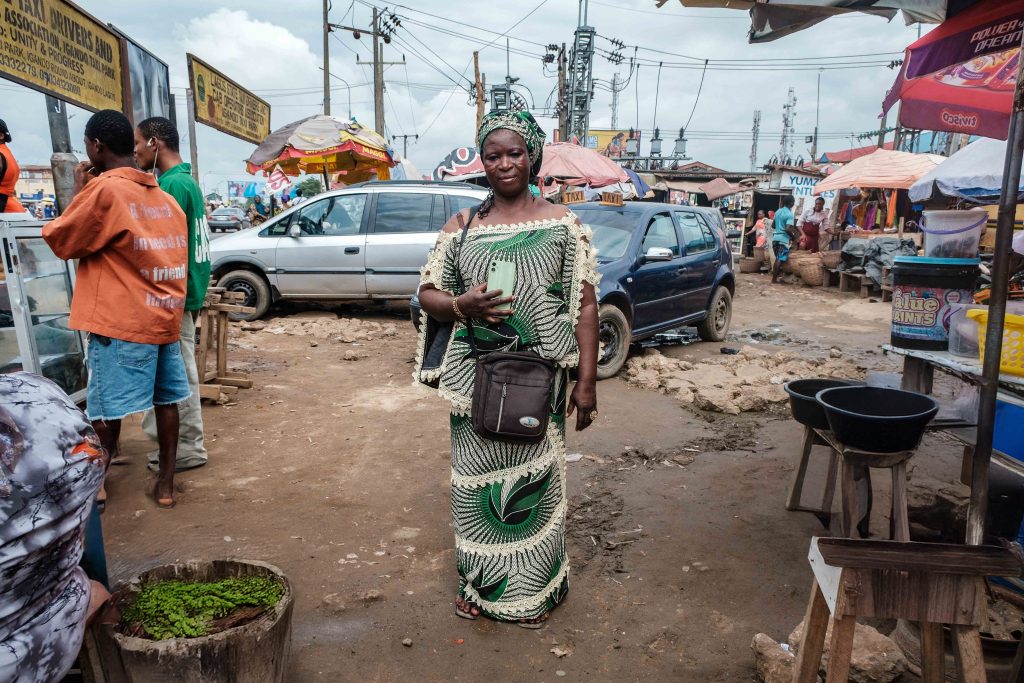
Cash loans grow faster
While smartphones remain its entry product, cash lending is emerging as the company’s fastest-growing segment.
Unlike smartphones, which customers typically replace every two to three years, cash loans can be accessed repeatedly once repayment behaviour is established.
Our cash lending business has grown significantly at a faster pace,” Duroshola said. “With a smartphone, people require one device every few years. But with cash, customers can borrow multiple times within a cycle if they repay on time.”
The company uses repayment history generated through device financing to build proprietary credit scores, lowering lending risk.
Daily micropayment repayment structures mirror the company’s device financing model and reflect rising demand for working capital among small traders navigating inflation and economic uncertainty.
Economic spillovers
The company’s distribution model is also generating employment through a nationwide sales network. More than 11,000 agents currently earn income through the company’s operations, with agent churn at just 0.1%, according to the company.
Local procurement spending reached ₦27.4 billion ($20.21 million) in 2024, while annual tax contributions exceeded ₦2.5 billion ($1.84 million), underscoring the broader economic footprint of the model beyond lending itself.
The company currently operates in six states, including Lagos, Ogun, and Oyo, but plans to expand its footprint to 20 states within five years while unlocking more than ₦1 trillion ($737.40 million) in credit.
It also wants to offer more products, including data bundles.
“We want to launch more products that are beneficial to everyday life. Things people do not have access to today,” Duroshola said.
Nigeria has become a critical growth market for the Nairobi-headquartered company, which became profitable in 2024, reporting $9.2 million in profit after a $24.7 million loss the previous year as revenue grew 66%.
But as asset-backed lending expands deeper into informal markets, scrutiny is likely to shift toward repayment enforcement practices and customer protections.
Editor’s note: A previous version of this story included a specific valuation of deployed credit that has since been removed.