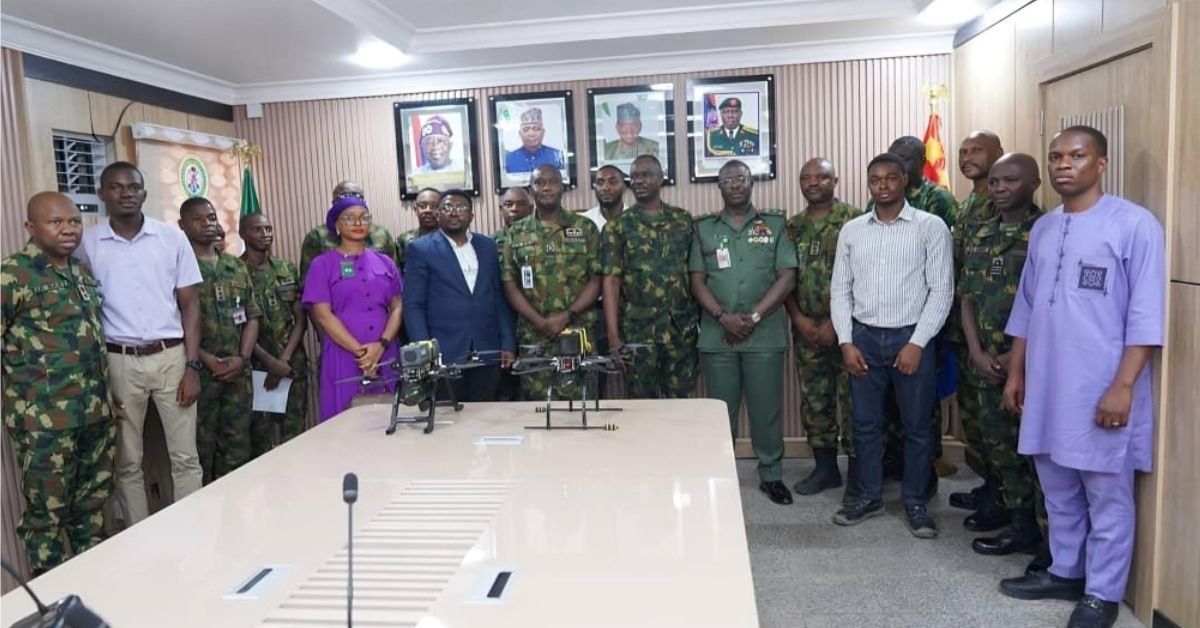
There is a particular kind of pride that arrives not with fanfare but with an unmistakable weight of history being made and that pride reached a new height recently when UNICCON Group of Companies, the Nigerian technology conglomerate already celebrated for building Omeife, Africa’s first humanoid robot and artificial intelligence (AI) model, has branched into the defence field with a robust partnership with the Defence Industries Corporation of Nigeria (DICON), a partnership that birthed a brilliant showcase of loitering munitions and jamming systems, at a secure facility in Jaji, Kaduna. A new crescendo was reached as they unveiled their latest creation, christened the UNIKAM series. Through this, Africa is finally building Kamikaze drones. Not an imported one. Not assembled one from foreign kits. Built from conception to deployment-ready capability, on African soil, by African engineers, for African security imperatives.
This is not a footnote. This is a headline that the world’s defence industry will need to read twice.
The hardware that changes the conversation
The drone developed by Babasky Technologies is, by all technical accounts, a precision strike system capable of carrying explosive payloads and delivering them within a 200-metre radius of a designated target. For those unfamiliar with the operational theatre across West and Central Africa, where insurgent groups like Boko Haram, ISWAP, and a constellation of other non-state actors have inflicted devastating casualties on military personnel operating in difficult terrain, this is precisely the kind of asymmetric capability that changes the equation.
The CEO UNICCON Group, Professor Chuks Ekwueme expressed his delight at being at the forefront of pioneering local technology and producing solutions that meet the unique needs of Nigeria and Africa, he noted that every component of the drone and munitions were locally sourced and produced by indigenous engineers and promises a sustained partnership with the defence industry to combat the growing challenges.
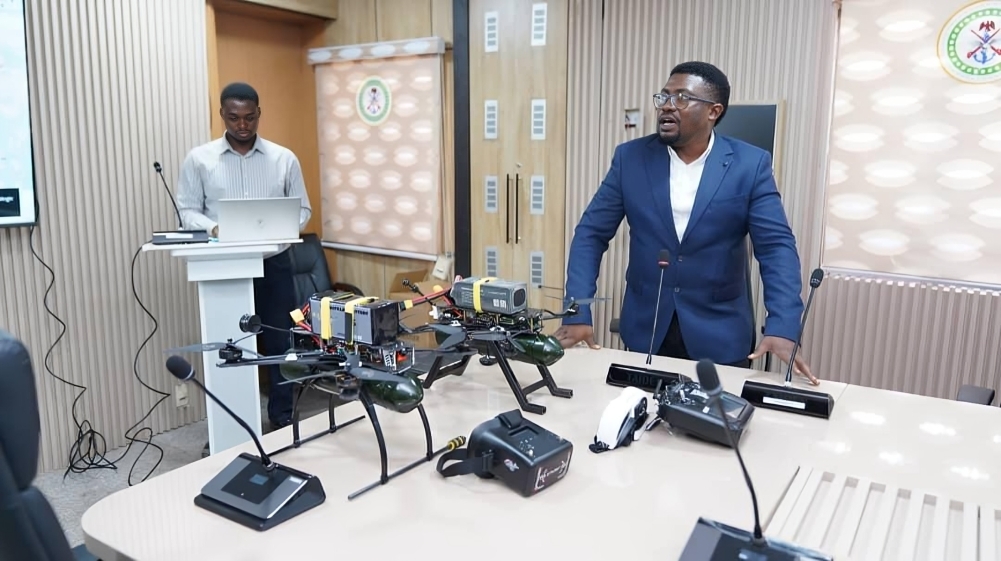
Military experts who have reviewed the system have described it in terms that should command serious attention: more robust, they say, than comparable drone systems observed in active deployment in the Middle East and in the ongoing conflict in Ukraine. That is a remarkable benchmark. The drones used in those theatres have reshaped modern warfare. They have forced military planners from around the world to reconsider the economics and ethics of conflict. For a system built in Nigeria to be measured against them, and to exceed them in certain performance parameters, is not merely impressive. It is a strategic inflection point.
The drone is not simply a delivery mechanism. Babasky Technologies has embedded advanced artificial intelligence (AI) capabilities into the system, including autonomous target detection. This elevates the platform from a remotely piloted weapon into something closer to an intelligent strike asset, the kind that reduces operator risk, increases mission precision, and shortens the decision-execution loop in time-sensitive engagements.
Why it matters
Nigeria’s security environment has, for over a decade, demanded exactly this kind of innovation. The human cost of insurgency across the North-East and North-West has been staggering thousands of soldiers, civilians, and displaced persons bearing the weight of a conflict that conventional military responses have struggled to fully contain. The ability to field a domestically produced precision strike drone represents more than tactical advantage. It represents strategic sovereignty.
For too long, African militaries have been dependent on foreign procurement cycles on the willingness of external partners to supply, or withhold, critical defence technology. That dependency carries a price beyond the financial. It shapes doctrine, limits responsiveness, and creates vulnerabilities that adversaries learn to exploit. A homegrown kamikaze drone capability breaks that dependency in a category that matters enormously.
The timing is also significant at a continental scale. Across the Sahel, the Horn of Africa, and the Great Lakes region, the security challenge is evolving faster than traditional procurement timelines can accommodate. The capacity to design, iterate, and manufacture locally, to respond to the battlefield as it actually exists rather than as it was anticipated years ago during a foreign procurement negotiation, is an advantage that cannot be overstated.
The DICON partnership: proof of institutional commitment
What distinguishes UNICCON Group’s defence ambitions from those of a mere innovator is the institutional depth behind them. The company maintains a joint venture with the Defence Industries Corporation of Nigeria (DICON), the Federal Government’s defence manufacturing arm, a partnership that has now endured for more than two years. In an industry where joint ventures frequently dissolve before they produce anything of substance, this durability speaks to a genuine alignment of vision, capacity, and trust.
The relationship was recently put on public display at a secure facility in Jaji, Kaduna State, where UNICCON and DICON held a joint showcase of advanced drone systems and electronic warfare jamming innovations. The significance of a public-facing demonstration at a military facility should not be underestimated. It signals that this technology has cleared the scrutiny of Nigeria’s defence establishment, that it has been evaluated not merely as a prototype curiosity but as a platform with operational potential.
For investors and defence contractors assessing the African defence technology landscape, that institutional imprimatur is exactly the kind of validation that de-risks engagement.
The investment case is already writing itself
Let us be direct about what this moment represents for those watching with commercial interest.
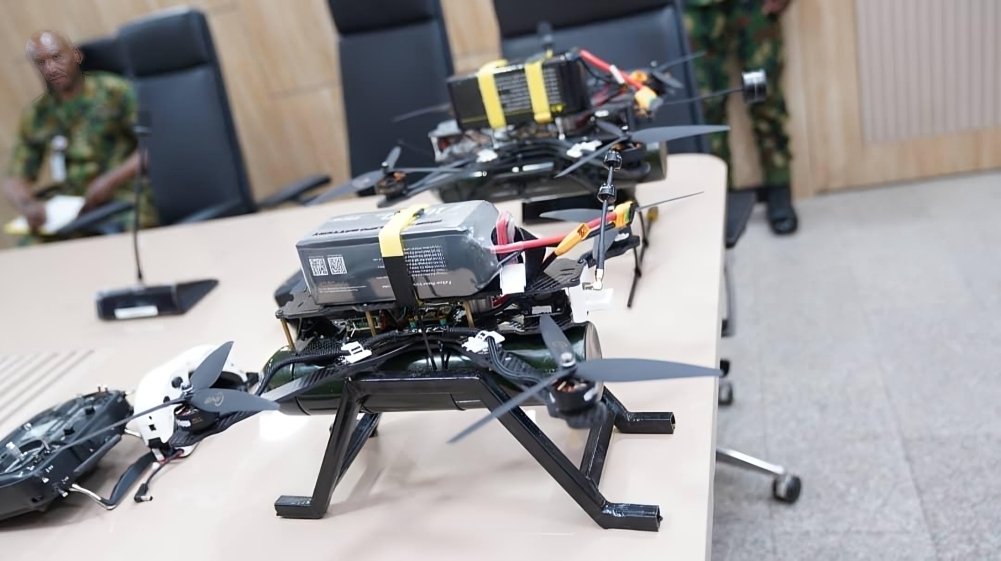
UNICCON Group has now demonstrated, with two landmark achievements, that it possesses both the technical talent and the organisational architecture to produce world-class, category-defining technology at scale. Omeife, the humanoid robot, placed the group on the global innovation map. The Babasky kamikaze drone places it in a far more immediately monetizable arena, one where African governments are actively seeking procurement alternatives, where global defence contractors are looking for regional partners, and where the geopolitical appetite for Africa-sourced solutions has never been higher.
The addressable market is substantial. Nigeria alone has a defence budget that runs into hundreds of billions of naira annually. Multiply that sovereign demand across the African Union’s 55 member states, each grappling with its own version of the security challenges that have driven this innovation, and the scale of the opportunity comes into view. Add the possibility of export markets, where nations in the Middle East, South Asia, and beyond have demonstrated appetite for cost-effective, capable drone systems, and the horizon extends considerably further.
This is a company that has chosen to build what Africa needs, in Africa, with African expertise. It has found a committed institutional partner in DICON. It has produced a system that stands comparison with the most combat-proven drone technology in the world today. And it has done all of this in an environment that does not traditionally make such achievements easy.
A continent building its own future
There is a version of Africa’s story that has always been told from the outside, one in which the continent is a theatre of problems awaiting foreign solutions. UNICCON Group and Babasky Technologies have now added a compelling new chapter to the counter-narrative: that Africa is not only capable of solving its own security challenges but of doing so with technology sophisticated enough to set the global standard.
The drone exists. The partnership is real. The capability has been demonstrated before the eyes of Nigeria’s defence establishment. What comes next, the scale, the deployment, the investment, the continental adoption, is a story still being written.
Those who wish to be part of writing it would do well to pay attention now, before the rest of the world catches up.