Table of contents
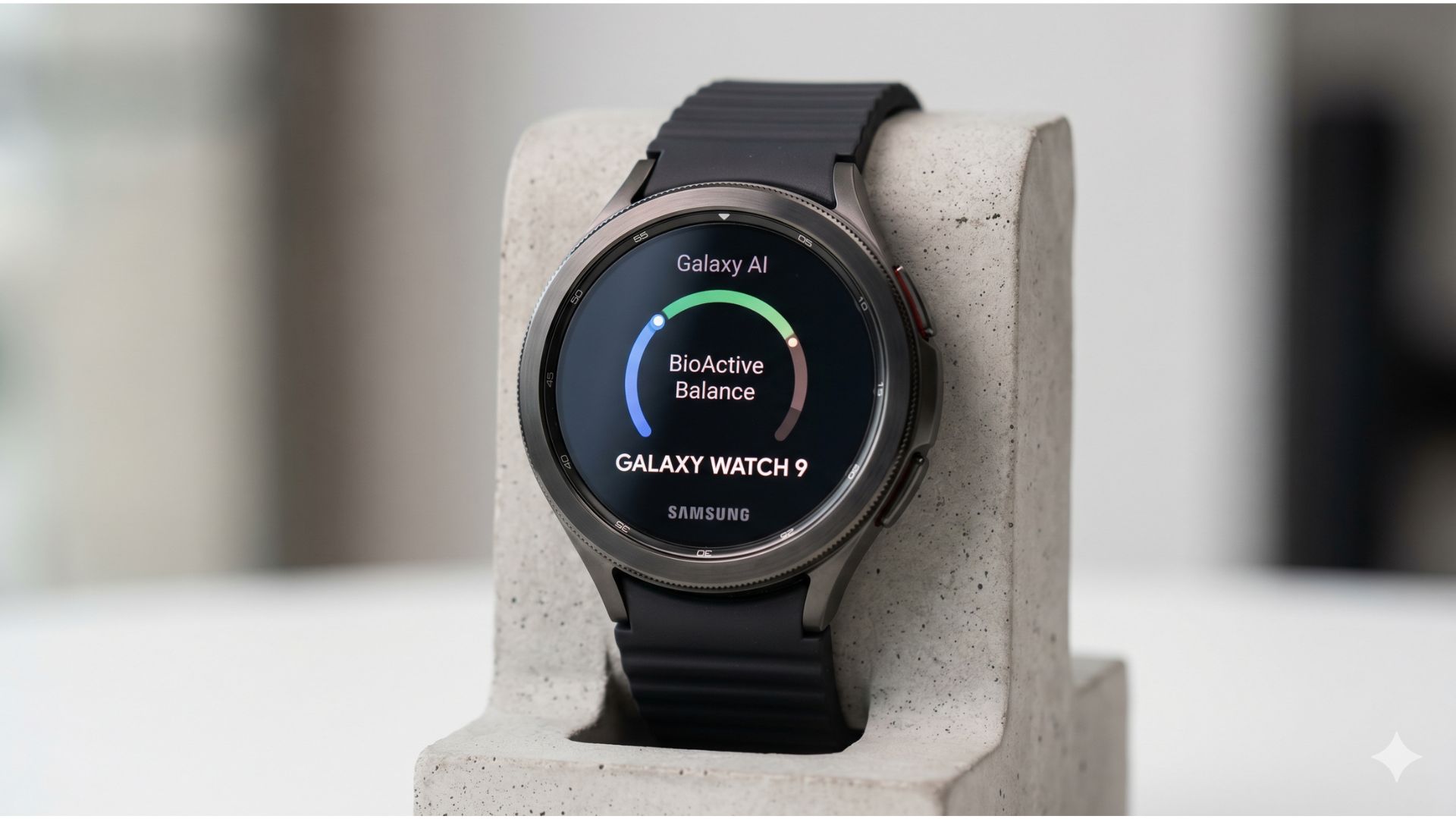
A new Samsung smartwatch is coming, and every clue points straight at a Galaxy Watch 9. Samsung’s own health app, a new chip from Qualcomm, and a string of leaked filings all hint at an imminent launch, even though Samsung itself has stayed quiet about the name.
This guide separates what’s confirmed from what remains speculation, so you know what to trust. It covers the expected launch date, pricing, key features and upgrades, and how the device compares with the Galaxy Watch 8.
Has Samsung announced the Galaxy Watch 9?
Not yet. As of June 19, 2026, Samsung has not sent out an Unpacked invite or used the name “Galaxy Watch 9” in any official statement. Two things tied to the watch have been confirmed, though.
A Samsung Health app overhaul. On June 4, 2026, Samsung’s Global Newsroom announced a major update to the Samsung Health app, rolling out from June 8. Samsung says the update showcases the key health features of its upcoming Galaxy Watch, though it stopped short of naming the device. Hon Pak, who leads Samsung’s Digital Health team, said the update connects your health data to AI-driven insights, helping you better understand your body.
The app now centers on five areas: Sleep, Activity, Nutrition, Mindfulness, and Vitals. New features include:
- Vitals checks five overnight signals (heart rate, heart rate variability, breathing rate, skin temperature, and blood oxygen) against your baseline and alerts you only when something is genuinely off.
- Heart Health Score, a single daily number that replaces last year’s Vascular Load and blends your sleep, stress, activity, and body composition data.
- Daily Cardio Load, which tracks how much strain your body has taken on and suggests when to train and when to rest.
- Fitness Index, which compares your heart rate, VO2 max, and daily steps against your peers.
- Hearing Health, which uses your watch’s microphone to flag loud environments that could damage your hearing.
- Antioxidant Index and AGEs Index upgrades, both of which now track trends over time instead of single readings.
Samsung’s own footnote says these features will first be available on the upcoming Galaxy Watch, which means current Watch owners get the redesigned app now, but the full feature set is tied to new hardware.
Samsung has also recently published two health studies tied to the Galaxy Watch line. A joint study with a hospital in Korea found that the Galaxy Watch 6 could predict a fainting episode up to 5 minutes before it occurred, with 84.6 percent accuracy. A separate study with Massachusetts General Hospital is using the Galaxy Watch 8 to track muscle loss in patients on GLP-1 medication. Neither study confirms a Watch 9 feature, but both show where Samsung’s health focus is heading.
A new chip. At MWC 2026 in March, Qualcomm confirmed that the next Galaxy Watch will use its new Snapdragon Wear Elite chip. Samsung backed this up with an on-record quote from InKang Song, who leads technology strategy for Samsung’s mobile business, saying the new chip will help the watch become an even better wellness companion. Qualcomm named Samsung, Google, and Motorola as launch partners for the chip.
Here is what the Snapdragon Wear Elite brings:
- A 3nm chip with one fast core at 2.1GHz and four efficiency cores at 1.95GHz.
- Up to 5 times the CPU power and 7 times the GPU power of the previous Snapdragon wearable chip, enough to render 1080p video at 60fps.
- A dedicated AI chip that can run models with up to 2 billion parameters right on your wrist, working through about 10 tokens every second.
- 30 percent more battery life than the last generation, plus a 50 percent charge in around 10 minutes.
- Wi-Fi 6, Bluetooth 6.0, UWB, GPS, 5G and satellite messaging support, all in one chip.
There is one catch. Samsung and Qualcomm only said next-generation Galaxy Watch, not which model. Some reports say both the Watch 9 and Watch Ultra 2 get the new chip. Others, including information from Notebookcheck, say only the Watch Ultra 2 gets the Snapdragon chip while the standard Watch 9 keeps the older Exynos W1000. This is still unresolved.
The Unpacked date. Korean media reports point to July 22, 2026, in London, as the date for Samsung’s next Unpacked event, where the Galaxy Watch 9 line is expected to share the stage with the Galaxy Z Fold 8, Z Flip 8, Z Fold 8 Wide and Samsung’s new Galaxy Glasses. Samsung has not confirmed this date.
Regulatory filings. In the middle of June 2026, the Galaxy Watch 9 and Galaxy Watch Ultra 2 cleared both FCC and CMIIT certification. The filings list model numbers SM-L340 and SM-L345 for the 40mm Watch 9, SM-L350 and SM-L355 for the 44mm Watch 9, and SM-L715 for the Watch Ultra 2. No Classic model number appeared in either filing, which is a strong sign that Samsung is skipping the Watch 9 Classic this year. A separate charging certification confirmed both watches stick with 10W wired charging, so do not expect faster charging this time around.
When will the Galaxy Watch 9 release?
Last year’s launch gives the clearest clue here. Samsung announced the Galaxy Watch 8 on July 9, 2025, and put it on sale on July 25, 2025, a gap of 16 days. If Samsung follows that same pattern, expect the Galaxy Watch 9 to go on sale in early August 2026. The leaked Unpacked date of July 22, 2026, would only mark the announcement, not the on-sale date, and Samsung has not confirmed even that date yet.
How much will the Galaxy Watch 9 cost?
Pricing is the one area where leaks have gone quiet. PhoneArena has made it clear that the Galaxy Watch 9 price has not leaked yet. Tom’s Guide expects prices to hold steady this year, while Tech Advisor argues a price increase is likely given how much Samsung raised prices on the Galaxy S26 line. Neither outlet has an actual number to point to, and Samsung itself has said nothing official.
Until Samsung says otherwise, your best guide is what the Galaxy Watch 8 line costs at launch in 2025:
- Galaxy Watch 8 (40mm, Bluetooth): $349 / £319 / €379
- Galaxy Watch 8 (40mm, LTE): $399 / £369 / €429
- Galaxy Watch 8 (44mm, Bluetooth): $379 / £349 / €409
- Galaxy Watch 8 (44mm, LTE): $429 / £399 / €459
- Galaxy Watch 8 Classic (46mm, Bluetooth): $499 / £449 / €529
- Galaxy Watch 8 Classic (46mm, LTE): $549 / £499 / €579
- Galaxy Watch Ultra (2025): $649 / £599 / €699
That was already a $50 jump from the Galaxy Watch 7. If Samsung raises prices again this year, expect the Galaxy Watch 9 to land close to these numbers or slightly above them.
What are the expected specs of the Galaxy Watch 9?
Leaks have given us a fairly clear picture of both the standard Galaxy Watch 9 and the Galaxy Watch Ultra 2, even though nothing here is official yet. The Galaxy Watch 9 Classic appears unlikely to launch this year, as it has not appeared in any regulatory filings.
Galaxy Watch 9
- Processor: still unclear. Could be the new Snapdragon Wear Elite or the carryover Exynos W1000.
- RAM and storage: 2GB of RAM and 32GB of storage, the same as the Watch 8.
- Display: a 1.34-inch screen on the 40mm model and a 1.47-inch screen on the 44mm model, both Super AMOLED with sapphire crystal on top.
- Battery: the 40mm model is expected to carry a 382mAh battery, which Samsung may market as 400mAh, a 23 percent jump from the Watch 8’s 325mAh cell. The 44mm model stays at 435mAh, the same as before.
- Sensors: the same BioActive sensor for heart rate, ECG, and body composition, plus blood oxygen and skin temperature tracking. A non-invasive glucose sensor has been rumored but is not confirmed.
- Durability: water resistance up to 5ATM, an IP68 rating, and a military-grade build, all carried over from the Watch 8.
- Software: One UI 9 Watch built on Wear OS 7, which is based on Android 17.
- Connectivity: Bluetooth, Wi-Fi, and an optional LTE version. 5G and satellite messaging appear to be reserved for the Ultra 2.
Galaxy Watch Ultra 2
- Processor: the new Snapdragon Wear Elite chip, which most leaks agree on.
- Battery: a big jump to a 784mAh cell, which Samsung may market as 800mAh, a 35 percent increase over the 590mAh battery in the current Watch Ultra.
- 5G and satellite: a 5G model for the US and South Korea, while Europe gets an LTE version and a Bluetooth-only version, which would be a first for the Ultra line. The chip also supports satellite messaging for emergencies.
- Display: a 1.5-inch AMOLED screen at 480×480 resolution, with a rumored brightness boost to around 4,000 nits that is not yet confirmed.
- Build: a 47mm titanium case rated to 10 ATM and IP68, with the same third button as on the current Ultra.
- Storage: 64GB of storage is expected, running One UI 9 Watch on Wear OS 7.
- Glucose monitoring: heavily rumored for the Ultra tier but not confirmed by Samsung.
One UI 9 Watch itself brings Live Updates, a Now Bar, redesigned widgets, and Gemini-powered AI features. Google says Wear OS 7 also delivers up to 10 percent better battery life compared to the previous version.
Galaxy Watch 9 vs Galaxy Watch 8: how do they compare?
The table below aligns what we know for certain about the Galaxy Watch 8 line with what is currently expected for the Galaxy Watch 9 line. Treat every column marked “Expected” as a leak, not a confirmed spec.
| Spec | Galaxy Watch 8 (2025) | Galaxy Watch 9 (Expected) | Galaxy Watch Ultra (2025) | Galaxy Watch Ultra 2 (Expected) |
|---|---|---|---|---|
| Announced / Released | July 9 / July 25, 2025 | Expected July 22, 2026 (announcement) / early August 2026 (on sale) | July 9 / July 25, 2025 | Expected July 22, 2026 (announcement) / early August 2026 (on sale) |
| Processor | Exynos W1000 (3nm) | Unconfirmed: Snapdragon Wear Elite or Exynos W1000 | Exynos W1000 (3nm) | Snapdragon Wear Elite (3nm), most likely |
| RAM / Storage | 2GB / 32GB | 2GB / 32GB (expected) | 2GB / 64GB | 64GB expected |
| Display | 1.34 inch (40mm) / 1.47 inch (44mm) Super AMOLED, 3,000 nits | Same sizes expected, Super AMOLED | 1.5-inch AMOLED, 3,000 nits | 1.5-inch AMOLED, rumored brightness boost to around 4,000 nits |
| Battery | 325mAh (40mm) / 435mAh (44mm) | 382mAh (40mm), marketed around 400mAh / 435mAh (44mm) | 590mAh | 784mAh rated, marketed around 800mAh, a 35 percent increase |
| Charging | 10W wired | 10W wired, no upgrade expected | 10W wired | 10W wired, no upgrade expected |
| Sensors | BioActive sensor (heart rate, ECG, body composition), blood oxygen, skin temperature | Same sensors expected, glucose monitoring rumored but unconfirmed | Same as Galaxy Watch 8 | Same as Galaxy Watch 9, glucose monitoring is rumored for the Ultra tier |
| Durability | 5ATM, IP68, military grade build | Same expected | 10ATM, IP68, military-grade build, titanium | Same expected, titanium |
| OS at launch | Wear OS 6 / One UI 8 Watch | One UI 9 Watch / Wear OS 7 expected | Wear OS 6 / One UI 8 Watch | One UI 9 Watch / Wear OS 7 expected |
| Connectivity | Bluetooth, Wi-Fi, optional LTE | Bluetooth, Wi-Fi, optional LTE. 5G and satellite are not expected | LTE standard | 5G in the US and South Korea, LTE in Europe, plus satellite messaging |
| Price at launch | $349 / £319 / €379 (40mm, Bluetooth) | Unconfirmed. Galaxy Watch 8 pricing is the best guide | $649 / £599 / €699 | Unconfirmed. Expected to be similar to its predecessor |
What we still do not know
Two big questions remain open heading into Samsung’s expected July event. The first is whether the standard Galaxy Watch 9 gets the new Snapdragon chip or sticks with the older Exynos processor. The second is whether the Galaxy Watch 9 Classic is truly gone for good or just delayed.
Once Samsung sends out an Unpacked invite, lists a price with a retailer, or confirms which chip goes where, this picture will get a lot clearer.