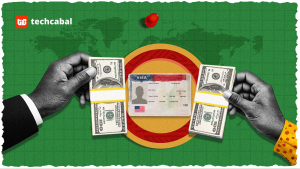
When the United States extended its $100,000 H-1B fee, experts predicted skilled foreign workers would simply pivot to alternative visas like the O-1 or student tracks. The reality? There was no workaround—just a systemic shutdown. In this episode of Digital Nomads, EMMANUEL NWOSU breaks down US State Department data revealing that non-immigrant visa issuances contracted by one million in just five months year-on-year, with H-1B entries plummeting 52%. For African talent, the door is slamming shut: continental visa entries were halved, while total US visas issued to Nigerians collapsed by an astounding 86.7%.
In our last Digital Nomads edition, we examined the US Department of Homeland Security’s (DHS) proposed $103,265 H-1B fee and what it could mean for the next generation of foreign workers trying to enter the United States.
Two critical developments have occurred since then. First, the public comment window for the DHS’ proposed policy closed on September 24. Second, US President Donald Trump extended the $100,000 H-1B fee by another year.
First introduced in September 2025 for a twelve-month duration, the surcharge will now remain active through September 2027, despite pending appeals court challenges.
The H-1B visa allows US employers to sponsor foreign professionals in specialised occupations, chiefly across technology, engineering, and advanced technical fields.
The $100,000 surcharge targets skilled professionals applying from abroad—a pathway heavily utilised by nationals of India, China, and Nigeria, all of which have ranked among the programme’s top ten beneficiary countries since at least 2024.
If enacted, the broader DHS proposal would extend the fee to all cap-subject H-1B petitions, including in-country workers adjusting their status. This dual-track strategy provides the administration with alternative legal avenues to restrict entry should one measure be struck down in court.
To evaluate how these policies have reshaped global talent flows, we analysed US Department of State immigration datasets spanning Fiscal Year (FY) 2023 through FY2026.
H-1B visa issuances plummeted 52% during the first five months of FY2026 (October 2025 to February 2026, the latest period for which data is available). Across all non-immigrant visa (NIV) categories, total issuances contracted by one million year-on-year over the same window. Across Africa, issuances were halved, while Nigeria—formerly the continent’s largest source of US visas—suffered an 86.7% collapse.
Initial expectations suggested that as the H-1B surcharge constrained offshore hiring, foreign talent would pivot toward alternative visa classifications. Instead, data from the current fiscal year reveals a systemic contraction—and in several countries, an outright collapse.
The H-1B cliff
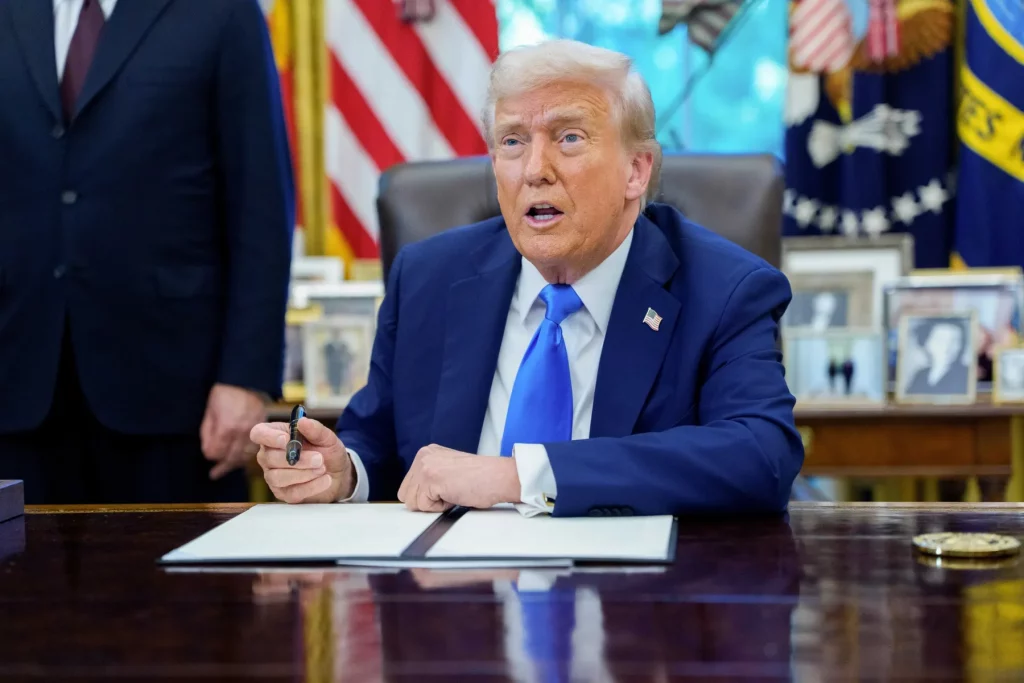
Trump signed the proclamation, mandating US employers to pay $100,000 to sponsor foreign talented employees on the H-1B visa. The administration’s rationale was to curb visa abuse, allowing companies to sponsor foreign talent they genuinely need, and freeing up jobs for US citizens.
In the five months that followed that order, the visa became a less familiar route for US immigration.
H-1B issuances fell from 115,164 recorded in October 2024 through February 2025 (FY2025) to 55,057 in the same five-month window of FY2026, a 52% drop.
Against FY2023’s comparable period, it was down 55%. The visa that built Silicon Valley’s engineering base had been halved in under a year.
India, which accounts for the majority of H-1B issuances globally, saw its numbers fall from 79,395 in the first five months of FY2025 to 30,593 in the same FY2026 window, declining by 61.5%.
January and February, the first full months after the fee took effect, show the scale of the change even more clearly. India’s H-1B issuances fell from 31,135 to 3,047 across those two months, a 90% collapse. China fell 29% over the same two-month comparison. Every other major sender fell, but nothing like India.
That gap reflects the structure of the H-1B market. India’s dominance is built partly on high-volume offshore hiring by IT services firms, which bring workers from India to the US for assignments with American clients. That is precisely the model that Trump’s $100,000 offshore fee was designed to curb.
This was not a substitution story
To determine whether foreign professionals were pivoting to alternative pathways, we tracked non-immigrant visa categories across employment, education, business, travel, and family migration.
The analysis evaluated B-1/B-2 visitor visas; F-1 student visas; J-1 exchange visas; L-1/L-2 intracompany transferee visas; O-1 extraordinary ability visas; E-1/E-2 treaty trader and investor visas; H-2A and H-2B seasonal worker visas; R-1 religious worker visas; P-class talent visas (P-1 through P-4) for athletes, artists, entertainers, and their dependents; North American Free Trade Agreement (NAFTA) and United States-Mexico-Canada Agreement (USMCA) TN visas for eligible Canadian and Mexican professionals working temporarily in the US; and H-4, F-2, and J-2 visas for the spouses and children of certain H, F, and J visa holders.
Across all monitored categories, only a single visa group recorded growth: E-1/E-2 treaty trader and investor visas edged up by 406 (from 22,225 to 22,631). By contrast, H-1B issuances dropped by 60,107.
If skilled workers were circumventing the H-1B surcharge via the O-1 extraordinary ability visa, the data fails to support that hypothesis; O-1 issuances declined 10.5% (from 8,911 to 7,971). Meanwhile, F-1 student visas dropped 44.7% (from 79,660 to 44,027), extending a multi-year contraction in academic vetting.
Other employment categories followed suit: J-1 exchange visas fell 10.8%, L-1/L-2 intracompany transferees dropped 14.6%, and H-4 dependent visas fell 54.8% in tandem with principal holders.
This Was Not a Substitution Story
Every US temporary-visa route, Oct–Feb, FY2025 vs FY2026. If skilled workers were rerouting around the H-1B fee, another category should have risen. Almost none did.
Each row is scaled to its own range, so bar length shows the size of that category’s swing, not its rank against the others — B1/B2 alone (2.2m issuances) dwarfs every other route.
In total, non-immigrant visa issuances contracted from 4.54 million to 3.50 million, representing one million fewer legal entries over five months. Notably, seasonal labour diverged sharply: uncapped H-2A agricultural visas rose 9.4%, whereas capped H-2B non-agricultural seasonal visas plummeted 75.6%.
The data confirms that foreign workers did not migrate to alternative visa classes. Instead, legal entry contracted across the board.
Africa, the continent being written out entirely
While African countries were never the dominant force in US immigration, the contraction made it seem worse. India and China together accounted for roughly 82% of H-1B approvals in FY2025.
The Visa Contraction
How US non-immigrant visa issuances moved, month by month and country by country, before and after the $100,000 H-1B fee.
Who fell furthest, Oct-Feb, FY2025 to FY2026
Across the visa categories we tracked, African countries received 168,078 US visas from October 2024 through February 2025. In the same five months of FY2026, that number fell to 84,485, a 50% decline.
Compared with the same period in FY2023, African visa issuances were down 58%.
Nigeria accounted for the biggest fall. From October 2024 through February 2025 (FY2025), Nigerians received 34,643 US visas across the tracked categories. A year later, the number was 4,595, declining by 86.7%.
The collapse was concentrated in B1/B2 business and tourism visas, which fell from 31,089 to 3,251, a 90% drop.
Nigeria had been Africa’s largest source of US visa issuances in FY2023, FY2024, and FY2025. In the first five months of FY2026, it ranked sixth, behind Morocco, South Africa, Egypt, Ghana, and Kenya.
The declines were not limited to Nigeria. Ethiopia’s issuances fell 72.6%, while Egypt’s fell 52.7%. Across Africa, F1 student visas fell 62.5%, from 8,294 to 3,110.
Morocco went the other way. Its B1/B2 issuances rose 60%, from 10,625 to 17,031. No other African country recorded a comparable increase. The issuance data does not explain why, although the clearance of a processing backlog at the Casablanca consulate is one possible explanation.
H-1B petitions have historically represented a small fraction of African migration to the US. Nigeria, the continent's top H-1B beneficiary, recorded 497 issuances in the first five months of FY2025, falling to 199 over the same period in FY2026. (While Nigeria recorded 2,423 total USCIS petition approvals in FY2025, consular issuances reflect physical passport stamps for workers entering from abroad, as opposed to in-country status adjustments).
The broader takeaway is that the migration barrier extends far beyond high-skilled technical visas. The sharpest drops have occurred in visitor and student visas—the primary avenues for African mobility.
The data points to an unambiguous reality: US immigration pathways for African professionals, students, and travellers have not merely shifted to other channels; they have contracted across almost every category simultaneously. While processing rates could fluctuate before FY2026 concludes in September, the current environment demonstrates that regions with lower historical visa volumes are absorbing severe proportional losses as structural barriers escalate.
True scale demands moving beyond surface-level integrations to robust execution. We’ve filtered the noise out of Moonshot 2026, optimising the conference strictly for high-calibre connections between startup founders, global financial operators, enterprise leaders and individuals rewiring Africa’s technical frameworks. Get 20% off Early Bird tickets for a limited time.