Over 100 million Africans live with a disability, yet local sign languages, speech accents, and street layouts are virtually absent from global AI models. JOHN ADOYI, in this feature, writes about the Hub for AI and Disability Inclusion (HAIDI) and the African Disability Data Network (ADDN): the new pan-African coalition building the data rails needed to fix AI’s disability desert.
When Francis Elendu, a secondary school teacher in Enugu, in southeastern Nigeria, wants to go out, he picks up his phone and his guide cane to aid his navigation.
“My guide cane is like the best tool for mobility,” he says. “I use some apps on my phone, like Envision AI and Seeing AI, to see things like poles and high objects on the road that my guide cane cannot detect.”
But the technology does not always understand the environment around him. Navigation apps can struggle with Nigerian streets and local context.
“I don’t know if when they were developing the apps, they considered some places that are not America or Europe because sometimes, these apps will be seeing things that are completely different,” Elendu says.
His experience points to a problem that extends beyond one person’s interaction with AI. More than 1 in 8 people across the 47 countries that make up the World Health Organisation (WHO) African Region have a significant disability, according to WHO’s 2022 Global Report on Health Equity for Persons with Disabilities.
A 2025 Artificial Intelligence for Development (AI4D)-commissioned scoping study, which examined Ghana, Kenya, and Rwanda and included research with more than 585 participants, found that persons with disabilities are underrepresented in datasets used to train AI systems, while existing disability data remains fragmented and poorly mapped.
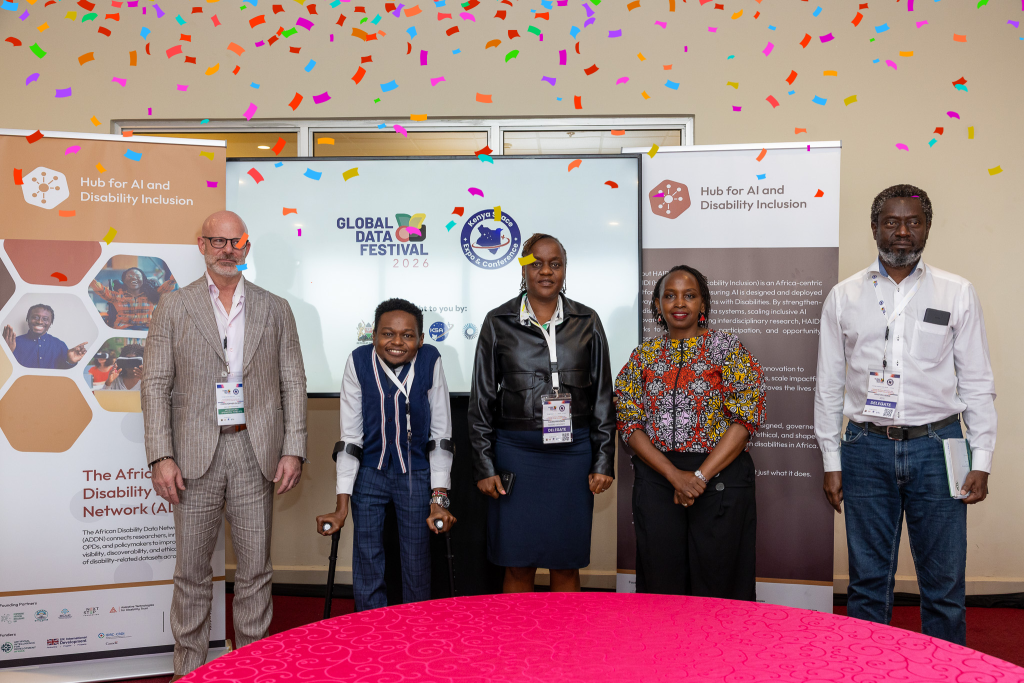
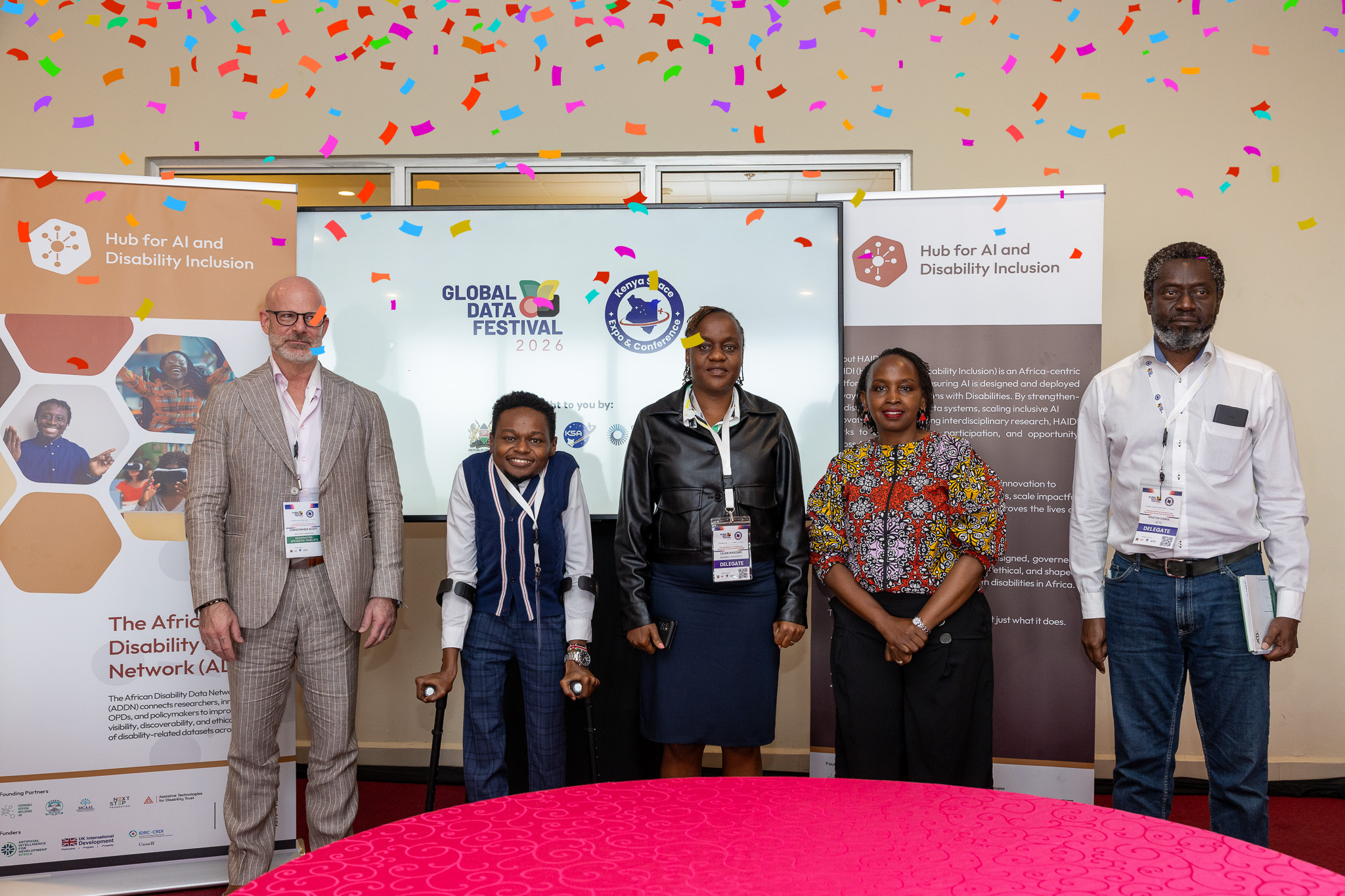
To address that gap, researchers and disability advocates have launched the Hub for AI and Disability Inclusion (HAIDI) and the African Disability Data Network (ADDN) to strengthen the data infrastructure for inclusive AI in Africa.
Backed by the International Development Research Centre (IDRC), the UK’s Foreign, Commonwealth and Development Office (FCDO) and the AI4D programme, the initiatives were unveiled at the Global Data Festival in Nairobi through a partnership involving the Responsible AI Lab (RAIL) at Ghana’s Kwame Nkrumah University of Science and Technology (KNUST), Next Step Foundation, Assistive Technologies for Disability Trust (AT4D), and Maseno University’s Centre for Applied AI (MCAAI).
“Every AI system begins with data,” said Christopher Harrison, Head of AI at Next Step Foundation. “The question is whether that data reflects the diversity of the people who will ultimately be affected by the technology. When persons with disabilities are missing from datasets, their experiences, needs and perspectives risk being overlooked in the systems built from them. Closing that gap is not simply a technical challenge; it is essential to building a more equitable digital future.”
Rather than building AI applications, the organisations behind HAIDI are focused on the data infrastructure needed for inclusive AI.
Laying the groundwork
Although launched together, HAIDI and ADDN serve different but complementary roles.
Hosted by the Responsible AI Lab (RAIL) at KNUST, HAIDI is the continental hub bringing together disability communities, researchers, innovators, policymakers, and institutions working to advance inclusive AI. Its work focuses on strengthening disability-centred data systems, supporting inclusive AI innovation, advancing research, and promoting ethical AI governance.
ADDN is one of the initiatives operating within that ecosystem. Rather than functioning as a central repository, it has been designed as a coordination and discovery network that helps researchers, startups, policymakers, and institutions identify disability-related datasets and connect with the organisations that manage them.
“ADDN is designed to make disability-related datasets more discoverable and easier to navigate rather than storing all the data in one place,” the consortium told TechCabal. “For startups and innovators, one of the biggest barriers to developing inclusive AI solutions is simply knowing what datasets already exist and who manages them.”
A researcher building an AI-powered sign language translation tool could use ADDN to determine whether a relevant dataset already exists, identify the institution that manages it, and request access directly from that organisation under its own governance and consent framework.
Instead of transferring ownership of sensitive disability data to a central platform, ADDN acts as a bridge between those who need data and those who already hold it, reducing duplication and encouraging collaboration across countries and institutions.
The hub itself will host open resources such as benchmarks, governance frameworks, and training materials that do not carry the same sensitivities as raw disability data.
Mapping Africa’s disability data
One of the initiative’s first objectives is to answer a basic question: What disability data already exists across Africa? The consortium admits it does not yet know.
The AI4D-commissioned scoping study found gaps in datasets for African sign languages and local languages. Kenyan Sign Language data, for example, is extremely limited compared with American Sign Language, while Kinyarwanda voice data involving speech impairments is almost non-existent in global datasets.
“That study is what surfaced the disability data desert,” the consortium said. “It told us the gap exists and why, but it was not a full inventory of every dataset out there. So no, we do not have a definitive count yet, and closing that gap is exactly what HAIDI’s research agenda is built to do next.”
That next step begins with a continent-wide inventory and mapping exercise, one of HAIDI’s priorities for its first year. Researchers will identify disability-related datasets across areas including sign language, speech and health, document where they are held, and determine where the biggest gaps exist across languages, disability types, geographies, and data modalities.
But finding existing datasets is only part of the problem. The consortium says inconsistent annotation formats can also make disability datasets difficult to combine or use for machine learning.
Alongside the mapping exercise, HAIDI will develop three Africa-focused datasets to address some of the gaps identified by the consortium. The first will focus on sign languages, the second on mental health and sexual and reproductive health, and the third on inclusive employment.
The consortium said the health dataset will initially involve participants aged 18 and older, with a target age range of 18 to 30. It may eventually include people aged 13 to 17, but only after parental consent arrangements are addressed. The consortium says the datasets will be developed with subject experts and disability communities, with personal data anonymised where possible.
Building trust into the data
Creating new disability datasets is only part of the challenge. Convincing people to contribute their data, particularly information that is deeply personal, requires strong safeguards around privacy, consent and governance.
The consortium says any activity involving persons with disabilities will undergo ethics review and receive approval from relevant institutional review boards and national regulatory bodies. It also says participants will provide informed consent, while personal information will be anonymised wherever possible and securely stored.
But anonymising the data does not necessarily eliminate privacy risks. Fola Adeleke, an AI governance and data protection expert, says de-identification does not always prevent people from being re-identified, depending on the type and scale of data collected.
“It depends on the scale of the data and the type of data you are collecting,” Adeleke said. “There are some metadata that you may not be able to completely anonymise.”
The consortium also says participants will have the right to withdraw their data. If someone withdraws, the data will be removed from the published dataset, but the consortium acknowledges that it would be difficult to remove data that has already been downloaded and used to build AI models.
For Adeleke, that makes consent particularly important.
“Once the data is used to train the AI, it may be technically difficult or impossible to withdraw that data without retraining the model,” he said. “So informed consent is crucial before the data is used.”
Those governance measures reflect a broader principle underpinning the initiative: persons with disabilities should not simply be sources of data but active participants in shaping how that data is collected and used.
Representation remains one of the initiative’s biggest challenges
HAIDI and ADDN say they are working with sign language innovators, disability organisations, and research institutions across multiple countries to make its datasets more representative. It also plans to collect gender-disaggregated data and increase the participation of women and girls with disabilities, who are often excluded from research because of social stigma and caregiving responsibilities.
The collaborative model is already beginning to take shape. The consortium says it is already engaging more than 80 founders developing sign language technologies through its Pan-African Sign Language Webinar series, building an early network of researchers and innovators working across different African sign languages rather than treating accessibility challenges as country-specific problems.
For Abdulazeez Hamdallah, a Lagos-based disability advocate with a hearing impairment, the need for better local data is apparent in the tools he already uses. He uses ChatGPT, the AI chatbot built by research company OpenAI, to write reports and messages, organise his ideas and prepare training materials, while relying on live conference apps Google Meet and Microsoft Teams for live captions and Otter.ai for meeting transcription.
But the tools do not always make communication easier. Hamdallah says those tools have poor support for sign language and can struggle with accents, fast speech, and background noise.
“I have been in meetings and places where I did not understand what was being said because the live captioning could not caption properly because of the person’s accent,” he says. “So, it can be very frustrating at times.”
That is one of the gaps the consortium’s planned sign-language dataset is intended to address. Hamdallah says the people whose experiences are being collected should also be involved in deciding how the data is gathered and managed.
“I think it is a very good and important initiative, especially if people with disabilities are directly involved in collecting and managing the data,” he says.
For Yinka Olaito, Executive Director of the Centre for Disability and Inclusion Africa, initiatives like HAIDI and ADDN arrive at a crucial moment.
“This is coming at the right time in Africa, where AI is becoming part of everything we do,” Olaito said. “It is important for us to think about AI through the lens of disability inclusion because otherwise we will continue to have discrimination around speech and other areas of disability, leaving people out of technologies that should benefit them.”
Describing the initiatives as “a good starting point,” Olaito said much more was needed to ensure Africa’s AI ecosystem did not replicate existing patterns of exclusion and that the launch should spark a wider conversation about the role of disability data in shaping the continent’s AI future.
“We are still grappling with challenges around digital accessibility, funding, and infrastructure, but that makes it even more important to ensure we take advantage of AI in a way that includes everyone,” he says.
From data to applications
The consortium also wants the data to translate into products. Alongside the launch of HAIDI and ADDN, it announced an 18-month support programme for three startups building AI solutions for persons with disabilities.
Selected startups will receive grants of up to KES 5 million ($38,600), technical and product support, opportunities to test their products with disability communities, and access to funding and partnership networks. The programme is open to startups working in areas including education, employment, mental health, caregiving, and assistive technology.
Over the next year, the consortium plans to establish HAIDI’s governance structures, complete its disability data inventory, develop the three flagship datasets, and assess how disability inclusion is reflected in national AI strategies across Africa.
The initiative’s impact will ultimately depend on whether researchers, governments, and developers can use the data to build AI systems that better reflect the lives of persons with disabilities.
“HAIDI and ADDN demonstrate the power of collaboration in driving inclusive innovation,” said Bernard Chiira, founder and chief executive officer of Assistive Technologies for Disability Trust (AT4D). “By bringing together disability communities, researchers, technology partners, and policymakers, we are creating the data and partnerships needed to build AI systems that work for everyone. This is an important step toward ensuring that persons with disabilities are not only represented in the future of AI, but are helping to shape it.”
True scale demands moving beyond surface-level integrations to robust execution. We’ve filtered the noise out of Moonshot 2026, optimising the conference strictly for high-calibre connections between startup founders, global financial operators, enterprise leaders and individuals rewiring Africa’s technical frameworks. Get 20% off Early Bird tickets for a limited time.