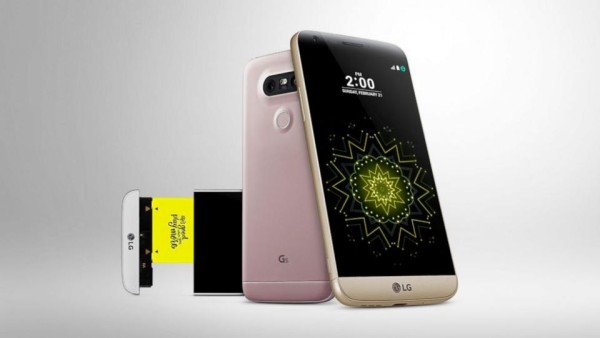
It’s a tough battle in the high-end smartphone space. With the forthcoming iPhone 7 and Galaxy S7 Edge, Apple and Samsung have tried to make the battle a binary, but at their Play Begins event at Mobile World Congress yesterday, LG unveiled their battleaxe – the G5.
And what a battleaxe it’s turned out to be. The G5 looks like it’s representative of the future of the smartphone as we know it – modular. The idea behind modular smartphones is simple: you have an endoskeleton, which holds the key components, and a number of user-replaceable modules. Anything from battery, to camera, to processor can be upgraded by the user without having to fiddle with a soldering iron.
Oh, and it’s not a new concept too. Since 2013, projects like Phonebloks, Google Project Ara (which was initially developed by Motorola Mobility), and Fairphone 2 have all toyed with the modular concept, but so far haven’t gained that much traction.
LG switched to a metal body with the G5, and it has an expansion slot, through which all the “Friends” (that’s what all the modular bits, and bespoke accessories are called) can be inserted and removed. A small key on the side of the G5 pops open the lower section. This lower section can then be pulled out, to insert the modules. So far, only 2 “Friends” have been unveiled.
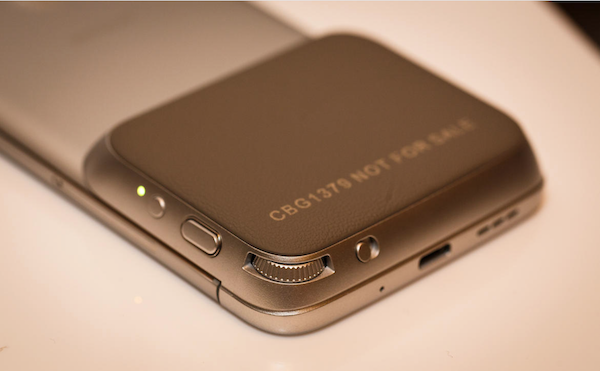
First, is the LG CAM Plus, a battery-camera hybrid, which has exposure lock, dedicated physical shutter and video recording buttons, an LED indicator and a jog dial to control zoom. It also gives the G5 additional 1200 mAh of juice, which should translate to 6-8 hours of real world use.
The second Friend is christened Hi-Fi Plus. This module was developed in collaboration with B&O Play, and it supports 32-bit, 384KHz HD audio playback (this is great news for audiophiles like myself). To give a sense of scale, a lot of the music we consume today is encoded at 128 – 256kbps, and played back at 24-bit, 44.1KHz.
At the heart of the G5, is a Qualcomm Snapdragon 820 processor, 32GB of internal storage (expandable via microSD), 4GB of RAM, a removable 2800 mAh juice pack, and a 5.3-inch Quad-HD display, with a pixel density of 554 ppi. All this spec-madness is put to use by Android 6.0 Marshmallow, it has an always-on display (for notifications) which doesn’t affect battery life.
As is rumored for iPhone 7, and a few other flagship smartphones, the LG G5 comes with 2 rear cameras, and one front camera. The rear cameras are a 16MP, 78-degree lens, and an 8MP, 135-degree lens to help take better landscape view pictures, while the front camera is 8MP.
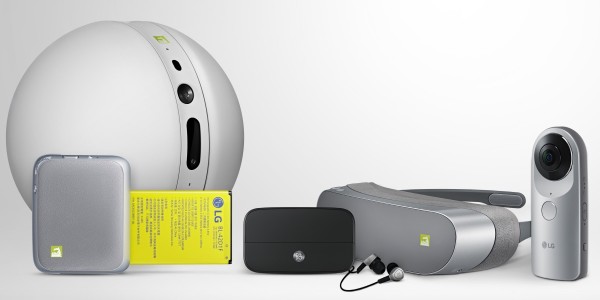
Of course, no high-end Android smartphone release in 2016 is complete without some VR talk, and LG hasn’t disappointed. They also unveiled the 360 VR, a lightweight virtual reality headset that connects to the G5 via a USB C connector, and 360 CAM, which as the name implies, will be used to shoot 360-degree content.
On paper, the G5 already looks like a major headliner for both MWC, and the year 2016 in mobile technology, and it will take a lot from Samsung and others to outshine it. I’m particularly enthused because it’s a step in the direction of modular phones. Who knows what modules manufacturers will develop for their mobile devices 4-5 or even 10 years from now?
The G5 will come in gold, silver, pink and grey, and while pricing isn’t available at the moment, it will be, by April, when the device launches.