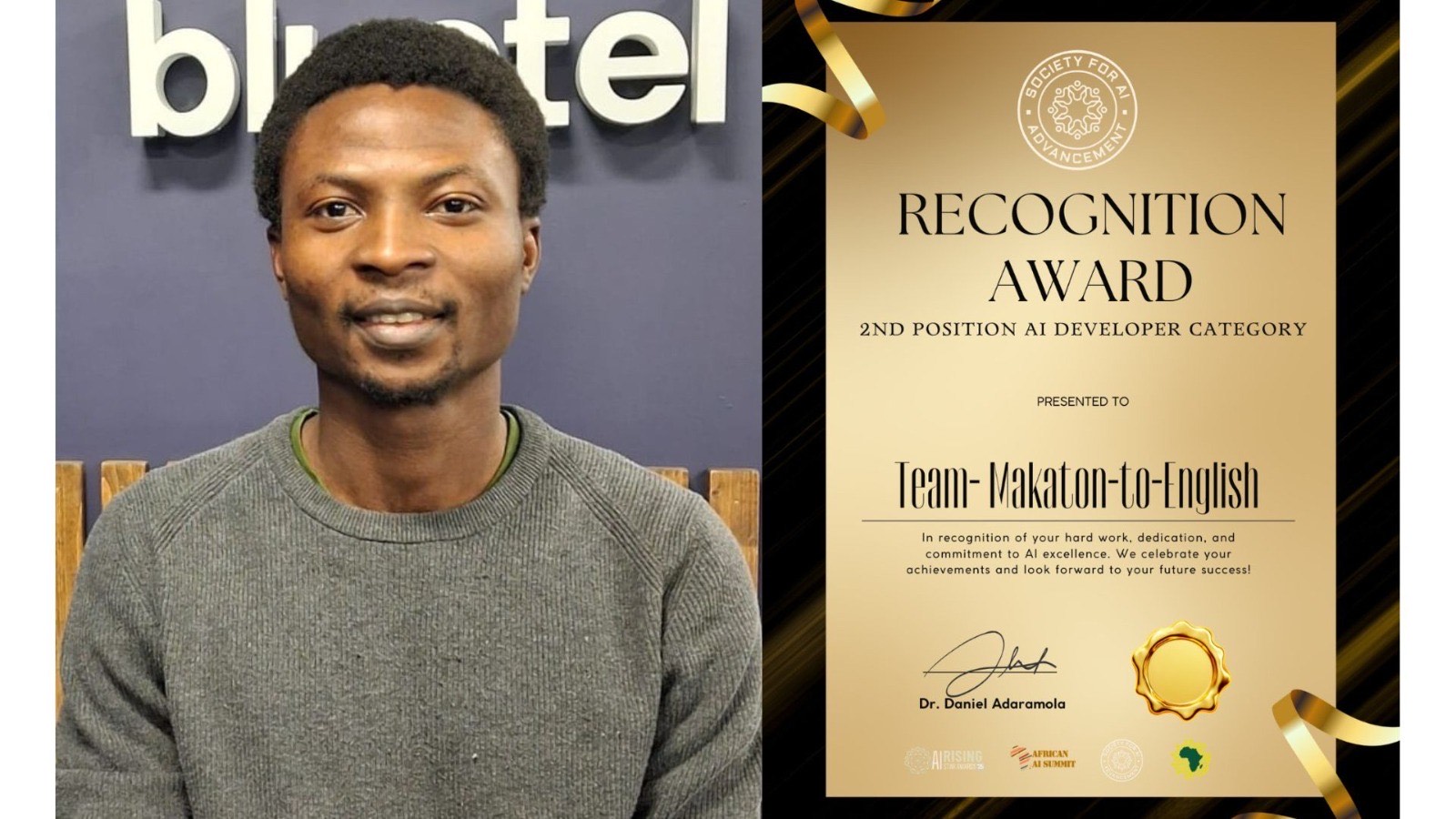
When the winners of the 2025 AI Rising Star Awards were announced, one project stood out for its heart as much as its technical ingenuity. Among more than a hundred African innovators, Omotayo Emmanuel Omoyemi’s Makaton to English translation system earned second place in the Solution Developers category, recognised for pushing the boundaries of inclusive artificial intelligence.
Giving voice to silence
In classrooms and communities, thousands of people rely on Makaton a communication system that combines signs, symbols, and speech to express themselves. Yet few technologies can interpret these gestures or integrate them into digital communication.
That gap inspired Omotayo to design a system that allows computers to understand Makaton in real time. Using Google’s MediaPipe for hand-landmark detection and a rule based AI classifier, the prototype recognises gestures such as hello, thank you, and please, translating them instantly into spoken or written English.
During pilot tests in a UK secondary school, the system achieved up to 95 percent accuracy with sub second response times. Teachers described it as intuitive, accessible, and a breakthrough for inclusive learning environments.
Innovation that connects people
The project’s impact lies not only in accuracy but also in accessibility. It runs entirely through a standard laptop webcam, with no need for specialised hardware. That makes it affordable for schools and families supporting children with communication challenges.
“I wanted to prove that accessibility shouldn’t depend on expensive devices,” Omotayo explains. “AI can and should work for everyone.”
The system was first introduced at the ICSIE 2024 (13th International Conference on Software and Information Engineering) held in Derby, United Kingdom, and later featured in the ACM Digital Library, where reviewers praised its potential for large scale classroom deployment.
An enhanced version of the prototype, incorporating improved recognition and classroom feedback, was subsequently presented at the UK Computational Intelligence Conference (UKCI 2025) in Edinburgh, where it further demonstrated the system’s feasibility for real world educational use.
A rigorous and prestigious competition
The AI Rising Star Awards brought together Africa’s most promising innovators in artificial intelligence, evaluated by a distinguished panel of global experts spanning cybersecurity, AI governance, digital transformation, and business innovation.
Judges included internationally recognized leaders from CIOs and AI researchers in the UK and UAE to top African cybersecurity executives and innovation strategists many of whom advise the African Union, Global Forum on Cyber Expertise, and multinational enterprises.
Each submission underwent a multi-stage assessment covering technical performance, scalability, social impact, and ethical AI design.
Earning second place in the Solution Developers category placed Omotayo among the top ranked innovators across the continent, standing out for the project’s real-world feasibility, research depth, and social relevance.
“Knowing that our work was evaluated by experts who shape AI policy and infrastructure across continents made the recognition even more meaningful,” Omotayo says. “It wasn’t just about innovation it was about impact, responsibility, and inclusion.”
Beyond the award
Building on the Makaton project, Omotayo has begun developing AURA (Adaptive Understanding and Relearning Assistant) an AI therapy platform for individuals with Apraxia of Speech, a condition that disrupts speech planning and coordination. AURA merges speech recognition, error detection, and gesture based interaction to create adaptive therapy experiences.
Both projects share a single mission: to make AI listen and respond to those who communicate differently.
Looking ahead
As Africa’s AI ecosystem grows, innovations like this demonstrate that the continent’s research is not only catching up but reshaping the conversation around inclusive technology.
“Recognition at the AI Rising Star Awards shows that socially responsible AI can thrive in Africa,” says Omotayo. “My goal is to keep building systems that translate empathy into code.”