The year is 2017, and Aisha Owolabi is in between Chemistry experiments with her coursemate, Ifeoma Amadi, at the University of Lagos.
She doesn’t know it yet, but that conversation would begin a different kind of experiment that has nothing to do with chemistry. One that would become an almost decade-long career in content and marketing, making her find a home on three continents.
The lab experiment that failed successfully
“I was in my second year in uni, in the lab, because I was studying Pure and Applied Chemistry,” Owolabi recalled. “I remember [Ifeoma Amadi and I] were doing these experiments, and she started telling me how she was feeling stressed from work with her clients. And I was like, ‘What are you talking about?’”
Along with being a student, Amadi had worked as a social media manager. The conversation made Owolabi aware for the first time that there was a different use case for social media, beyond just building personal connections.
That night, after a deep internet search on social media, she enrolled in a digital marketing course.
During this time, the Google Garage, which had several beginner courses for digital skills, became her best friend. Learning in theory was one thing. And Owolabi realised that she needed to practice what she was learning.
“My sister was running an event planning business at the time, and I took over her business’s social media and started working at no cost,” she said. “That was the very first project in my portfolio.”
By the time Owolabi was done with her first course that year, she crafted her resume and started seeking internships at digital marketing agencies. In one internship with a digital marketing agency, she recalled earning ₦20,000 ($14.07)* monthly, with ₦19,800 ($13.93) covering her transportation expenses.
“So I was making ₦200 ($0.14) a month in the end.” She said, “But I really wanted the experience. This was the only agency that would take me [because] I was still in school.”
As she transitioned through a couple more internships, her weeks became split between navigating periodic tables at school and working on content and marketing for clients on other days.
After she graduated from university, Owolabi joined She Leads Africa (SLA), a platform that empowers African women through online and educational content, in January 2019, which she defines as an opportunity that placed a strong emphasis on content.
“Everything we did was built on content more than social media as a platform,” she said. “So I started to get closer to the world of content. That switch happened from thinking of myself as a social media manager to thinking of myself as a content expert, storyteller, or content strategist.”
But there was one more move that shifted everything.
Meet Aisha from Carbon, who made moves at Wizeline
After transitioning out of SLA, Owolabi started a career in product at Carbon, a neobank, which she joined only a week before its rebranding in April 2019.
“I joined a company that was pioneering an industry and building a new category in Nigeria,” she said, “ Nigeria had never seen digital banking before Carbon. And I joined the company seven days before its rebrand from PayLater (a loan provider) to Carbon.”
Where banks would communicate in a precise and robotic tone, Owolabi set out to make the voice of banking more human.
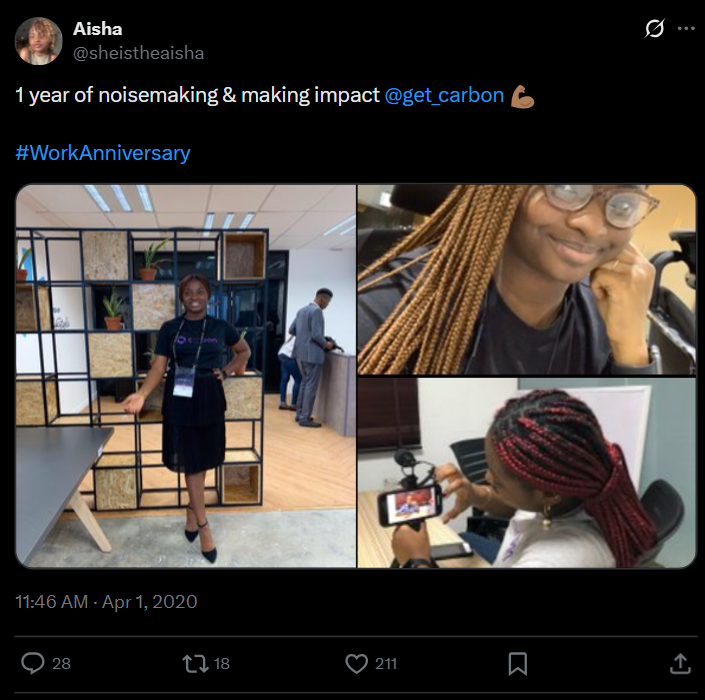
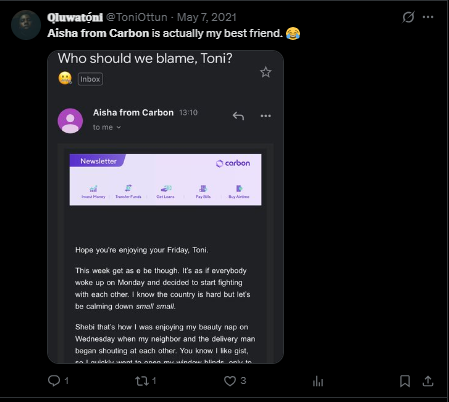
She leveraged the neobank’s largest channel, newsletters, humanising fintech for Nigerians across the board with emails by ‘Aisha from Carbon’.
”You would receive an email from GTBank at the time, and it was always the same: ‘Dear customer,’” Owolabi said. “Banks weren’t trying to be your friend–it just wasn’t a thing. So we were the first brand in that space that was trying to do something different and connect that audience in that way. And it worked.”
Until the pandemic hit, Carbon, a fintech that offered loan services, was hit too. “Many people couldn’t pay back their loans,” she shared.
Senior roles took a pay cut, and Owolabi was affected. It was a struggle for the content marketer.
However, the pandemic presented a unique opportunity for remote work. Having a flatmate who successfully earned in dollars, Owolabi realised she could grow her earnings and a career across borders.
She started to apply for roles with multinational companies, and after 8 months of job hunting and rejections, Owolabi secured a contract role with Wizeline, where she led content and marketing across regions. Wizeline partnered with Fortune 500 companies and major startups, including Google, Netflix, and Etsy, to handle the complex technology projects that they did not want to burden their internal teams with.
The opportunity, while it grew her earnings over tenfold, coincided with the EndSARS protest, a social movement against police brutality in Nigeria, which Owolabi recalls as a distressing period. It was then that the restlessness to change her environment began to creep in.
Owolabi spoke with her manager at Wizeline, Saraí Castañeda, to pursue relocation to Mexico, where the team was based. Even though Owolabi was a contractor, Castaneda facilitated the conversation with the Talent team, and by December 2020, three months into her role, Wizeline offered Owolabi a relocation to its Mexico office.
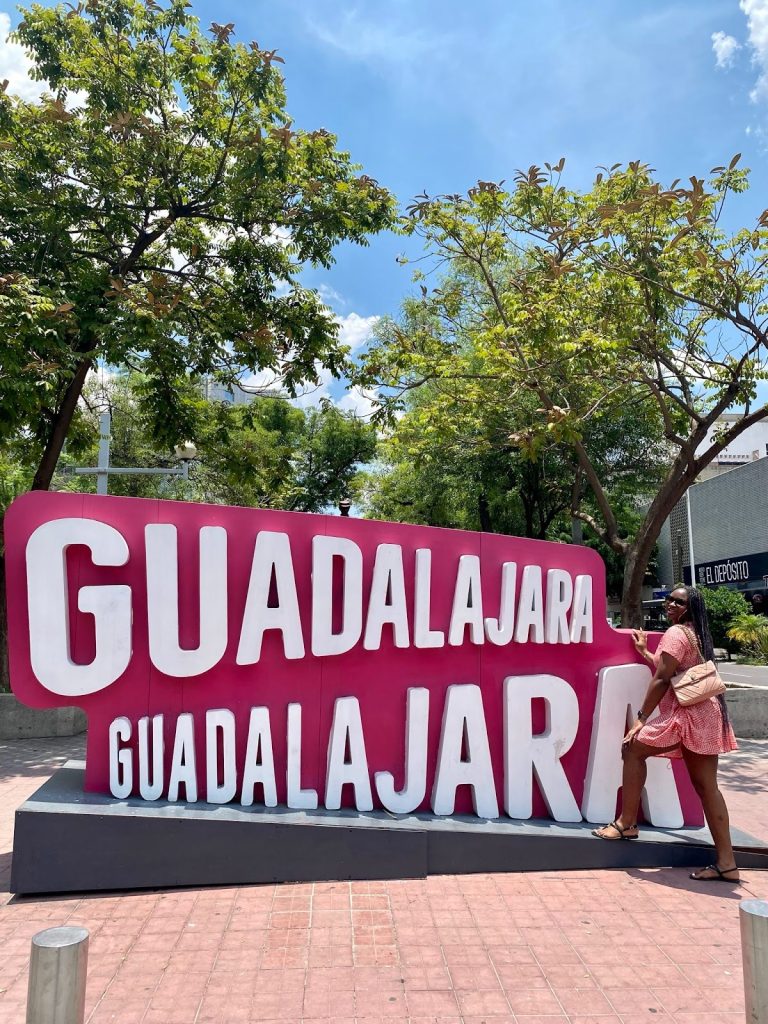
Roughly six months later, she was on a plane out of Nigeria into the cultural heart of Mexico: Guadalajara.
The green passport trade-offs
Transitioning into a global firm as the “first Nigerian” among 2,000 employees was a new experience, but Owolabi learned to navigate the twists and turns.
To get the visa and the residency, she transitioned from a USD-paying contract to a full-time role that paid in Mexican Pesos. It was a significant cut from her USD salary.
The gain? A full-time role with Wizeline, which provided health insurance, legal residency, and a physical office in Guadalajara. Settling into a new country came with its own differences, language being one. While the company didn’t mandate its workers to understand Spanish, she needed to know the language to ‘do life.’
Before her move, Owolabi had the choice between Mexico City and Guadalajara. She considered the feel of both cities; Mexico City captured the electric frenzy of Lagos, Nigeria, where she lived. Or Guadalajara, with a slower pace of life.
“But you know, what influenced my decision?” Owolabi asked, “I looked at the marketing team and who was where.”
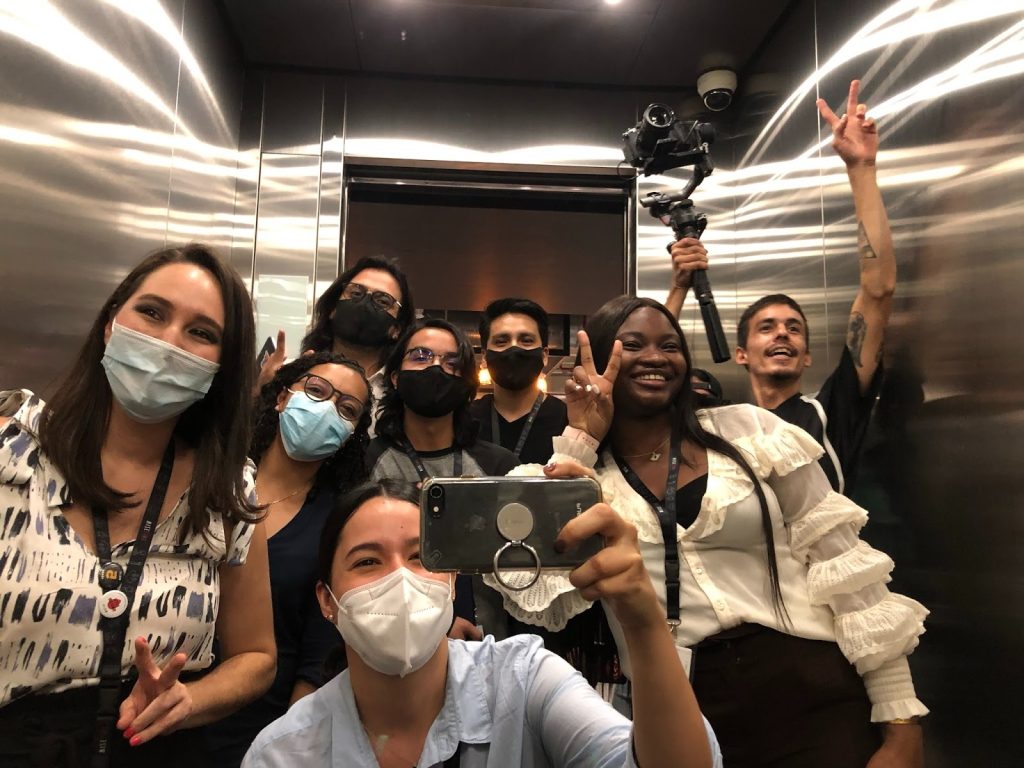
Most of Owolabi’s colleagues in Mexico City were more established. They comprised mothers who had families and Wizeline’s older colleagues. The closest friend Owolabi had made on the team while working remotely was Leslie, who lived in Guadalajara.
“She [was] the only young person on the team,” she said. “ [So, I asked] which friends am I going to make? I moved to Guadalajara, because that’s where I know at least one person. That was how I made my choice, and what a wonderful, wonderful decision.”
Becoming a global talent
In December 2021, a trip to the United Kingdom changed everything. A few of her friends had already relocated to the UK, and one friend, Peace Itimi, nudged her to apply for the Global Talent Visa by TechNation, which allows top tech talent to contribute to the UK tech ecosystem without being attached to a company or role.
Owolabi was unsure if a career path like hers in content might be considered a “technical” enough contribution to the tech ecosystem. TechNation’s Global Talent Visa distinguishes between two categories: Exceptional Talent for established leaders with over five years of experience, and Exceptional Promise for emerging talent.
Owolabi set aside her fears and started preparing her application, targeting the ‘exceptional promise’ category of the Visa. By January 2022, she turned in her application.
Within a month, she received her rejection letter. But Owolabi was not convinced. She appealed to TechNation, reframing her entire career story around the value and impact of her storytelling (like the “Aisha from Carbon” era), which she successfully championed.
By the morning of March 7, 2022, Owolabi received a pleasant surprise on her birthday: an endorsement by TechNation for the Global Talent Visa.
After her Global Talent Visa endorsement, Owolabi transitioned out of her role at Wizeline. By the time she was moving to the U.K, she had an offer for a senior content marketing manager role at hyperexponential, a company building pricing software for speciality and company insurance, where she worked for a year before starting the same role at a global AI company, Photoroom.

In the past three years at Photoroom, Owolabi has run its global content strategy, built the Photoroom blog and story program from the ground up and led a brand activation in the heart of London.
When she spoke to TechCabal, she was in a booth at the Photoroom office in Paris, where she was preparing towards a thought leadership report launch.
“I still live in the UK,” she clarified. “But again, one of the beautiful benefits of the Global Talent Visa is that you can work for a company literally anywhere in the world.”
She jokes that home is where she pays rent, which is currently the UK. And while it is home in the meantime, her curiosity will certainly lead her elsewhere.
Leading a career in the content space, Owolabi confessed that living across borders has enriched her creative output with storytelling and content.
Moving to Mexico was a big culture shift, which allowed her work with people from brand-new cultures, but also learn how to tailor her communication for people from other cultures.
Within teams, she is clear on the importance of diversity: “You cannot build a diverse product without having a diverse team.” Over time, she stopped thinking about working with only a Nigerian audience in mind to thinking about how her content can serve people everywhere.

For Owolabi, being a Nigerian with all the experiences she has acquired has positioned her to bring a different perspective to the table wherever she is.
She recognised that her open-mindedness has been a massive contributor to her global career.
“I’m open to new experiences and to contributing, but also allowing the job and the experience to transform me—it’s not just about what you’re bringing,” she said. “ You’re also taking and absorbing, and you know, I think now I just embody the global mindset as a person.”
*Exchange rate at $1 = ₦1421.06, as of January 24, 2026
Editor’s note: This article has been updated to correct the spelling of hyperexponential and to clarify the timeline around Owolabi’s relocation to the U.K. and subsequent roles.