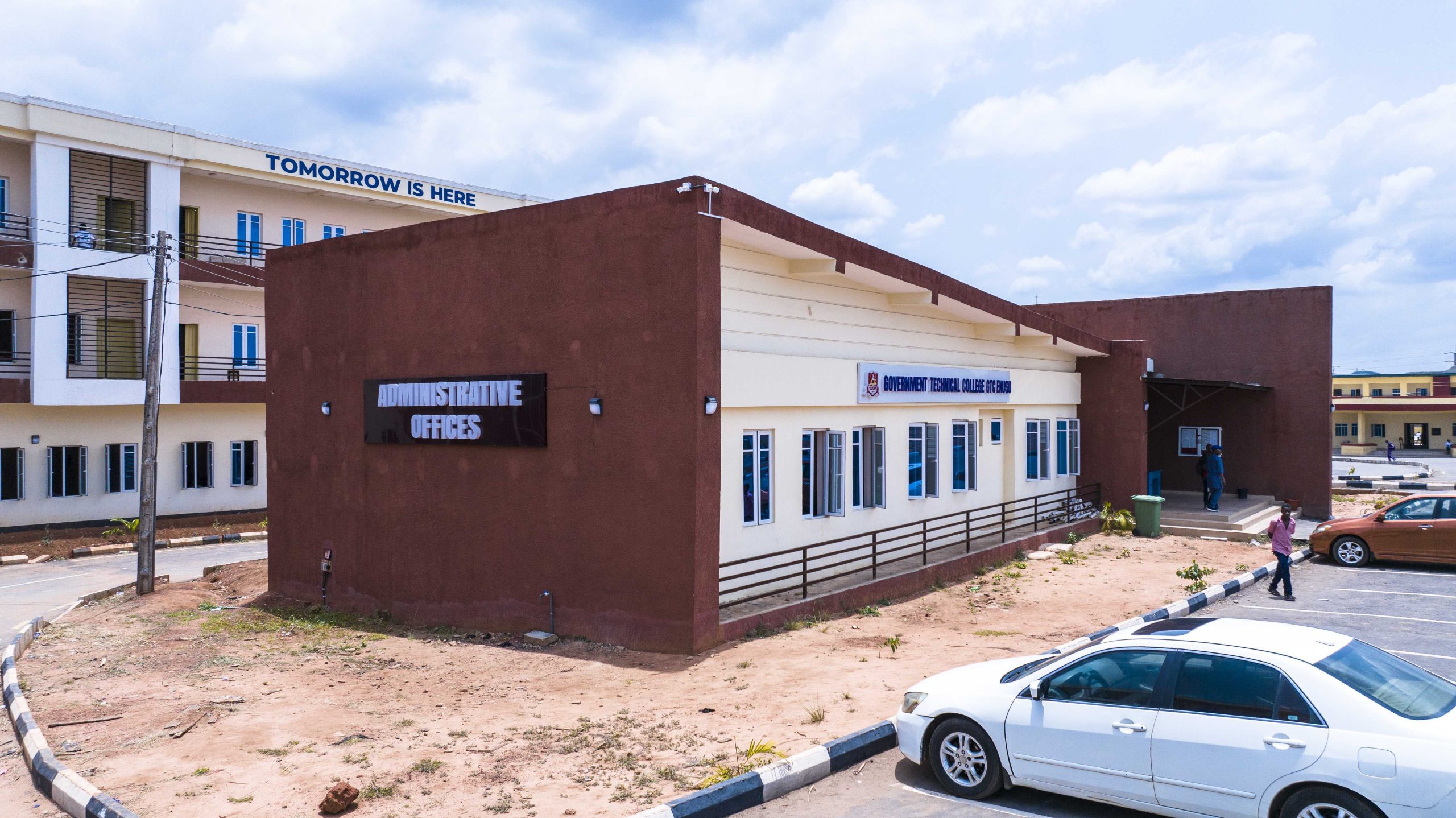
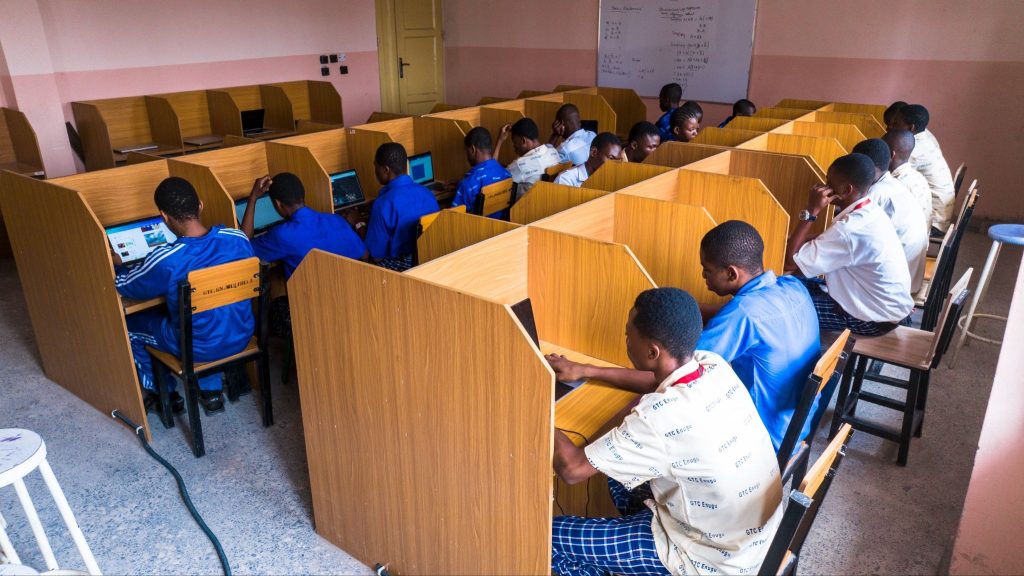
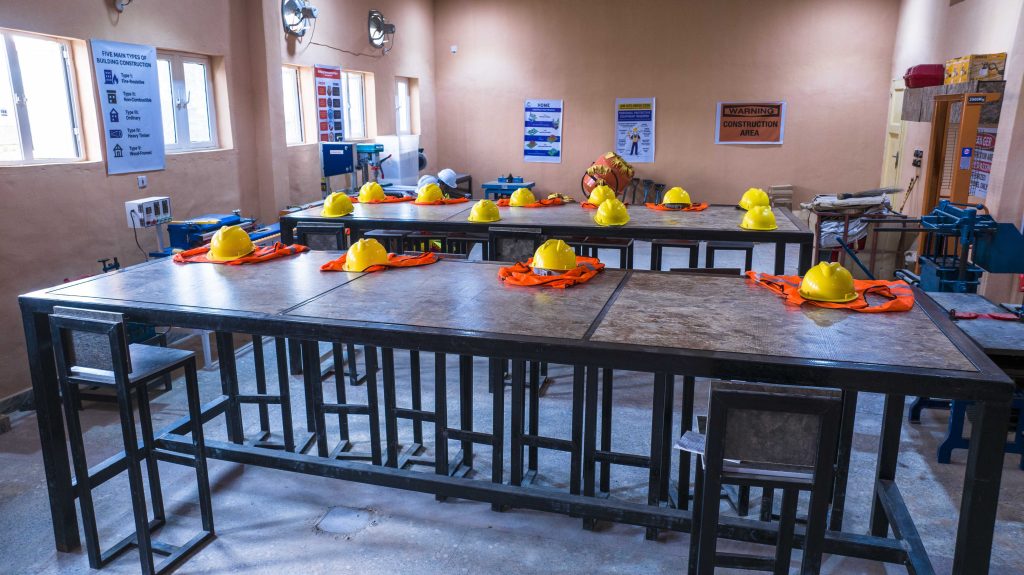
On the outskirts of Enugu city in Southeastern Nigeria, the state government is developing new schools in communities where classrooms have long faced challenges such as inadequate infrastructure and outdated curricula. The buildings are clean-lined and modern, fitted with interactive boards, science labs, digital libraries, and innovation studios.
In some, children who once hawked goods in markets now sit behind desks, tapping through lessons on computer screens.
The state government says it wants to build 260 smart schools, one in each ward, one of the most ambitious public education reforms in Nigeria today, aimed at improving classrooms and restructuring key elements of the system. That intent is backed by money: 32.27% of the state’s 2026 budget has been earmarked for education, the highest allocation by any Nigerian state.
But behind that promise is a tougher reality: decades of systemic failure in public education still weigh on infrastructure, technology, and political will.
A system in crisis
Before the introduction of smart schools, the problems were stark. According to Chinyere Onyeisi, Special Adviser to the Governor on Education Innovation, the state uncovered a deep “learning crisis” when it began assessing its public schools.
“Three out of four children in our public schools have foundational literacy problems,” she told TechCabal on Wednesday during a tour of one of the pilot smart schools at Owo in Nkanu East Local Government Area. “When they don’t have a good foundation, they continue to struggle all the way to secondary school.”
The dysfunction went far beyond weak reading skills. Students were routinely promoted regardless of competence, many carrying fractured academic histories—switching schools, dropping out intermittently, or landing in classes far above their level, according to Onyeisi. Teachers, wary of losing enrolment, often passed them on rather than insist they repeat a class, deepening the gaps with each step forward.
In 2023, Enugu had an 89.46% literacy rate with the number of out-of-school children at 7.5%, ranking among the lowest 10 states in Nigeria. The reality was different.
In one early assessment, Onyeisi said she and her team conducted in 2024, the scale of the problem became “undeniable.”
“In a class of 40, only seven students could read,” she recalled. “The remaining 33 could not read, could not write properly, could not even spell simple words.”
She also noted that English comprehension was a barrier. Many students had been taught primarily in local dialects and struggled to follow lessons delivered in English. Others exhibited behavioural challenges—bullying, restlessness, disengagement—symptoms of a system that had long failed to hold their attention.
“It was clear to us that nothing had been happening in many of the schools,” she said bluntly. “I’m not exaggerating because I saw it.”
Building from the margins
Rather than begin the smart school projects in urban centres like Enugu City metropolis, Nike or Nsukka, the state started its smart school rollout in rural communities, places where the system was weakest.
“If it works in the village, it will work anywhere,” Onyeisi explained.
Each smart school, she further noted, is designed as an integrated campus, combining early childhood, primary, and junior secondary education. Some merge as many as six previously under-resourced schools into one facility, bringing together hundreds of students under a single system.
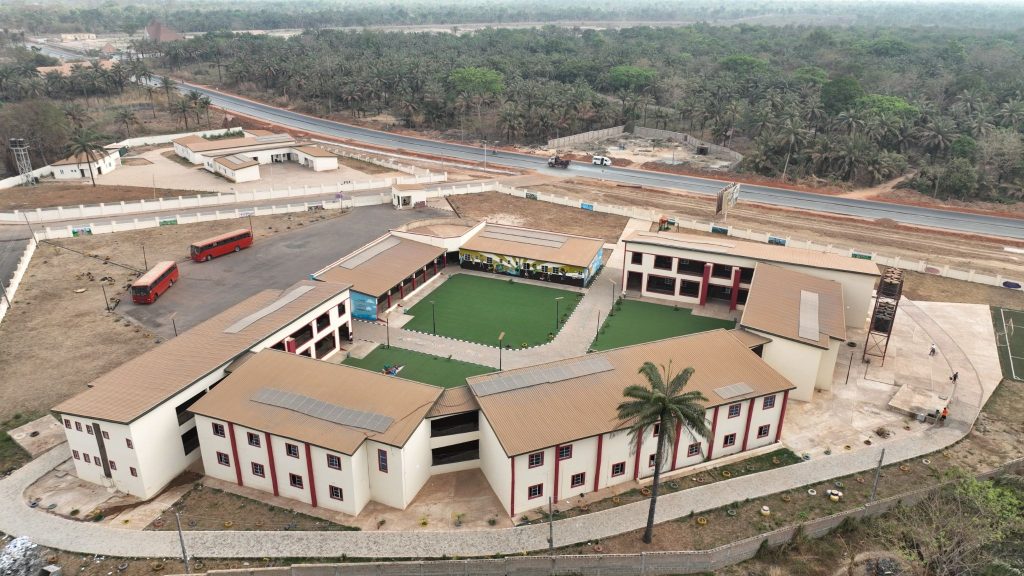
The infrastructure includes classrooms equipped with interactive boards, science labs segmented into physics, chemistry, and biology stations, and innovation studios where students explore robotics, coding, and artificial intelligence (AI).
But the model goes beyond hardware. It also includes free uniforms, books, and daily meals, an effort to remove the economic barriers that keep children out of school. The Enugu State Government disclosed that it earmarked ₦30 billion ($21.7 million) in its 2026 budget estimates to provide daily meals for about 260,000 pupils in the 260 Smart Green Schools built across the state.
“You see a child on the street, you can now ask: What are you doing here?” Onyeisi said. “Because now you have smart schools, they are free, they provide food, uniforms, books—there’s no excuse not to be in school.”
That combination of incentives is aimed at tackling Enugu’s out-of-school crisis, long visible in markets where children of school age work during class hours.
Rewiring how children learn
Perhaps the most significant shift is not in infrastructure, but in how students are taught. For decades, Nigeria’s public education system has relied on rote memorisation, ability to recall information verbatim. The result is that students learn content for exams and often forget it soon after.
The new Basic Education Curriculum for the 2025/2026 session aims to change that. It prioritises critical thinking, problem-solving, and digital literacy as core pillars, replacing memorisation with applied learning. Government reform documents acknowledge that the previous curriculum was overloaded and outdated, forcing teachers to rush through topics and reinforcing exam-driven learning.
The smart schools are trying to break that cycle through experiential learning or “learning by doing.”
“We moved away from the conventional lecture method,” Onyeisi said. “Everything the student learns, they must engage with it practically.”
In practice, this means lessons are tied to real-world contexts. Onyeisi noted that a topic like drug abuse, for instance, is no longer taught as an abstract concept. Teachers use videos, case studies, and discussions to connect it to lived experiences.
Interactive boards replace chalkboards, turning lessons into multimedia experiences. Students watch, listen, question, and respond.
The curriculum itself has also been updated, according to Onyeisi. While still aligned with Nigeria’s national standards, it incorporates new subjects such as robotics, coding, AI, and mechatronics, a multidisciplinary field of engineering that acts as the “connective tissue” between mechanical systems, electronics, and computer software. It was introduced from the upper primary levels.
In one school’s “smart farm,” students plant crops, track growth, and record data, blending agriculture with science and mathematics.
“They count seeds before planting, monitor germination, and record observations,” Onyeisi said. “They are learning data collection without even knowing it.”
The difficult work of catching up
The transition, however, has not been smooth, she noted. When the first smart schools opened in September 2025, many students arrived with severe learning gaps.
“It was a shock,” Onyeisi admitted. “But it showed us the reality.”
Rather than push ahead with the curriculum, the state paused and implemented intensive intervention programmes. Teachers were retrained in phonics, handwriting, and foundational literacy techniques.
“We told them: forget covering the syllabus. Let’s fix the foundation first,” said Onyeisi.
For three weeks, classes focused almost entirely on reading and writing basics: letter sounds, simple words, and handwriting drills. Students who lagged were separated for additional support, she noted.
“We saw improvement,” she said. “Students began to understand more. They became more engaged.”
Even so, the challenge remains ongoing. Rebuilding foundational skills across thousands of students is a long-term effort, not a quick fix.
There is also a challenge of maintaining the facilities, which are starting to show signs of wear and tear, including removed ceiling boards, rusty staircases, and peeling floors.
“We have a plan to make maintenance regular and sustainable, so we are speaking to some people who would start work on the facilities before the school break is over,” Onyeisi said.
Technology as the backbone and bet
To ensure a sustainable supply of technology, the state has partnered with a subsidiary of the Haier Group, a Chinese electronics company, to supply and assemble the technology powering the smart schools. Haier operates through its subsidiary Hiatech Enugu, led locally by Uche Chime.
“All the ICT products you see here—the interactive screens, laptops, desktops—are assembled here in Enugu,” Chime told TechCabal during a visit to the assembly plant.
So far, the company claims to have delivered 30,000 all-in-one desktop units to the state government, with thousands more devices planned, including tablets for students.
“The governor said he wants every child in a smart school to have access to a tablet,” Chime explained. “You can imagine that’s the kind of thing you see in the Western world.”
Students from Primary 4 to 6 would be allowed to use the tablets only in school, while the students in Junior Secondary 1 to 3 can take the tablets home, according to Abasiekeme Umana, an aide to the Governor of Enugu State, Peter Mbah.
The project, Hiatech stated, extends beyond education. Hiatech is also planning renewable energy facilities, including solar panel assembly and battery production, to support the infrastructure powering the schools.
“We are looking at injecting over $30 million into renewable energy,” Chime said. “Lithium batteries, inverters, solar panels—these are all part of the plan.”
The goal is to localise production, reduce costs, and create jobs. “When we can source materials locally, we make products more affordable,” he added. “And we create employment for the state.”
Early signs of transformation
In classrooms, there are glimpses of change.
Onyeisi recounts taking a group of primary school students to a radio programme. When asked what she wanted to become, one 12-year-old girl gave an unexpected answer.
“She said she wanted to be a farmer,” Onyeisi recalled. “Not just any farmer—she talked about large-scale farming, creating jobs, ensuring food security.”
It was not just the answer, but the reasoning behind it that stood out for Onyeisi.
“These are the kind of children we are now seeing,” she said. “They are thinking differently.”
Juliet Okeyeze, head teacher at Enugu Smart Green School, recalled a student who is shy and struggles to speak in class but excels in robotics, building and programming devices with ease. In a traditional system, such a student might be overlooked. Here, the goal is to recognise and nurture different forms of intelligence.
“Our assessment is not just based on English or writing,” said Okeyeze. It’s also about what you can do with your hands.”
The sustainability question
Yet for all its promise, the smart school initiative carries real risks.
The first is scale. Building 260 schools is ambitious; maintaining them can be harder. Technology needs constant updates, steady electricity, and ongoing technical support—areas where public projects in Nigeria often stumble. Early warning signs are already emerging, with critics questioning the quality of some facilities after images surfaced online.
“We see those videos, and each time we reach out to the local government where the projects are located to find out what happened,” Umana said. “Monitoring all the projects in 260 wards may not be very easy.”
Power infrastructure remains another pressure point. The state needs 200 megawatts of electricity to be self-sufficient. It currently receives approximately 70 megawatts (MW) of power from the national grid, with plans to generate 1000MW from its coal deposits. In the meantime, these developmental projects have to rely on renewable energy sources.
Flagship sites like the Enugu Smart Green School in Owo and the Government Technical College on Abakaliki Road, GRA Enugu, are currently powered by 16-tubular-battery solar systems, with plans to transition to longer-lasting lithium batteries. This underscores the complexity of sustaining these systems.
The second risk is teacher capacity. Retraining programmes are underway, according to Onyeisi, but reshaping teaching culture across hundreds of schools is a long, uneven process—one that could take years to take hold fully.
The third risk is funding. The model—free meals, learning materials, and embedded technology—is capital-intensive, raising questions about its long-term sustainability, especially in a volatile economic climate. While the state has embraced a fully digital governance system, bureaucratic bottlenecks still slow access to funding, making rapid execution difficult. As a result, the rollout has been structured in phases.
Even Chime acknowledges that constraint. “You cannot do everything at once,” he said. “It has to be done step by step.”
Whether Enugu succeeds will depend not on the scale of its ambition, but on the discipline of its follow-through.