For many Nigerians, a banking app does not earn loyalty by looking sleek. It’s judged by how reliably it works when money is on the line.
Mobile app bank users usually range from: traders managing daily cash flow, small business owners juggling payments, and young professionals who expect transfers to go through instantly, every time.
These are the users Dash Microfinance Bank targets, and they have zero patience for frictions in mobile app interactions.
The microfinance bank’s bold claims are pitched around: open an account in under three minutes with your BVN, send money instantly, buy airtime and data, pay bills, access an Afrigo debit card, run business POS collections with same-day settlement, and grow your savings from the same app.
By integrating robust Corporate Internet Banking with seamless POS hardware, the bank seeks to provide business owners with the tools necessary to manage liquidity, track real-time transactions, and scale operations without the traditional bottlenecks associated with retail banking.
This is a serious promise, especially for a microfinance bank trying to serve people who need digital banking to feel practical rather than performative.
Dash frames itself as “a modern way of banking,” with a vision centred on accessible, secure services and financial inclusion. This is not an app trying to impress fintech enthusiasts; it is trying to become part of the everyday money movement.
The Microfinance bank enters this space with a familiar but ambitious promise: open an account in under three minutes using just your BVN, send money without failure, pay bills seamlessly, and manage savings; all from a clean, mobile-first interface.
But in Nigeria’s market, where nearly every fintech claims speed and simplicity, does Dash Microfinance Bank actually reduce the everyday friction Nigerians experience with digital banking?
Here’s what we found:
First impressions: a bank app that starts with speed
The “3-minute account” promise
Dash positions itself as a near-instant banking solution: sign up with your BVN and get started in under three minutes.
This is aligned with how modern Nigerian fintech onboarding works: BVN-driven identity verification, minimal manual input, and quick account provisioning. And on the surface, Dash follows that playbook well from our testing.
Also, from available indicators (app positioning and user expectations), the process is streamlined and achievable under ideal conditions, but like most apps in this category, it’s unlikely to be consistent under three minutes for all users, especially under poor connectivity.
Our Take: The mobile app is fast and well-designed for speed and onboarding. The “3 minutes” is achievable, but not consistently guaranteed, owing to the variability in the network conditions.
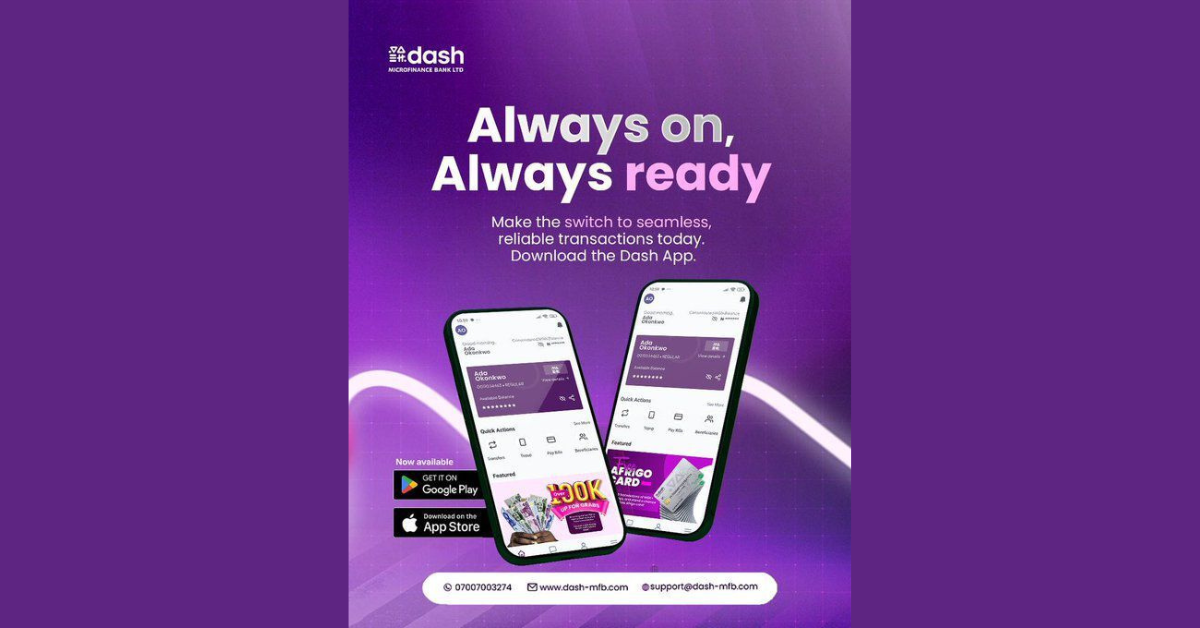
UI/UX Design: Clean, but is it intuitive for everyone?
Dash leans toward a clean, minimal interface, which is the right direction for a microfinance product targeting digitally savvy users, traders and everyday earners with varying levels of digital literacy.
The layout is function-first rather than design-heavy, which is a strength.
The design prioritises core actions (send, pay, save) and reduces visual noise. The labels are clear enough, and a first-time user can navigate the app without much guidance
Our Take: The mobile app is clean and usable across user segments if there is consistency across all screens.
From both the “3-minute” narrative and the UI/UX design, Dash has removed the friction that many banking apps still add.
Core transactions: where the real test begins
Transfer Reliability: The “100% Success Rate” Claim
Dash’s claim of a “100% success rate” on instant transfers is bold. In Nigeria’s financial ecosystem, no app operates in isolation. Transfers rely on: NIBSS infrastructure dependencies, network downtimes and receiving bank issues.
We found out that Dash has an optimised internal system which ensures its transfers are processed quickly. The transactions were stable with no delays.
Bills & airtime: The everyday use case
If onboarding is the first impression, bill payments and airtime purchases are what determine whether users stay.
Dash includes the expected essentials: airtime top-ups, data subscriptions and utility bill payments. With its speed of transaction completion and simplicity of flow (fewer taps to complete bill payment), this feature proves that the microfinance mobile app is less about innovation and more about execution.
Given the standardisation of these services across Nigerian fintech apps, Dash performs competently here, assuming no backend inconsistencies.
Our Take: This is one of the app’s strongest daily-use features.
Dash’s core transaction features what users care about, because no one remembers a banking app for its interface if transfers are unreliable.
Business angle: the Afrigo card and the POS layer
Afrigo Debit Card: A Strategic Local Bet
Dash’s support for the Afrigo Debit Card is a notable strategic move.
Afrigo, Nigeria’s domestic card scheme, is designed to reduce reliance on international networks, lower transaction costs and expand financial inclusion.
For Dash users, this could mean a wider affordability for card usage, alignment with national payment priorities, and local relevance in ATM and POS transactions.
This combination gives the app a more local, operational feel than banking products that only talk in broad digital terms.
As mentioned in the introduction, Dash’s centerpiece is the Corporate Internet Banking (CIB) platform, designed specifically for the nuances of business management such as bulk payments, payroll, and detailed financial reporting. Unlike standard personal banking, the CIB provides higher transaction limits and multi-user approval workflows to ensure security.
As MD/CEO Rotimi Awofisibe notes, the goal is to remove growth friction by combining these CIB capabilities with high-uptime POS solutions, giving owners a 360-degree view of their finances from the moment a customer taps their card to the moment funds are reinvested.
Noteworthy is that the microfinance bank has deployed advanced POS terminals engineered for high-volume environments, offering rapid processing speeds and dual network connectivity to minimise “declined” transactions, a common pain point for Nigerian merchants.
Our Take: For small businesses, if the card and POS flow work as promised, it can reduce friction around receiving and spending money inside the local economy.
Financial Wellness Tools
Savings Goals: Useful or Just Decorative?
Dash does not position itself as just a payments app; it also frames savings as part of the experience, saying users can “grow your savings” from their smartphones.
It also says users can save for emergencies, business capital, or personal milestones, with flexible withdrawals on some plans and lock-in maturity on fixed plans.
That is a useful spread of options, especially because it gives users different savings behaviors rather than one generic wallet.
If executed well, this feature can move Dash from being just a transaction app to a financial behavior tool.
The Overall Outlook
Dash is not trying to reinvent digital banking, but a simple app built for Nigerians who want everyday finance to feel simpler, faster, and less intimidating.
The mobile app is designed with the right intentions: fast onboarding, instant transfers, airtime and bill payments, an Afrigo debit card, POS terminals for businesses, and savings tools that fit different goals and lifestyles are especially notable because they show that Dash is thinking beyond basic transfers and leaning into Nigeria’s local payments ecosystem.
Like many emerging fintech products, its real strength will not be in what it promises, but in how consistently it delivers under real conditions.
That is where banking apps separate themselves from marketing decks. Dash has built a solid case for relevance. Now it has to build the harder thing: confidence.
If Dash can keep account opening quick, transfers stable, support reachable, and savings genuinely useful, it will not just be another microfinance app. It will be the kind of people who keep because it works when they need it most.
.