By: Nosa Omusi
The continent’s most ambitious companies have become increasingly sophisticated at scaling strategy, products, systems, processes, and go-to-market engines. Yet one critical element of scale is still treated almost as an afterthought: the leaders responsible for executing those strategies. In many of the organizations I have worked with across Africa’s innovation ecosystem, the systems have scaled faster than the people expected to run them.
Over the past decade, I have worked across Africa’s innovation ecosystem in roles spanning high-growth startup accelerators, investment firms, and fast-scaling companies. I have served as Vice President in two high-growth organizations. In my penultimate role as VP of Growth at Miva University, I led the institution’s expansion from 2,500 to 10,000 students in just over a year.
Across these experiences, I have worked closely with founders, executives, and large cross-functional teams in some of the continent’s fastest-growing organizations. And when I say “fastest-growing,” I am not referring only to startups. I also mean organizations that are deeply focused on building innovative solutions, scaling across borders, driving rapid product adoption, or expanding their sphere of influence beyond traditional markets.
In these diverse environments, I have seen the same pattern repeat endlessly, with the same dire consequences.
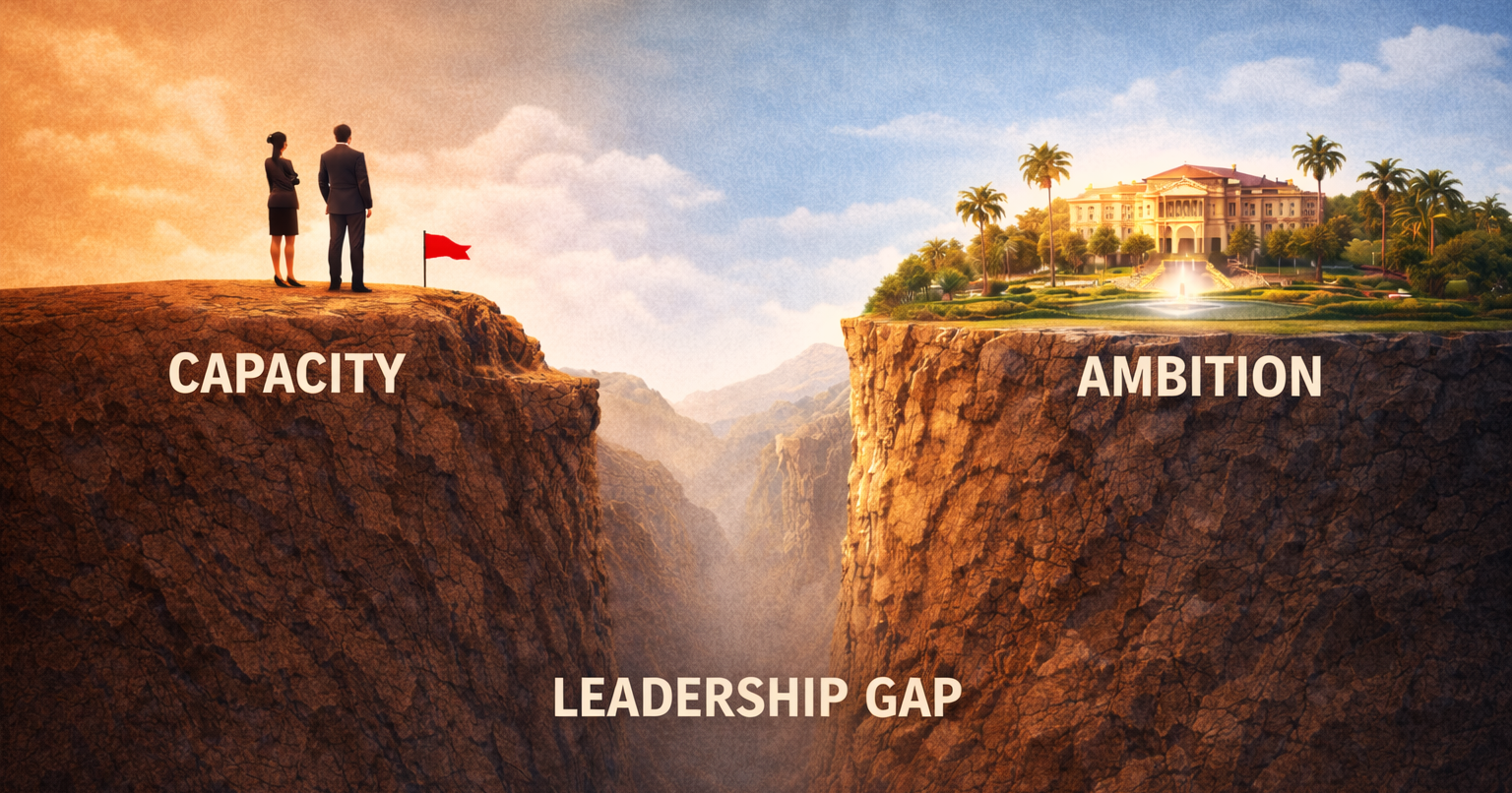
Put simply, many African companies have learned how to scale strategy, but they have not yet learned how to scale leadership.
That gap is quietly becoming one of the biggest constraints on growth.

The Execution Paradox
We often repeat the phrase that execution matters more than strategy. But strong execution rarely comes from process alone. At its core, it comes down to people. Motivated and empowered teams can build everything else.
Capable leaders recognize quickly when a plan is not working and adjust course. They take ownership of outcomes and communicate relentlessly with their teams.
While technical knowledge is usually abundant, the real power of leadership is the ability to help people exceed what they, or others, believed was possible.
History is full of these examples. From the Siege of Orléans to Apple Inc.’s turnaround, extraordinary outcomes have often been unlocked not just by better plans but by leaders capable of inspiring extraordinary performance in ordinary people.
The Failure We Rarely Name
Yet if strong leadership can multiply success, the opposite is also true. Poor leadership can quietly undermine even the most promising ventures.
Within Africa’s innovation ecosystem, there is almost a willful ignorance about the role that poor leadership has played in the rise and fall of some of the continent’s most audacious ventures over the last decade.
I am often bemused when I read postmortems of promising startups, products, partnerships, or even established companies that failed in their push into new markets or frontiers.
The explanations are usually familiar. Market readiness. Macroeconomics. Regulation. Competitor action. Infrastructure constraints. Product-market fit. Funding. Changes in customer behaviour. And to be fair, these are often legitimate challenges.
But far less frequently do we confront a simpler and more uncomfortable possibility. In many cases, when you strip away the surface explanations, what remains is simply bad leadership. The irony of bad leadership is that, unlike broken processes or flawed strategies, which become obvious in hindsight, most poor leaders do not realize they are poor leaders. And most people only recognize bad leaders after working with them.
But the symptoms are usually there.
When personality clashes drive high attrition, when demotivated teams repeatedly ship poor products or miss deadlines until the market opportunity disappears, leadership is usually at the center of the problem. The same pattern appears when executives know the arithmetic of revenue, but not the discipline of profit. And when founders fall out with investors because they cannot manage upward, surface misalignment early, communicate a credible plan, and execute on it, that, too, is a leadership failure.
We must confront an uncomfortable truth: no amount of funding or clever tales of sticks and carrots will suddenly turn a poor leader into a strong one.
The Real Constraint: Leadership Capacity
Most organizations today are not short on ambition. They are short on the capacity to build leaders.
I have been in companies where there are quiet, dark jokes about how the higher people rise into leadership roles, the closer their dramatic failure seems to be. Beneath the humour is a serious problem: increased responsibility without a commensurate investment in leadership capacity. The capacity void shows up long before the Peter Principle enters the room.
Organizations that want better outcomes must invest deliberately in the leaders responsible for delivering them. The real question, then, is: how should organizations build leadership capacity in a way that actually translates into better execution?
Traditional leadership programmes often move too slowly to matter. Their content can also be disconnected from the markets and operational realities where change must actually be implemented. Many of us have seen a person who returns from a prestigious business school abroad, energized by new ideas yet unsure how to translate those perspectives into their current organization or market. Sometimes, products are sunsetted, and departments restructured while their leaders are just returning from a year-long executive programme.
At the other end of the spectrum, the rise of on-demand courses has made learning more accessible, but these programmes often reduce behaviour change to content consumption. This is particularly true when on-demand courses don’t involve practice-based learning.
To be clear, both approaches have their place. But building cutting-edge, outcome-changing leadership capacity in fast-paced environments requires deeper consideration.
First, organizations must demonstrate a clear and deliberate intent to develop great leaders. This requires confronting the internal barriers that often hinder the process and embedding leadership capacity-building into the organization’s strategy. It is not about the familiar “we care deeply about our people” rhetoric delivered in town halls, the marquee programmes reserved for a select few, or the values printed on office walls. What ultimately matters is whether the organization’s everyday actions consistently signal that strong leadership principles truly matter.
Second, leadership development must be grounded in a deep understanding of both the organizational and individual context. This includes factors such as the company’s structure, history, short and long-term ambitions, as well as the leader’s role, career stage, and personal motivations.
Third, organizations must clearly define the behaviours they want to reinforce and those they want to discourage, and make explicit how those behaviours contribute to achieving the company’s strategic objectives.
Finally, leadership development must be accompanied by meaningful accountability. Organizations must actively track whether positive changes occur at both the individual and organizational level, and remain deeply engaged as supportive partners throughout the learning journey.
Scaling Leaders, Not Just Systems
If leadership capacity has become the hidden constraint on execution, organizations need to rethink how they build it.
From my experience across Africa’s innovation ecosystem, leadership capacity can grow through three reinforcing mechanisms. I have termed these the 3Ss.
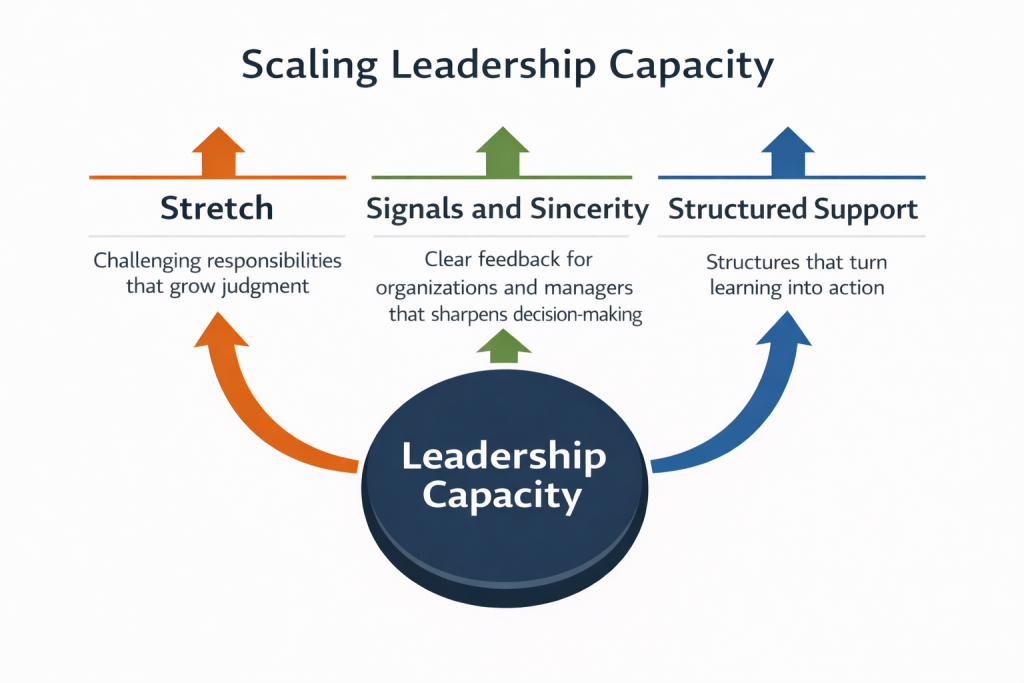
The 3S Framework for Scaling Leadership Capacity
Stretch
Leaders need opportunities to operate in environments where decision complexity increases and consequences become real. Like a muscle, leadership capacity develops under controlled stress and repeated use.
Signals and Sincerity
Leadership ability improves when managers and their organizations receive honest signals about how their decisions affect teams, performance, and organizational outcomes. Senior executives must also shed the invidious lens that views candid professional feedback as an excuse for poor performance or, worse, a sign of dissent. Great leaders emerge and thrive in environments where challenging the status quo is not only permitted but encouraged, especially when it leads to better outcomes.
These organizations also need to have honest (uncomfortable) conversations about their role in leadership development (or underdevelopment) and to embrace the investment needed to build capable leaders. Leadership capacity is one of the most valuable assets an organization can build.
Structured support
Organizations that scale successfully invest deliberately in systems that help managers develop the core leadership skills relevant to their roles. Organizations can not build leadership capacity alone. They must partner with credible learning institutions that bring the perspective, experience, track record, and accountability required to accelerate development within their firms. Institutions such as the African Management Institute have emerged precisely to address this challenge by helping organizations build practical leadership capability at scale.
Without these reinforcing loops, leadership development becomes accidental. And accidental leadership rarely keeps pace with deliberate organizational growth.
Why This Matters Now
This leadership gap becomes even more urgent as we enter the era of artificial intelligence. As organizations increasingly automate decisions and embed operational logic into AI systems, the values behind those systems will matter more than ever.
One of the central ideas in modern AI research is the value alignment problem, popularized by AI researcher Stuart Russell. The concept is simple. AI systems optimize the objectives we give them. But human judgment, values, and trade-offs are far too complex to fully encode in software.
The implication for organizations is profound. As companies integrate AI into hiring, customer service, operations, and strategy, they are effectively codifying the logic by which their organizations operate. If leadership principles such as judgment, empathy, accountability, and responsible decision-making are not already embedded in the organization’s culture and processes, AI will not introduce them. It will simply scale whatever logic already exists.
In other words, AI will not solve the leadership capacity gap. It may simply expose it faster than ever before.
Final Thoughts
Africa has no shortage of bold ideas and ambitious, intelligent people chasing the next breakthrough. What we are short on is leadership capacity at the pace our ambitions demand.
The companies that will define the next decade will not simply be those with the best strategy or the most funding. They will be the ones who invest deliberately in building leaders who can execute, adapt, and inspire performance at scale.
Because in the end, organizations do not scale through strategy alone. They scale through people.