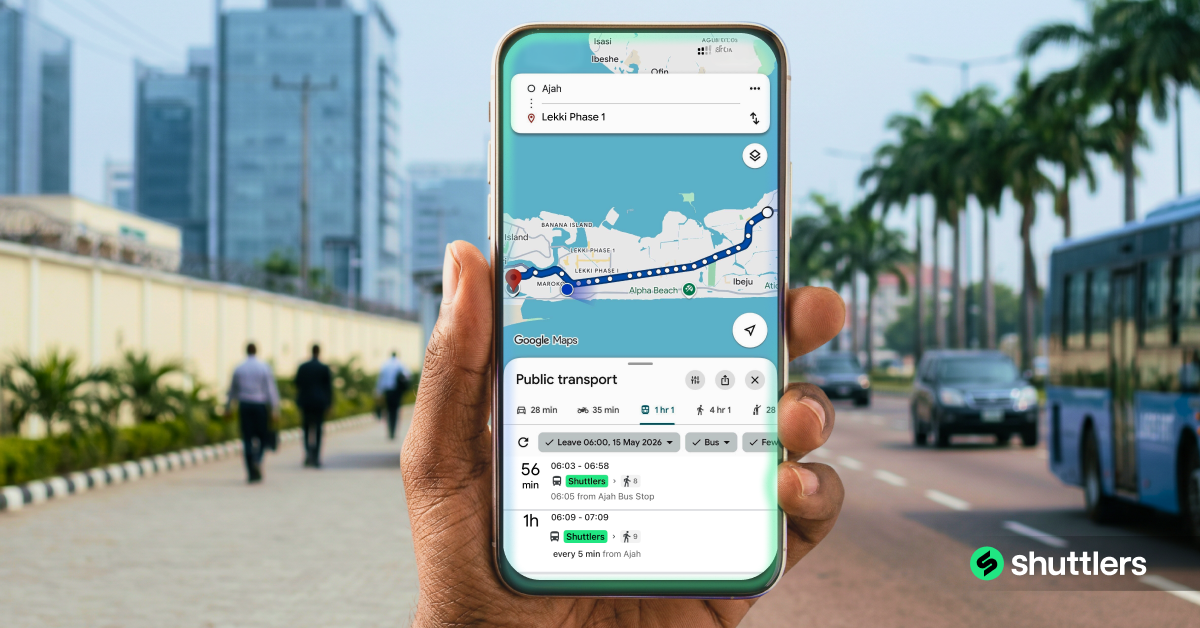
Shuttlers, the Nigerian shared mobility startup, has integrated its bus routes into Google Maps Transit, bringing its services to the navigation platform after completing more than 10 million trips since launching in 2016.
The integration brings Shuttlers’ scheduled routes into Google Maps’ transit layer, allowing commuters to discover routes and book seats directly within Google Maps while navigating Nigeria’s major cities.
The move reflects how private mobility operators are increasingly filling gaps left by overstretched public transport systems in African cities. According to the World Bank, African cities are about 29% more expensive overall than cities at similar income levels, with residents paying roughly double the global average for transport.
In Lagos, a study by the Danne Institute for Research found that the average commuter spends about 2.21 hours in transit daily, equivalent to roughly 11 hours in a five-day workweek. Private mobility operators have emerged as structured alternatives to informal buses and increasingly expensive ride-hailing services.
“For millions of professionals, commuting is still unpredictable, exhausting and expensive,” said Damilola Olokesusi, CEO and co-founder of Shuttlers. “We have spent the last 10 years building technology and operational infrastructure that makes daily transportation more dependable for commuters, businesses that employ them, and the fleet operators who power our network.”
Shuttlers said it integrated its route data, scheduling systems, and real-time operations with Google’s technical requirements to join Google Transit.
Founded in 2016, Shuttlers operates a scheduled bus service for professionals and corporate employees across Nigeria’s major cities. The company said it currently serves 30,000 active users across more than 1,000 itineraries and runs a fleet of more than 430 buses daily across Lagos, Abuja and Port Harcourt.
Shuttlers said it has completed more than 10 million trips since launch, maintains a 99% trip completion rate and a 99.94% incident-free record, and operates both a Business-to-Business-to-Consumer (B2B2C) model, allowing companies to fully or partially subsidise employee transport, and a direct-to-consumer option for individual commuters.
“Reliable transit information helps people navigate cities more confidently and efficiently,” Olumide Balogun, Director for West Africa at Google, said. “As more Nigerians adopt digital tools for everyday mobility, integrations like these help make trusted transportation easier to discover and access.”
As it expands its mobility offering, Shuttlers said it is integrating compressed natural gas (CNG) and electric buses into its fleet as part of efforts to reduce emissions from urban transport operations, with the company estimating emissions reductions of up to 60% compared to diesel alternatives. In April 2025, the company announced that it had introduced 20 CNG buses to its fleet.
In 2023, Shuttlers raised a $4 million equity round led by Verod-Kepple Africa Ventures, following a previous $1.6 million seed round in 2021, led by VestedWorld, which also participated in the raise alongside SheEquity, CMC 21, Alsa, EchoVC, and VestedWorld.