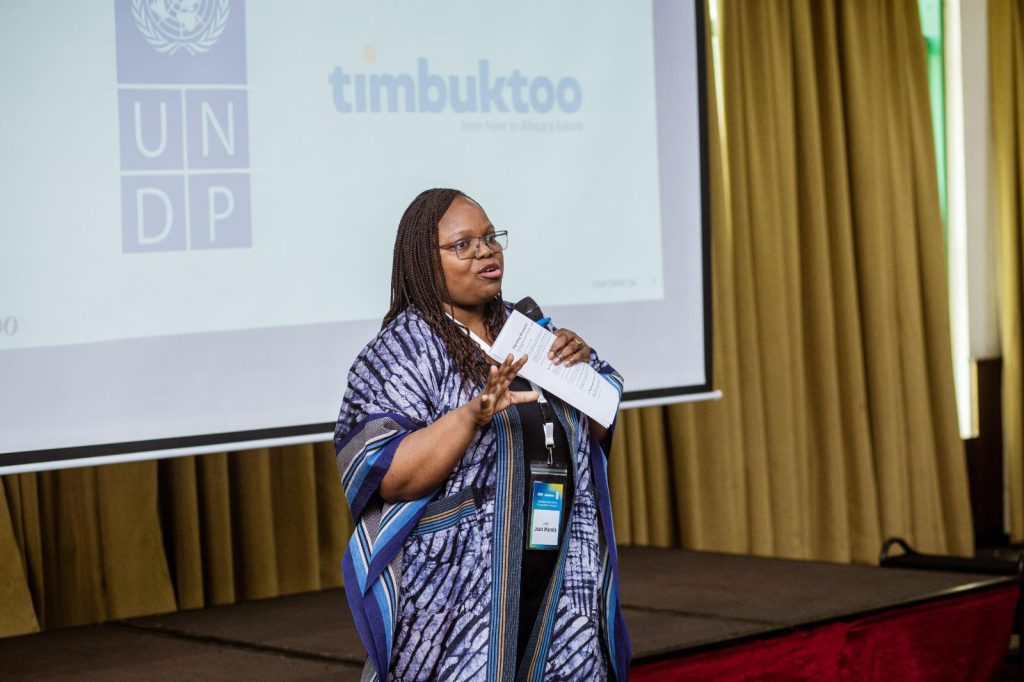



On a Saturday morning in early May, sales professionals gathered at a tech hub in Lagos with their laptops and notebooks. The event was called Quota and Code, a one-day, hands-on AI skills training workshop designed for enterprise sales teams. By the end of the day, every attendee had built functional websites and AI agents they could deploy in their jobs the following morning.
The organiser and lead trainer behind this AI adoption workshop is Akanni Isaac, a Lagos-based enterprise technology professional whose initials, fittingly, are AI. Over the past five years, Isaac has managed enterprise relationships across Africa for one of the world’s largest cloud communications platforms, working with banks, telecoms, and retailers as Customer Growth Manager for Africa. His career arc, from Mid-Market Account Executive to regional Customer Growth Manager in roughly four years, has earned him multiple top-performer awards.
But Quota and Code is not part of his day job. It is a side mission he built to close a gap he could no longer ignore.
Building an AI Training Curriculum Born From a Real Skills Gap
The idea for Quota and Code emerged from a pattern Isaac kept noticing across the clients and colleagues he worked with every day. Professionals in African enterprises understood AI tools were reshaping their fields. They had read the articles, attended the webinars, and heard the predictions. But almost none of them received structured, practical AI training they could apply immediately, especially within the context of sales or business development.
“There was a gap between awareness and application that nobody was closing,” Isaac says. “People knew they should be using AI. They just did not know where to start or which tools applied to their specific context.”
Existing AI education, he found, fell into two unhelpful categories: generic “AI for Everyone” courses that never addressed the realities of sales or enterprise workflows, or high-cost corporate consulting programmes that most organisations simply could not afford. Neither option bridged the gap between knowing about AI and actually using it on the job.
So he designed his own curriculum from scratch. The programme covers seven modules: AI tools and automation, specialised AI agent development, financial statement literacy, sales performance under pressure, personal positioning, and AI-augmented deal strategy. He secured a venue at a prominent Lagos tech hub, promoted the workshop through his professional network and LinkedIn, and deliberately kept the event independent of employer or sponsor branding.
“I kept it independent so the soul of the event could stay intact,” he explains.
Attendees came from technology companies, financial services firms, and enterprise sales organisations. Some were early-career professionals. Others were senior leaders trying to understand what their teams should be doing differently. The diversity of the room was, in itself, a data point: demand for practical AI skills training in Africa cuts across seniority levels and sectors.
One week after the workshop, an attendee messaged Isaac: “I have already prompted my branch manager to have the branch train on the tools you taught yesterday.”
From Civic Tech to Enterprise AI: A Track Record of Practical Innovation
Quota and Code is not Isaac’s first technology project built for real-world impact. In early 2023, he led the commercial and implementation strategy for a WhatsApp-based voter education chatbot deployed during Nigeria’s general election, developed in partnership with civic technology organisation Yiaga Africa.
The chatbot helped voters locate their polling units and verify their registration, all through WhatsApp, without requiring any new app download. With over 40 million active WhatsApp users in Nigeria at the time, the decision to build on existing infrastructure rather than create a new platform was deliberate and strategically sound. The project was covered by major Nigerian media outlets and executed under significant deadline pressure with no prior template to follow.
It taught Isaac a principle he still applies today: build AI solutions for the channels users already have, not the ones you wish they used.
“Meet people where they are” has become a core design philosophy for every project Isaac takes on, whether that is a civic chatbot, a corporate AI workshop, or a sales automation tool.
The Cost of Delayed AI Adoption in African Enterprises
Beyond running workshops, Isaac has been developing and publishing his thinking on AI adoption across Nigerian technology and business media. His central argument: African enterprises are paying a hidden cost by delaying AI adoption, and that cost is not measured in missed efficiency gains, but in missed organisational learning cycles.
“A company that starts building AI capability today may have functional systems within nine to twelve months,” he has written. “A company that starts in 2027 will not have them until 2028, representing a two-year competitive disadvantage.”
He is particularly critical of what he calls the “waiting for the right time” mindset, a stance he argues is less about strategy and more about decision avoidance. “If you cannot name the specific trigger (a regulatory milestone, a competitor action, a technology maturity threshold), then you are not waiting for a signal. You are avoiding a decision.”
Not everyone agrees with the urgency of this framing. AI infrastructure across Africa remains uneven. Data readiness varies significantly by sector, and some practitioners argue that premature AI adoption without strong data foundations creates more operational risk than it resolves. Isaac acknowledges these real constraints but frames them as parameters to work within, not reasons to delay.
What’s Next for Quota and Code and Africa’s AI Skills Movement
Quota and Code is now being planned as an annual AI skills training event, with discussions underway about expanding to other African cities. The next edition is already in early planning stages.
Isaac is measured about what he has built so far. The first workshop had fifty attendees. The curriculum fit into a single day. But something about the model, independent, practitioner-led, and resolutely practical, appears to be resonating in a market where formal AI training remains largely inaccessible for most working professionals.
“A year from now, I expect Quota and Code will have reached two hundred professionals across three cities,” he says. “The curriculum will be refined. The community will be larger. But the core principle will remain the same: meet professionals where they are, give them tools they can use immediately, and trust them to take it from there.”
Why Practitioner-Led AI Education Is Gaining Ground in Africa
The Quota and Code model reflects a broader trend: the most effective AI upskilling programmes in emerging markets are increasingly coming not from universities or large EdTech platforms, but from practitioners who understand both the technology and the professional context their peers actually work in.
For sales professionals in Africa navigating the rapid integration of AI tools, from automated CRM updates to AI-generated proposal drafting and conversational sales agents, the gap between what enterprise AI can theoretically do and what professionals are trained to use remains wide. Quota and Code is one of the rare programmes explicitly designed to close it.
As AI adoption in African enterprise accelerates, it will need more Akanni Isaacs: professionals who understand the technology, understand the business context, and are willing to build the bridges themselves.