Metro Africa Xpress (MAX), a Nigerian mobility financing startup, has raised $24 million in an equity and debt funding round as it continues its transition to electric mobility financing in West and Central Africa after hitting profitability in Nigeria.
The equity round saw participation from Equitane DMCC, Novastar, Endeavor Catalyst, and other global investors, alongside asset-backed debt from the Energy Entrepreneurs Growth Fund (EEGF) and additional development finance partners.
“This capital allows us to scale faster, deepen clean energy infrastructure, and build a truly pan-African mobility platform that expands access, lowers costs, and delivers durable impact,” Adetayo Bamiduro, the CEO of MAX, said.
The raise signals strong investor confidence in MAX’s transition from a traditional vehicle financing business to an integrated electric mobility platform. The company’s growth mirrors a broader uptick in Africa’s EV ecosystem, where declining battery costs and volatile fuel prices are making electric two- and three-wheelers increasingly competitive.
This fresh capital will be used to scale MAX’s electric vehicle (EV) fleet, expand its battery-swapping and clean energy infrastructure, deepen its proprietary fleet management and IoT systems, and support expansion across West and Central Africa. The raise will also fund MAX’s ambitions to support 250,000 drivers by 2027 and cross $150 million in annual recurring revenue.
MAX says it has reached profitability in Nigeria, its largest market, where only a few players, such as Nigeria’s Moove and Kenya’s M-KOPA, have reported strong revenues and improving unit economics.
“Profitability in Nigeria proves that electric mobility in Africa is not a future concept. It is viable, scalable, and investable today,” Bamiduro added.
The startup’s profitability and fresh fundraising come a year after it pivoted to EV financing and laid off about 150 employees, roughly 30% of its workforce, as part of a strategic reset. At the time, the company introduced cost-saving measures, like reducing energy and generator usage at its offices, while exiting less profitable verticals to improve operational efficiency and capital discipline.
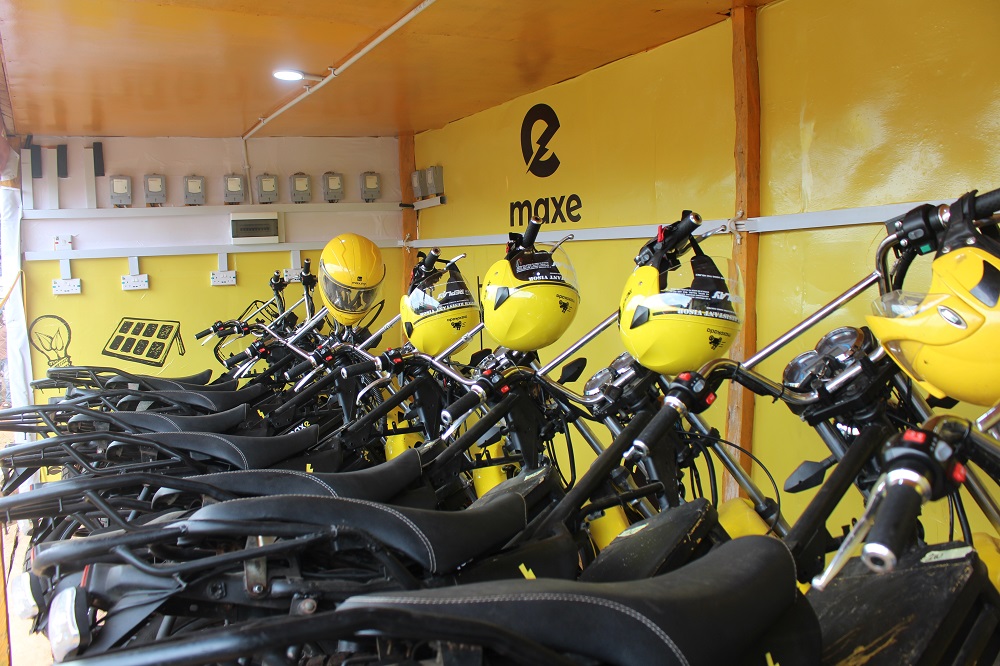
MAX’s core strategy is to reduce reliance on expensive imports by scaling local manufacturing. MAX, which had begun deploying its EVs in 2020, partners with local and regional original equipment manufacturers (OEMs), including Yamaha, Hero, and Spiro, to deliver vehicles optimised for African roads. Now, the company operates an assembly facility in Ibadan, with the capacity to produce up to 3,600 vehicles per month, covering both two- and three-wheel EVs.
MAX’s growth comes as electric mobility gains momentum across the continent. Declining battery costs and inconsistent fuel pricing are making EVs economically superior to gas-powered alternatives for commercial drivers. With about 20,000 EVs already on Nigerian roads and an expected compound annual growth rate (CAGR) of 30.6%, the EV sector is rapidly transitioning into a scalable industrial market.
Founded by Adetayo Bamiduro and Chinedu Azodoh in 2015 as a delivery service, MAX has experienced several pivots into ride-hailing, vehicle financing, and now EV assembly. Since 2019, MAX has raised about $87 million to fuel its growth. MAX’s profitability builds on its integrated pay-as-you-go (PAYG) business model that prioritises cash flow over rapid expansion.
To date, MAX says it has deployed over $56 million in fleet financing and has successfully repaid $44 million to users.