AI-assisted software engineering is here. The real question is: can your team use it without shipping chaos?
There’s a big difference between using AI to generate code and using AI to build software responsibly.
Most developers have already tried AI coding tools. Some use them every day. The upside is obvious: faster drafts, quicker debugging, fewer blank-page moments.
But there’s also a growing problem: a lot of teams are moving fast with AI and still struggling with reliability, maintainability, and clarity.
In other words: AI can help you ship faster, but without the right workflows, it can also help you ship confusion faster.
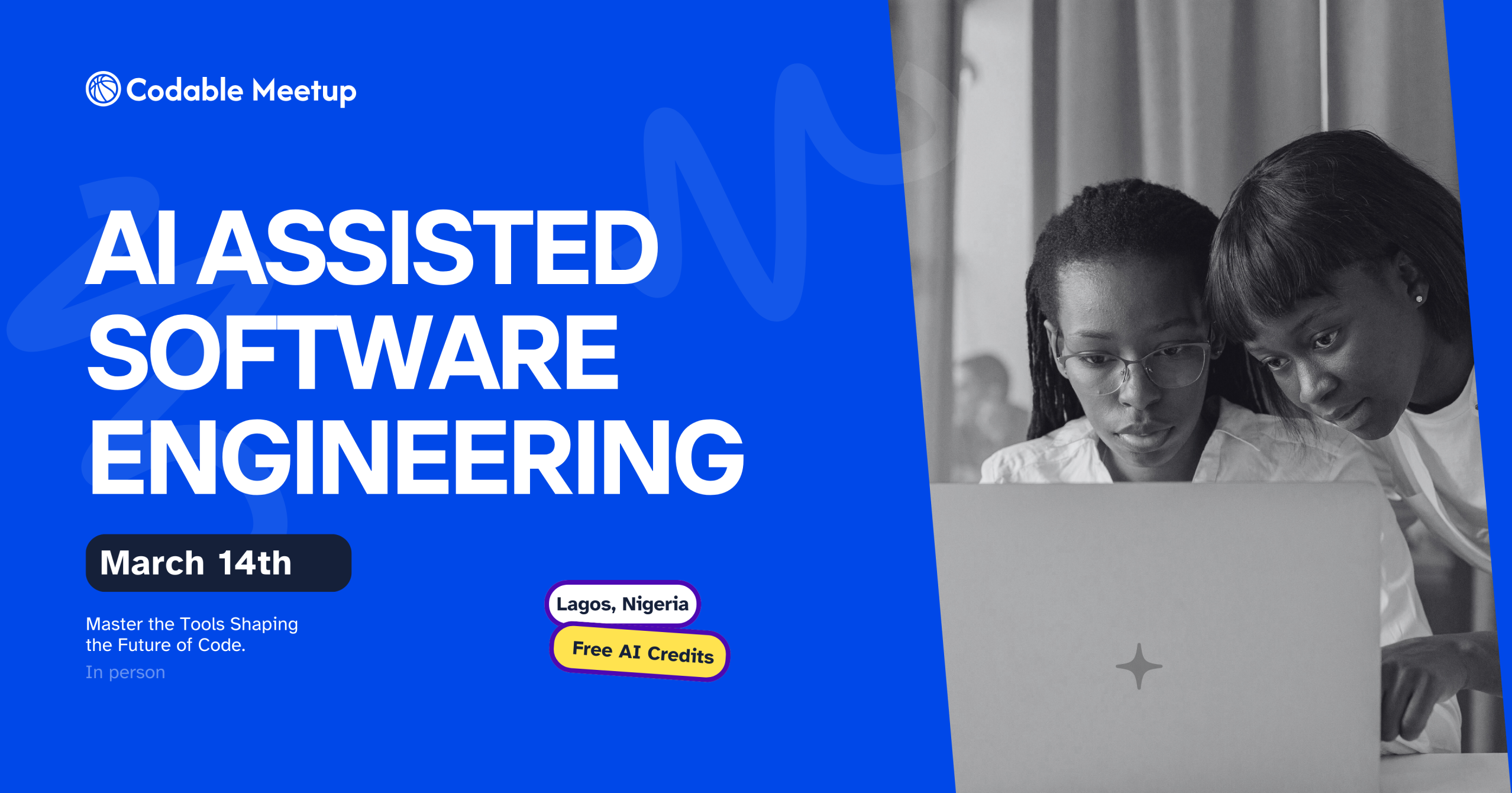
That’s exactly why Codable Meetup is hosting an in-person session in Lagos on March 14 at 10:00 AM at The Zone, Gbagada on AI-Assisted Software Engineering, a practical meetup for engineers who want to go beyond “vibe coding” and learn repeatable ways to work with coding agents.
Why this conversation matters right now
AI-assisted coding has moved from novelty to workflow.
We’re in the middle of a real paradigm shift: the role of the software engineer is changing. The job is no longer just to write code line by line, it’s to deliver verified, working software.
In many teams, code is no longer the bottleneck. Imagination, problem framing, and execution discipline are becoming the real constraints.
Developers are no longer just asking AI to write utility functions. They’re using agents to:
- scaffold features,
- refactor codebases,
- write tests,
- generate documentation,
- and even handle parts of implementation planning.
The opportunity is huge.
Some people would even argue that AGI is already here in practical form, or at least close enough to change how engineering teams work today. The challenge now is learning how to harness it well inside real software workflows.
But so is the risk of building brittle systems if teams don’t have structure:
- unclear prompts
- incomplete context
- poor specifications
- no review process
- no shared standards for using AI in production
That’s where this meetup comes in.
This isn’t a hype session. It’s a practical conversation about how software engineers can use AI tools more effectively , with better outcomes and fewer surprises.
What the meetup will cover
1) Introduction to Agents and Agentic Coding
AI coding is evolving beyond “one prompt, one response.”
This session will introduce the idea of coding agents , systems that can take a goal, reason through tasks, and help complete multi-step work.
We’ll break down:
- what “agentic coding” actually means in practice,
- where agents help most in a real dev workflow,
- and where human oversight is still absolutely essential.
If you’ve heard the term “agents” everywhere but still want a grounded explanation, this will give you one.
2) Context Engineering for Coding Agents
This is one of the biggest reasons AI coding succeeds or fails.
Most bad outputs aren’t because the model is “bad.” They happen because the model doesn’t have the right context.
At the meetup, we’ll look at context engineering:
- how to provide the right codebase context,
- how standards like the Model Context Protocol (MCP) can improve how agents and tools access context,
- what information the model actually needs,
- how to structure tasks so the output is more reliable,
- and how to reduce back-and-forth iterations.
If you’ve ever thought, “AI gave me something technically valid but completely wrong for my project,” this session is for you.
3) Spec-Driven Development (with AI in the loop)
AI can write code quickly. But speed without clarity creates rework.
That’s why we’re also covering spec-driven development , a practical way to use clear specs and constraints so AI-generated code is easier to review, test, and maintain.
We’ll discuss:
- how to define better implementation specs,
- how specs improve collaboration (especially on teams),
- how to use AI to accelerate delivery without losing engineering discipline.
This is especially useful if you’re building real products and need AI to support shipping quality, not just prototypes.
4) Orchestrating Multiple Agents for Real Engineering Workflows
As teams move beyond single prompts, the next challenge is coordination: how do you use multiple agents effectively across a real software workflow without creating more noise than output?
This session will cover practical patterns for agent orchestration in engineering teams, including:
- when to use multiple agents instead of one,
- how to split work across research, coding, testing, and review agents,
- how to design handoffs so context doesn’t get lost,
- and how to keep humans in control of quality and approvals.
We’ll also talk about headless and proactive agents , agents that can run in the background, monitor tasks, and handle routine engineering work without needing constant supervision.
The goal is to help you build workflows where agents are genuinely useful teammates, not tools you have to babysit.
To make this practical, there will also be real live demos during the meetup, and every attendee will receive free AI credits so they can actively participate and follow along during the sessions.
Facilitators and speakers
We’re bringing together a strong group of facilitators and speakers , senior engineers and technical leaders who are already shipping code with AI, building AI-assisted workflows, or leading teams that are adopting these practices in real products.
This is intentionally designed as a practitioner-led meetup. The people guiding these sessions are not just talking about trends , they’re doing the work.
Featured speakers include:
- Tobi Omotayo , Building Local Agents for Automating Knowledge Work LinkedIn – https://www.linkedin.com/in/tobiomotayo
- Kerry Ehiokioya , Senior Frontend Engineer at Helium Health LinkedIn – https://www.linkedin.com/in/kerry-ehikioya-5626a7159/
- Taslim Oseni, Senior Android Engineer at Cowrywise LinkedIn – https://linkedin.com/in/taslim-oseni
- Omoyeni Babatune , Senior iOS Engineer at Fairmoney LinkedIn – https://www.linkedin.com/in/omoyeni-babatunde
- Precious Oaseru , Tech Lead LinkedIn – https://www.linkedin.com/in/oaseru/
- Aderinola Odusanya, Senior Frontend Engineer LinkedIn – https://www.linkedin.com/in/odusanya-aderinsola-a4b865163
- Daniel Oniya, Senior Backend Engineer LinkedIn – https://www.linkedin.com/in/daniel-oniya
And a group of amazing panelist that will talk about the future of knowledge work in the intelligence age.
Who should attend?
This meetup is designed for:
- Software Engineers
- Mobile / Backend / Frontend / Full-stack Developers
- Engineering Leads
- DevOps / Platform Engineers
- Technical founders who still code
If you’re actively building software and want a better workflow for AI-assisted development, you’ll get value from this.
Why this is an in-person meetup
There’s a reason we’re doing this in person in Lagos.AI-assisted engineering is one of those topics where the most useful insights often happen in the follow-up conversations:
- “How are you handling code review and numerous PRs?”
- “What prompts actually work for your stack?”
- “How do you stop hallucinated changes from getting merged?”
- “What’s your team’s policy for using agents in production?”
The talks are valuable.
The conversations after are where people often get the practical answers they can apply on Monday.
Ticket information (please read)
This is a paid event.
Ticket price
- General Admission: ₦20,000
- Women in Tech: 50% discount available (₦10,000)
Why we’re doing this meetupAI-assisted software engineering is moving fast, and a lot of developers are learning by trial and error.
We want to create a space for builders in Lagos to:
- learn practical patterns,
- avoid common mistakes,
- and meet other engineers figuring this out in real products.
If you care about shipping better with AI , not just generating code faster , this meetup is for you.
Register now
Seats are limited because this is an in-person session.
Register now and secure your spot:
- Pay via Paystack
- Complete your Luma registration
- Get approved and join us in Lagos
If you know a software engineer who should be in this room, send this to them.
Can’t make it? Follow Codable Meetup on LinkedIn and X or our Luma Calendar for future sessions and recaps. – https://luma.com/codablemeetup