Connecting remote operations to core digital infrastructure has long been a structural challenge for enterprises operating across Nigeria and Africa. Oil platforms in the Niger Delta, telecom towers in rural Kano, mining sites, agricultural facilities, and bank branches in remote communities often require secure, high-performance access to infrastructure hosted in major data centres. In many cases, fibre, leased lines, or terrestrial networks are either unavailable, unreliable, or prohibitively expensive.
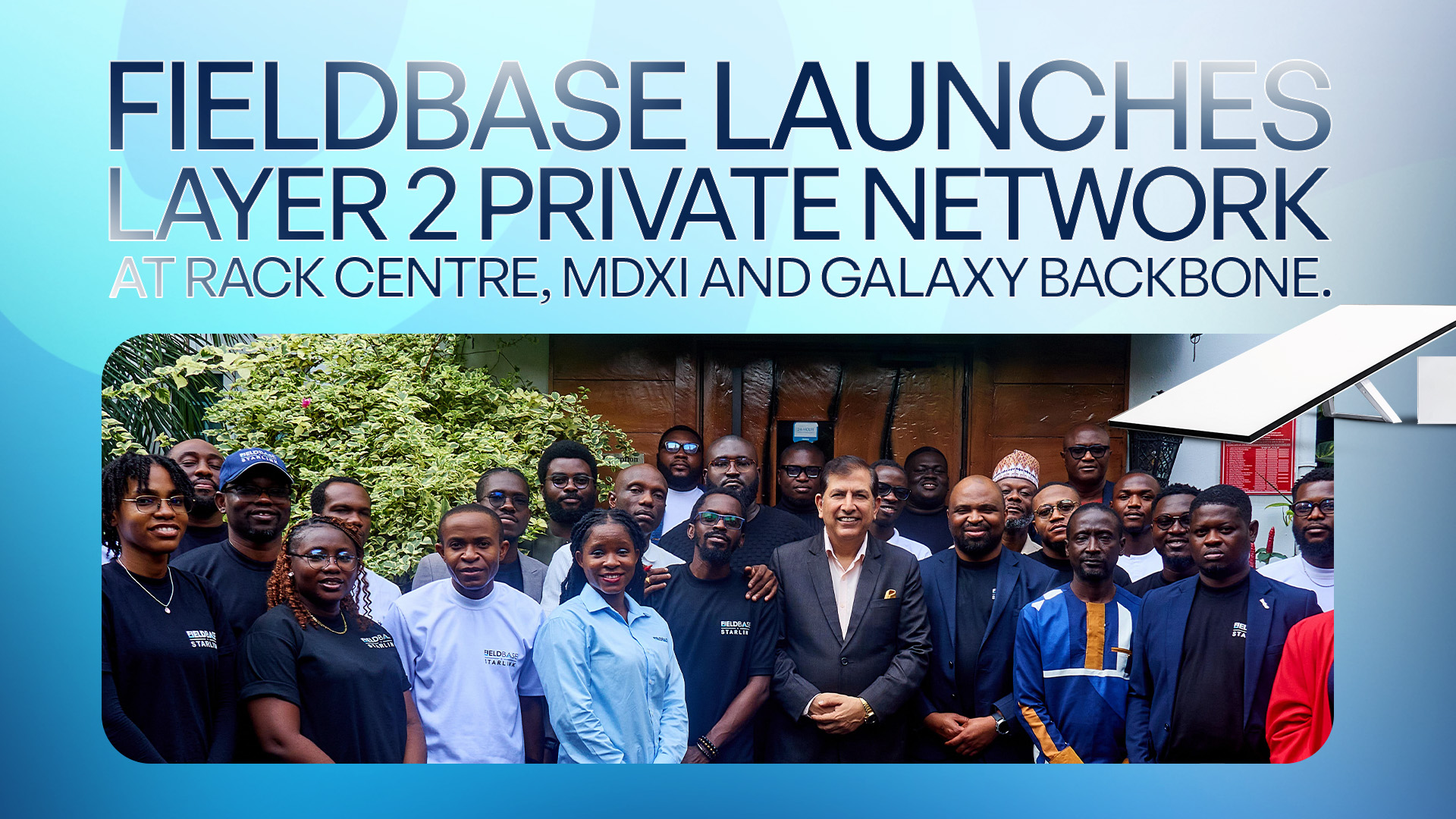
Fieldbase Services Limited, a Tier-1 global partner of Starlink, has introduced a new alternative. The company has launched Starlink Layer 2 Private Network Interconnection services across three major Nigerian data centre environments: Rack Centre in Lagos (Mainland), MDXI Lagos (Island), and Galaxy Backbone in Abuja.
The service enables enterprises to establish secure, dedicated private network connectivity from remote sites directly into infrastructure hosted at any of these facilities.
A private network, not public internet
Layer 2 VPN technology allows geographically dispersed locations to operate as if they are on the same local network. Rather than routing traffic over the public internet, a dedicated private Layer 2 channel is created between the remote site and the selected data centre.
Through its peering arrangement with Starlink and supporting ground infrastructure in Lagos, Fieldbase provisions Starlink terminals at remote locations and extends their full capacity directly into the chosen facility. A Starlink terminal capable of delivering 220 Mbps download and 40 Mbps upload provides that throughput as a private link, without shared bandwidth constraints.
This approach removes the unpredictability associated with traditional internet routing and creates a direct enterprise-grade connection between field operations and core systems.
Available across three data centre ecosystems
The service is now live at:
- Rack Centre, Lagos
- MDXI Lagos
- Galaxy Backbone, Abuja
Enterprises hosting infrastructure in any of these environments can now extend secure private connectivity to remote operations anywhere Starlink is licensed globally.
The availability across multiple facilities gives organisations flexibility in choosing where to colocate infrastructure while maintaining a consistent remote connectivity architecture.
Enterprise use cases
The implications span multiple sectors:
Financial institutions can connect rural branches, ATMs, and point-of-sale systems directly to core banking platforms hosted in Lagos or Abuja.
Telecommunications providers can link remote base stations to core network infrastructure without waiting for fibre rollout.
Energy and extractive companies can connect offshore or remote monitoring systems to central operations platforms in real time.
Enterprises with distributed operations can centralise application servers and databases while maintaining reliable access from warehouses, factories, or branch offices.
Cloud and technology providers can extend services into regions previously limited by terrestrial infrastructure constraints.
Performance and reliability
Starlink’s Low Earth Orbit satellite constellation enables latency typically ranging between 20 and 40 milliseconds, supporting applications such as database replication, VoIP, transaction processing, and video collaboration.
The satellite network automatically transitions between satellites to maintain connectivity. Bandwidth remains dedicated to the enterprise environment rather than being pooled in shared public internet channels.
Next-generation Starlink hardware is expected to support significantly higher capacity as the constellation expands.
Deployment model
Implementation follows a defined process:
- Technical assessment of the remote site and target data centre environment
- Network design and integration planning
- Equipment deployment and activation at the remote site
- Cross-connection within the selected facility
- Commissioning and live activation
Deployment timelines are measured in days rather than the months often associated with fibre builds or leased line provisioning.
Strategic impact
By making Layer 2 private satellite connectivity available across Rack Centre, MDXI Lagos, and Galaxy Backbone Abuja, Fieldbase has expanded the options available to enterprises that require resilient and secure infrastructure interconnection.
For organisations operating across challenging geographies, the constraint is no longer the absence of terrestrial infrastructure. Remote locations can now be integrated into core systems with predictable performance, dedicated bandwidth, and controlled security architecture.
The service is now operational across all three facilities.
Further information is available at www.fbase.co.uk.