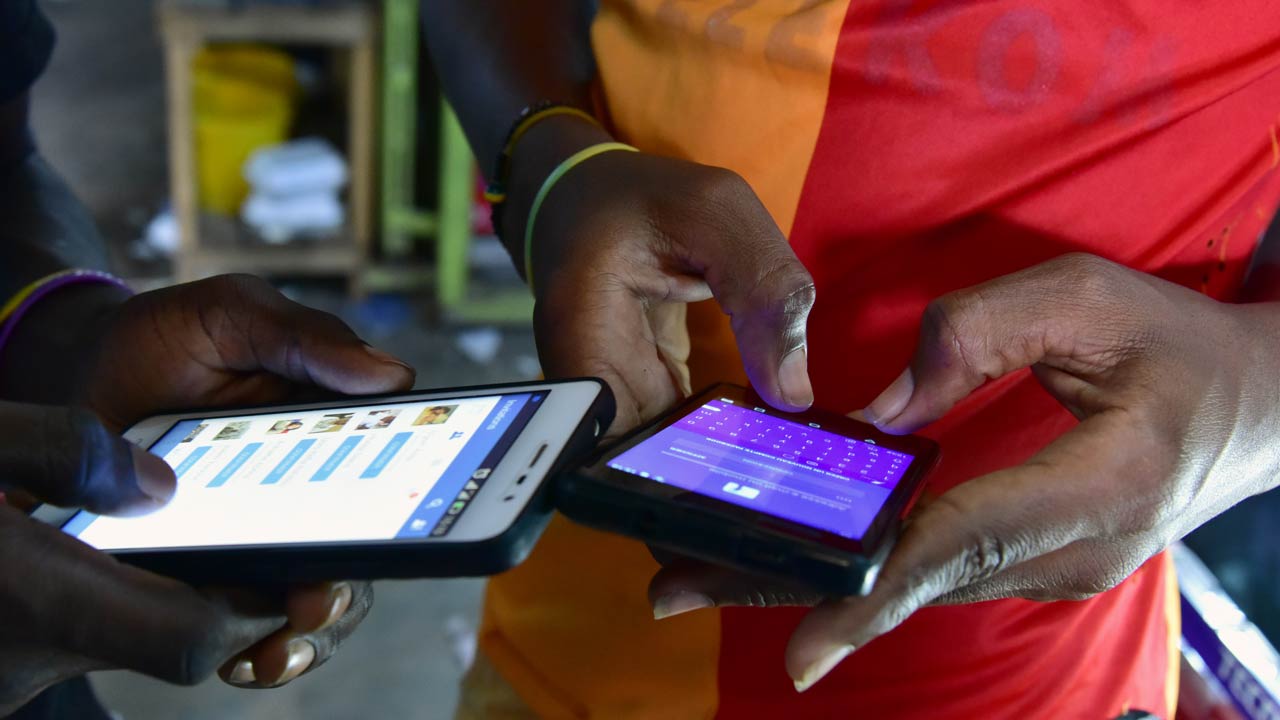
Africa’s mobile internet problem is no longer only whether a network reaches people. Increasingly, it is whether they can afford the phone needed to use it.
Across the continent, operators have spent years building towers, laying fibre and expanding 3G and 4G coverage. The networks are there. In Senegal, 4G reaches about 97% of the population; in Uganda, 98%; and in Nigeria, more than 80%. Yet millions of people living under those networks remain offline—not because there is no signal, but because getting online still costs too much.
“Africa has built the networks,” Caroline Mbugua, a senior official at the GSMA, the mobile industry association, said in an interview with TechCabal. “But not enough people can afford to use them.”
The challenge is no longer simply whether a community can access a signal. It is whether people can afford an internet-capable phone, pay for data, acquire the skills needed to use digital services and find sufficient value online to justify the cost.
The GSMA’s 2026 State of Mobile Internet Connectivity report puts the gap in stark terms: 3.1 billion people globally live within mobile-broadband coverage but do not use mobile internet. More than 90% of the 3.4 billion people still offline already live within mobile broadband coverage. In Africa, 906 million people—nearly 60% of the continent’s population—live within reach of 3G, 4G or 5G networks but remain offline.
The gap is even more pronounced in Sub-Saharan Africa, where just 25% of the population uses mobile internet, according to Mbugua. Another 66% live within mobile broadband coverage but do not use it.
That means Africa’s next connectivity challenge is not simply building more networks. It is making internet access affordable enough for people to use.
.At the centre of that push is a deceptively simple goal: a smartphone that costs about $30.
The target is not new, but it is becoming harder to reach. From memory chips and other components to network operations and taxes, the inputs that determine handset prices are moving in the wrong direction.
Memory prices more than doubled between Q3 2025 and Q1 2026, then surged by a further 80%-90% in Q2. The squeeze has hit the cheapest phones hardest, eroding margins in the sub-$100 segment and pushing prices higher. Omdia estimates that the average smartphone selling price in Africa rose by $41 year-on-year to $202, while shipments of sub-$100 devices fell 34%.
The question is no longer only whether Africa can build enough networks. It is whether governments and industry can make the devices needed to use those networks cheap enough for those who need them most.
A network without users
The GSMA’s figures describe a structural problem for both consumers and mobile operators.
The contrast is central to the industry’s concern: operators have invested heavily in coverage, but too few people use the networks frequently enough to generate the returns needed to fund the next wave of expansion.
Mbugua compares the situation to building a road with no cars on it. The road still needs maintenance, and the money used to build it remains tied up. But it produces little economic activity, making further investment harder to justify.
“That’s alarming because it means this investment has already rolled out,” she said. “It’s almost as if the government has built a road, but there’s no car on it.”
Africa is expected to attract $76 billion in mobile-network investment between 2025 and 2030, according to the GSMA. But sustaining that investment depends partly on whether existing networks can be monetised.
A network can cover a community without meaningfully connecting it economically. If households cannot buy smartphones, if data remains expensive relative to incomes, or if people lack the confidence and skills to use services safely, coverage becomes an underused asset rather than the foundation for a larger digital economy.
This changes the policy question. Telecommunications policy has traditionally focused on coverage targets, rural towers, spectrum auctions, fibre routes, and the number of people within signal range. Those metrics still matter, particularly for communities outside the coverage area. But for a continent with a large usage gap, another question has become just as important: what prevents people who already have a signal from getting online?
The answer begins with the cost of the mobile phone.
By the end of 2025, the GSMA found that an entry-level internet-enabled handset cost the poorest 20% of people in low- and middle-income countries 44% of their average monthly income. In Sub-Saharan Africa, the burden was higher: 76% of average monthly income for the poorest fifth of the population.
A phone that consumes most of a month’s income is not a discretionary purchase. It competes with rent, food, transport, medicine, school fees, and electricity. That is why the price of the cheapest usable smartphone matters so much.
The $30 smartphone challenge

The GSMA has previously modelled the potential impact of lower smartphone prices on internet adoption. A $30 entry-level smartphone could make devices affordable for almost 1.6 billion people living within mobile-broadband coverage. At $20, about 2.2 billion people could potentially afford one.
At recent exchange rates, $30 is roughly ₦40,000 in Nigeria, R490 in South Africa, KSh3,900 in Kenya and GH₵350 in Ghana. That is a meaningful upfront expense in markets where low-income households often earn irregular incomes: in Nigeria, it is more than half of the ₦70,000 monthly minimum wage; in South Africa, it is about two working days at the statutory minimum of R30.23 an hour. The comparison shows why a $30 handset is not merely a low-cost product benchmark, but a threshold that can determine whether a household can enter the digital economy at all.
The objective is not to create the cheapest phone possible for its own sake. It is to produce a device cheap enough to bring people online while still capable of running the services that increasingly define everyday life.
For many Africans, a smartphone is more than a communications device. It is a banking tool, a classroom, a workplace, a source of government information, and a gateway to online commerce. But getting a capable device down to $30 has become difficult.
Mbugua said the industry has been working toward lower-cost devices, but the economics have become harder.
“The biggest challenge we have, to be honest, in reaching the $40 price point is the price of chipsets,” she said. “The prices have skyrocketed.”
The pressure is not limited to chipsets. Smartphone manufacturers also face higher costs for memory, logistics, foreign exchange, taxes, and other parts of the supply chain. The $30 target is therefore not simply a manufacturing problem; it is a broader affordability problem.
Even if a manufacturer produces a $30 smartphone, consumers may pay considerably more by the time it reaches a retail shop. Import duties, taxes, distribution, currency movements, and retailer margins can all widen the gap between factory cost and the final price.
The GSMA argues that governments, operators, manufacturers, and financial institutions need to work across the entire ecosystem rather than expecting handset makers alone to absorb the cost. That could mean lower taxes on entry-level smartphones, device-financing schemes, efficient distribution, a stronger second-hand market and policies that reduce the cost of running mobile networks.
The objective is to reduce the price consumers actually pay, not merely the manufacturer’s cost.
Cutting the cost of access
Mbugua identifies three areas where governments can influence affordability: spectrum, taxation, and energy.
The first is spectrum—the radio frequencies that mobile operators need to provide services. Governments often treat spectrum as an immediate source of public revenue. Operators, in turn, treat it as a major capital cost that must eventually be recovered through customer revenues.
When spectrum costs are high, operators have less money for network expansion and may face pressure to raise service prices.
“Governments in the region continue to treat spectrum as a revenue resource, a revenue earner,” Mbugua said. “At the end of the day, these costs are passed on to the consumer.”
The GSMA argues that spectrum should be treated primarily as an enabler of connectivity. It recommends longer licence terms, local-currency pricing where appropriate, staggered payments and coverage obligations that reduce the need for large upfront fees.
Mbugua said spectrum pricing in China and Japan had been reduced to about 1% of operator revenues, while in some other markets it can amount to 26%, 50% or more. The comparisons vary by market, licence band and operator, but the underlying issue is straightforward: spectrum costs eventually become part of the economics of mobile services.
The second lever is taxation. Smartphones and mobile services in many African markets are subject to import duties, value-added taxes, excise taxes, and other levies. These generate revenue for governments but also raise the price of the tools people need to participate in the digital economy.
“Instead of taxing connectivity,” Mbugua said, “we need to tax the economy.”
That means governments could consider targeted tax reductions for entry-level smartphones and other measures that lower the cost of getting online.
South Africa offers a recent example. In April 2025, the government removed a 9% excise duty on smartphones priced below 2,500 rand (about $156). The GSMA says entry-level smartphone sales rose 80% in the following 11 months.
Mbugua acknowledged that it is difficult to establish causation perfectly, but said the increase was significant compared with previous periods. The measure also targeted price-sensitive consumers rather than subsidising all handset purchases.
Tax cuts alone will not solve Africa’s affordability problem. But they illustrate how policy affects the final prices consumers face.
The cost beyond phones
The third major cost is energy. Mobile networks, data centres and newer technologies such as 5G require growing amounts of electricity. In countries with unreliable grids, operators often depend on diesel generators and backup systems.
Mbugua said energy can account for up to 30% of an operator’s operating expenditure in some markets. Those costs feed into the economics of mobile services. When the cost of running a network rises, operators have less room to reduce prices or expand into areas where returns are already low.
This creates a cycle. High costs make connectivity less affordable. Lower adoption means operators generate less revenue from the networks they have built. Weaker returns make investors more cautious about financing additional coverage and capacity. The people most exposed are often those who can least afford a device and service in the first place.
That is why the $30 smartphone target cannot be separated from the wider economics of connectivity.
A cheaper phone will not solve everything. People may remain offline due to limited digital skills, poor network quality, unreliable electricity, fraud, safety concerns, language barriers, or a lack of relevant local content. But without an affordable internet-enabled device, those other problems become harder to address.
The GSMA estimates that closing the global mobile usage gap could generate $3.5 trillion in additional GDP between 2023 and 2030, with more than 90% of the benefit going to low- and middle-income countries. It is a modelled estimate, not a guarantee. But it captures the economic stakes of bringing more people online.
The affordability question is therefore bigger than the price of a phone. It is about whether Africa’s investment in digital infrastructure can translate into wider economic participation.
Africa has spent years building roads. It now needs more people to afford cars.
True scale demands moving beyond surface-level integrations to robust execution. We’ve filtered the noise out of Moonshot 2026, optimising the conference strictly for high-calibre connections between startup founders, global financial operators, enterprise leaders and individuals rewiring Africa’s technical frameworks. Get 20% off Early Bird tickets for a limited time.