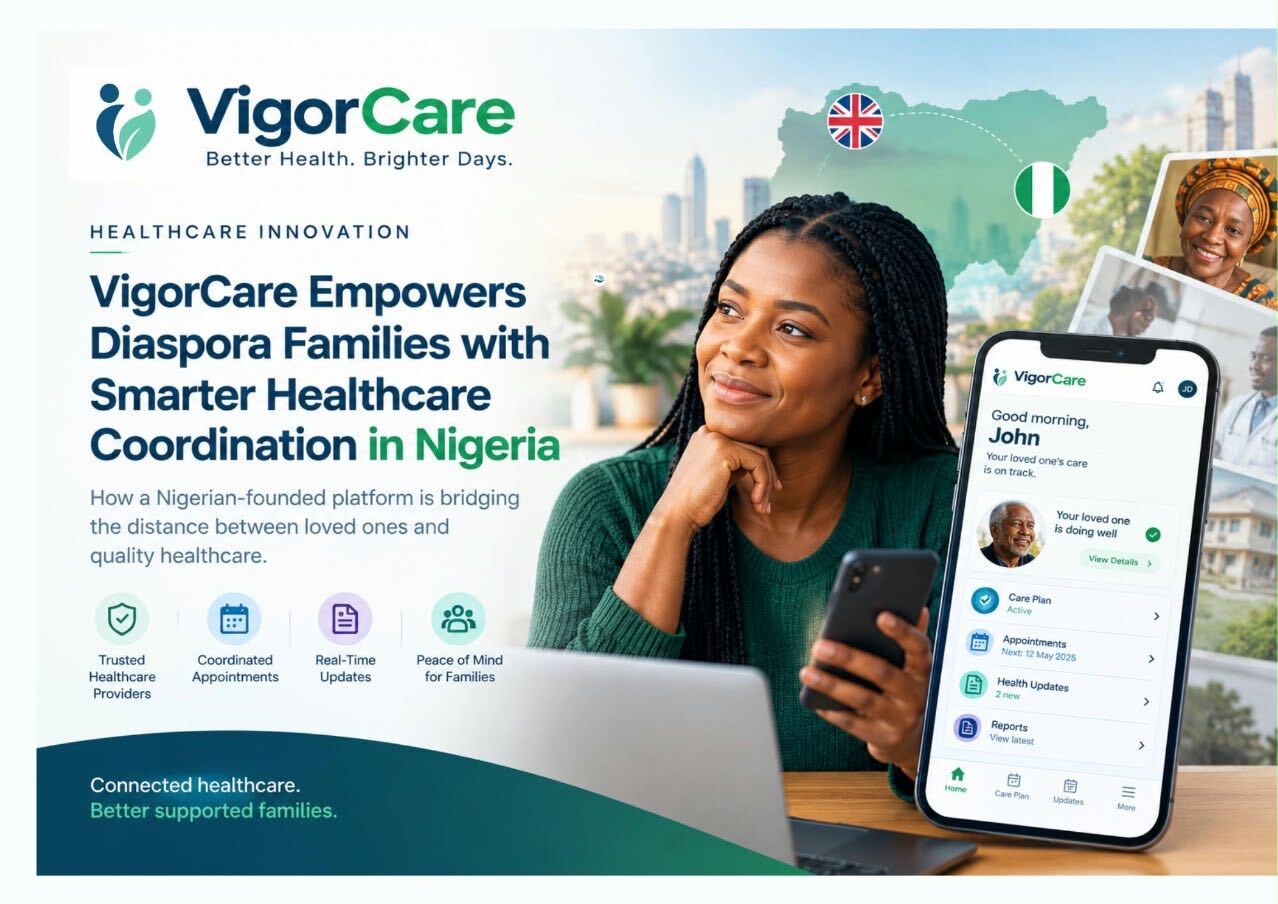
It’s 11 p.m. in London. Your mother in Ibadan has been having headaches for three days, and she’s the kind of woman who will “manage” until it’s an emergency. You can’t jump on a flight tonight. You can’t even get a straight answer about what’s wrong. This is the exact gap telemedicine was built to close, and it’s the gap VigorCare, a healthcare coordination platform built specifically for Nigerian families split across borders, is trying to close more deliberately than most.
“Telemedicine” is still a fuzzy word for a lot of people. Is it a video call with a stranger in a white coat? A WhatsApp message to a family friend who happens to be a doctor? VigorCare’s answer is more structured than either: a platform connecting diaspora sponsors, Nigerians who live far away from their immediate family and loved ones, those supporting their families in Nigeria, and a network of verified healthcare providers, with visibility for the sponsor built into the process from the start.
What VigorCare actually offers
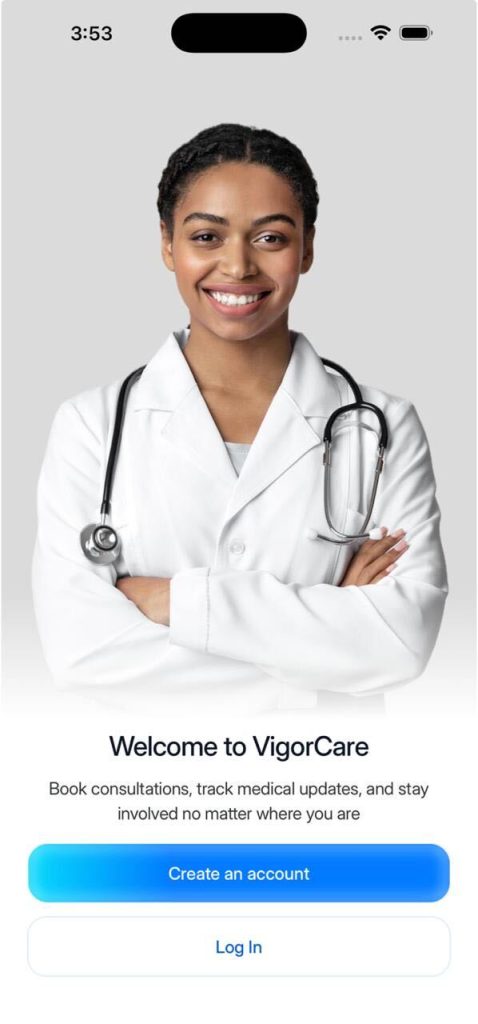
Before going further, it’s worth being specific about the product, since “telehealth platform” undersells it. VigorCare runs on two connected apps. The VigorCare app is for patients in Nigeria and the sponsors supporting them, wherever they are in the world: booking teleconsultations, tracking real-time medical updates, viewing medical records, receiving e-prescriptions, and managing payments in one place. The VigorProvider app is for the verified doctors, nurses, and specialists on the other end, giving them a structured way to manage appointments, patient records, and payouts within a vetted professional network.
Put together, the platform covers teleconsultations, triage support, verified providers, and secure payments, all built around one goal: helping people abroad fund, support, and monitor the wellbeing of loved ones in Nigeria without the usual black box of “did the money actually become healthcare.”
Telehealth isn’t a replacement for in-person care. It’s a better first step
The most common misunderstanding about telemedicine is that it’s meant to replace hospitals and clinics. It isn’t. Think of it the way streaming changed how people watch things. Netflix didn’t shut down cinemas, it became the obvious first option for most nights, while the cinema still exists for the experiences that actually need a big screen. Telemedicine works the same way: it’s the everyday first option, a kind of triage with a human being on the other end, a way to get a professional opinion quickly, figure out whether something can be managed remotely or needs a physical visit, and avoid the wasted trip, or the dangerous delay, that comes from guessing. Just as no one confuses a streaming subscription with a trip to the cinema, no one should confuse a video consultation with a hospital visit. Each has its place.
This is precisely the layer VigorCare positions itself in. Not competing with Nigerian hospitals, but helping families get to the right level of care faster: a virtual consultation when that’s enough, a referral to a verified in-person provider when it isn’t.
How a VigorCare consultation actually works
Strip away the branding, and here’s the shape of it. A sponsor abroad or a patient in Nigeria opens the VigorCare app, connects with a verified doctor or nurse from the platform’s provider network, and has a consultation by video or voice call. What happens next, whether that’s a home-management plan, a prescription, a referral for tests, or an instruction to get to a hospital, is logged in the app, so the sponsor isn’t left wondering whether the visit even happened.
That logging is the part that matters most against Nigeria’s healthcare backdrop. The country has roughly 30 doctors for every 100,000 people, a shortage that’s far worse in rural areas, where more than half the population still lacks access to a functional primary healthcare centre. Against that scarcity, a platform that can confirm, reliably and transparently, that a consultation actually took place isn’t a nice-to-have. It’s the whole value proposition for a sponsor whose only other option is trusting a phone update.
Nigeria’s digital health market is on track to be worth well over ₦180 billion by the end of 2026, with more than a dozen active telemedicine startups now employing thousands of people. VigorCare is building into that momentum with a specific bet: that the diaspora-to-Nigeria care relationship needs its own dedicated infrastructure, not a generic telehealth app repurposed for it.

When a video call is the right call, and when it isn’t
A virtual consultation on VigorCare tends to make the most sense for:
- Follow-ups on an existing diagnosis or treatment plan
- Managing chronic conditions like hypertension or diabetes between physical check-ups
- Getting a second opinion before a family commits to a procedure
- Minor, non-emergency symptoms that need guidance, not intervention
- Deciding whether something actually requires a hospital visit
It’s the wrong tool for chest pain, difficulty breathing, uncontrolled bleeding, signs of stroke, or anything that could be a medical emergency. VigorCare is explicit that it isn’t an emergency service or a substitute for professional diagnosis and treatment. A platform earns trust by saying that plainly, not by trying to keep a family on the call.
The real product: Follow-up care and peace of mind for sponsors
Where VigorCare gets genuinely useful isn’t the one-off consultation. It’s the follow-up. A parent’s hypertension review, a diabetes check-in, confirming a prescription got filled, asking a doctor to explain a lab result in plain language: these are the unglamorous, recurring touchpoints that are hardest to manage from another time zone, and easiest to lose track of entirely.
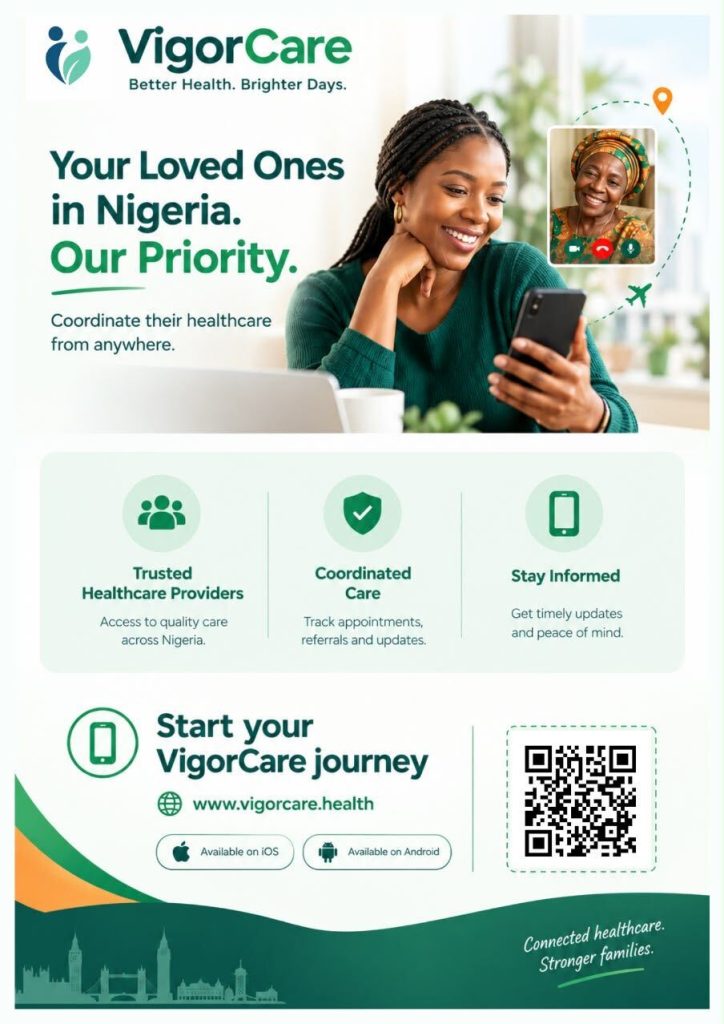
This is also where VigorCare is explicitly designed around the sponsor’s experience, not just the patient’s. Seeing, with the patient’s consent, that an appointment happened, that a prescription was issued, or that a follow-up is due, solves a very specific and very common anxiety for diaspora families: not knowing whether the money sent home for healthcare actually translated into healthcare. It’s a smaller, quieter promise than “book a doctor,” but for many families, it’s the one that matters most, and it’s the one VigorCare is built around.
Getting the most out of a virtual appointment
A telehealth consultation, on VigorCare or elsewhere, works better when you treat it like an actual appointment:
- Find a quiet space with decent lighting and network signal
- Have a list of current medications, allergies, and symptoms ready before the call
- Write down your two or three most important questions in advance
- Ask directly: Do I need an in-person follow-up? What should I watch for? When should I be worried enough to go to a hospital?
- Confirm what happens next, whether that’s a prescription, a referral, or a scheduled check-in, before you hang up
Benefits and limits, honestly
Telemedicine’s real strengths are convenience, speed of access, and continuity, particularly for people managing chronic conditions or coordinating care for someone in another country. Its real limits are just as important to say out loud: no physical examination, no diagnostic imaging, no substitute for a doctor’s hands and eyes when that’s what a condition needs. VigorCare’s model leans into this honestly, positioning itself as coordination and continuity infrastructure, the connective tissue between a family abroad, a loved one at home, and Nigeria’s actual healthcare system, rather than a replacement for any part of that system.
The bigger shift
What’s changing isn’t that Nigerians are abandoning hospitals for apps. It’s that families now have a credible middle option between “do nothing and hope” and “book a flight home.” VigorCare is betting that this middle option needs to be built specifically for the diaspora relationship, with transparency for the sponsor as a first-class feature rather than an add-on.
The technology will keep improving. The infrastructure gaps, connectivity, cost, trust, will take longer to close. But for the son in London lying awake over his mother’s headache, a same-night conversation with a licensed doctor, and confirmation that it actually happened, is a meaningfully better place to start than a guess.
VigorCare is available on Google Play and the Apple App Store, with more details at vigorcare.health