



TGIF.☀️
Few phrases travel further at African business summits than “shared ownership.” At the Africa CEO Forum in Kigali this week—the continent’s largest annual gathering of private-sector leaders, drawing some 2,800 participants from over 77 countries—it is the organising idea of the entire event.
The question is whether Kigali 2026 moves the idea closer to practice.
A presidential panel on continental alliances brought some of the day’s most direct language. Nigeria’s Bola Tinubu, addressing a packed audience of business leaders, said flatly: “Africa needs to put its money where its mouth is.” The forum’s theme, “Scale or Fail,” says the same thing with a deadline attached. For African founders who have spent years hearing about continental opportunity while watching capital flow elsewhere, the deadline framing is either promising or familiar.
A panel on gender and growth capital offered a sharper, more quantified version of the same problem. Female startup founders in Africa raised just $48 million in VC funding in 2024—the lowest on record—while male founders pulled in more than $2 billion. Research across 47 African countries traces much of the disparity to self-selection: women entrepreneurs opt out of applying for credit, not because they are rejected, but because they expect to be.
The broader cost, per the United Nations Development Programme (UNDP), is $95 billion in lost economic potential annually. The panel’s argument, made bluntly, is that this is less an inclusion problem than a capital misallocation one.
Abdul Samad Rabiu, Africa’s second-richest man and BUA Group chairman, opened the day with an address on the architecture of African growth. The architecture, as these panels made clear, has known load-bearing failures.
It’s the final day on the ground in Kigali. If you’re a founder here and want to talk, my inbox is open.
—Ganiu, Newsroom Editor
Get smarter about Francophone Africa with our newsletter, Francophone Weekly—the startups, tech policies, and institutions building the pipelines for ecosystem growth.

features
Quick Fire 🔥 with Babatunde Onadipe

Babatunde Onadipe is a cybersecurity professional with experience across consulting, aerospace, research, and financial services. He currently works as a Cyber Security Solutions Architect at the Bank of Canada, where he helps design secure and resilient technology solutions for critical financial infrastructure. His career has also spanned roles at McGill University as a Cloud Architect and AI Researcher, and at Bombardier Aerospace as a Cloud Infrastructure Security Engineer, blending hands-on engineering with applied research.
- Explain your job to a 5-year-old.
I help protect computer systems from bad people on the internet. Imagine a bank that keeps people’s money and important information safe. My job is to build strong “digital locks and walls” around it so no one can break in, steal things, or cause damage. I work with a smart team to find the safest ways to build and protect these computers. So basically, I’m like a superhero who protects the bank, but instead of a cape, I use a laptop.
- What’s one cyber risk you think most people still underestimate?
That’d be Shadow AI, and this refers to when employees use public AI tools at work without formal approval. People paste source code, customer data, financial figures, internal strategy documents, and confidential meeting notes into AI tools or chatbots to summarise, rewrite, or debug them. It feels harmless because the productivity gain is real and immediate, but the data may leave the organisation’s control and end up in third-party systems, logs, or model improvement pipelines.
- What’s one habit or mindset that has helped you most in your cybersecurity career?
Staying curious. Cybersecurity changes quickly, so I try not to get too comfortable with what I already know. I ask questions, learn continuously, and stay open to new ideas. That habit has helped me adapt, solve problems better, and see risks before they become bigger issues.


We Have Secured the Bank of Ghana EPSP Licence.

Fincra has officially secured its Enhanced Payment Service Provider license. This regulatory milestone authorizes Fincra to directly collect, process, and settle payments in Ghanaian Cedis, offering a highly streamlined financial pipeline for businesses operating within the region. Start here.
companies
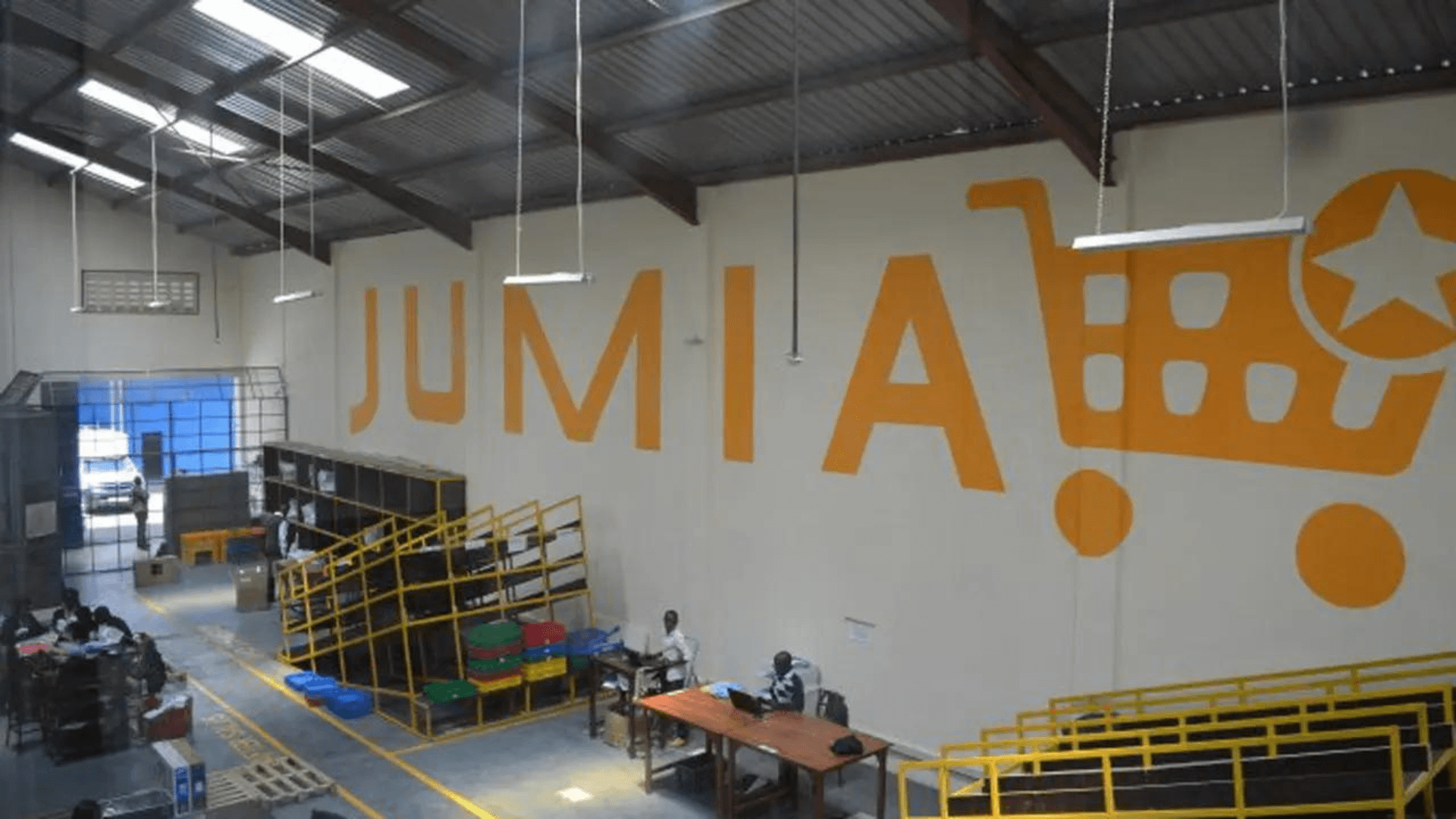
E-commerce firm Jumia plans another round of job cuts

There was a time when “AI will take jobs” sounded like a futuristic warning. For some employees at Jumia, that future has arrived. AI is becoming a benchmark reason why tech workers lose their jobs, and it’s not just in Africa.
Jumia, the e-commerce platform operating in nine countries across the continent, has announced its plans to cut 10% of its workforce as artificial intelligence takes over more tasks across the company. CEO Francis Dufay told Bloomberg that AI is now being deployed across logistics, operations, finance, marketing, and internal workflows to automate work that humans previously handled manually.
AI is coming for jobs: Across Africa’s tech and corporate sectors, companies are increasingly restructuring around automation and leaner operations. In 2024, Microsoft announced layoffs affecting about 9,000 employees globally as it increased its investment in AI. In 2026, Zap Africa, a Nigerian cryptocurrency startup, cut 44% of its workforce after introducing Martha AI, which handled first-line customer enquiries. Recent examples even include Coinbase, the US cryptocurrency firm, which cut 14% of its workforce in May, due to AI; it affected at least two African employees. And just yesterday, Dune, a data intelligence company, cut 25%—guess the culprit? AI.
The race to profitability is probably why: If you’re wondering why companies, especially Jumia, have become best friends with automation, the answer lies in profitability and efficiency drive. In its case, Jumia, since CEO Dufay took over in 2023, has been on a very public mission to hemorrhage losses.
The company exited multiple African markets, including South Africa and Tunisia, in 2024, shut down its food delivery business in Nigeria, Kenya, Morocco, the Ivory Coast, Tunisia, Uganda, and Algeria in 2023, reduced headcount by 7% in 2025 to automate parts of its customer support department, and cut costs across departments.
For companies, AI is becoming a cheaper, faster way to handle repetitive work and chase profitability.
Unlimited free transfers on PalmPay

PalmPay guarantees you unlimited free transfers to all banks in Nigeria and a 99.9% transaction success rate. We are making digital banking safer, simpler, and more reliable for everyday Nigerians. https://bit.ly/PalmPay-ng
policy
Kenya plans 16% VAT on electric vehicles, batteries, and e-bikes

In February, Kenya launched a National Electric Mobility Policy that made zero-rated value-added tax (VAT) on electric buses, e-bikes, motorcycles, and lithium-ion batteries one of its headline incentives. Three months later, the Finance Bill 2026 is proposing to move all of those items to exempt them from some taxes.
Here is what that shift actually means. Zero-rated means businesses pay 0% VAT and can reclaim spending on inputs like components, transport, and assembly. Exempt means a 16% VAT bill on those same inputs gets locked into the supply chain with no way to recover it, so manufacturers and importers build the cost into their prices. The person buying the bus or the boda boda pays for it in the long run.
This is Kenya’s second attempt at this move. The Finance Bill 2024 proposed the same reclassification and was only killed when mass public protests brought the entire bill down. Companies like BasiGo, Roam, and Ampersand, which have been scaling electric buses, motorcycles, and battery-swapping networks across East Africa, built their business models around the assumption that the tax environment would stay stable. A single 60kg solar battery could get KES 45,000 ($348) more expensive under the change, according to the Associated Battery Manufacturers (ABM).
Zoom out: Kenya’s electric vehicle sector has received themost EV startup funding in Africa. Rwanda is offering free land for charging stations and tax breaks to attract the same companies, while Kenya could be making it harder to operate.
Nigeria’s Sports Marketing Intelligence Report 2025

A football conversation no longer ends at the final whistle. It continues online, in culture, and in consumer behaviour. The Brila Sports Marketing Intelligence Report 2025 explores how brands can truly connect with today’s sports audience. Download the report here.
insights
Funding tracker
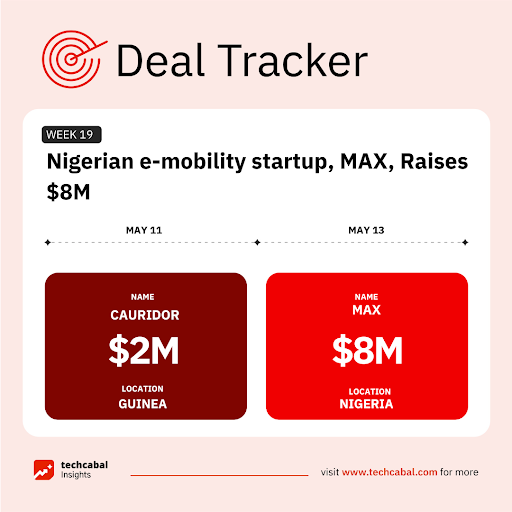
MAX, a Nigerian e-mobility startup, raised $8 million in debt funding from Dutch impact investor Triple Jump. (May 13)
Here is the other deal for the week:
- Cauridor, a Guinean fintech startup, raised $2 million in series A funding from Flourish Ventures and LoftyInc Capital. (May 11)
Follow us on Twitter, Instagram, and LinkedIn for more funding announcements. Before you go, we’re releasing a comprehensive Healthtech Report that explores trends, funding, and innovation across Nigeria’s healthtech ecosystem. Join the waitlist to get early access when it launches.
CRYPTO TRACKER
The World Wide Web3
Source:

|
Coin Name |
Current Value |
Day |
Month |
|---|---|---|---|
 Bitcoin Bitcoin |
$80,747 |
+ 1.67% |
+ 8.71% |
| Ether |
$2,262 |
+ 0.26% |
– 2.97% |
| XRP |
$1.47 |
+ 2.79% |
+ 8.22% |
| Solana |
$91.30 |
+ 0.86% |
+ 9.25% |
* Data as of 06.12 AM WAT, May 15, 2026.
Events
- The Africa Tech Summit London 2026 is back for its 10th edition. Held at the London Stock Exchange building in London on May 29, the event will feature a small, high-impact gathering of founders, investors, and global partners driving the future of tech in Africa. Use the code TC10 to get 10% off tickets. Register to attend.

Written by: Ganiu Oloruntade, Opeyemi Kareem, Zia Yusuf, and Success Sotonwa
Edited by: Emmanuel Nwosu and Ganiu Oloruntade
Want more of TechCabal?
Sign up for our insightful newsletters on the business and economy of tech in Africa.
- The Next Wave: futuristic analysis of the business of tech in Africa.
- Francophone Weekly by TechCabal: insider insights and analysis of Francophone’s tech ecosystem
P:S If you’re often missing TC Daily in your inbox, check your Promotions folder and move any edition of TC Daily from “Promotions” to your “Main” or “Primary” folder and TC Daily will always come to you.