By Sofiat Nafiu
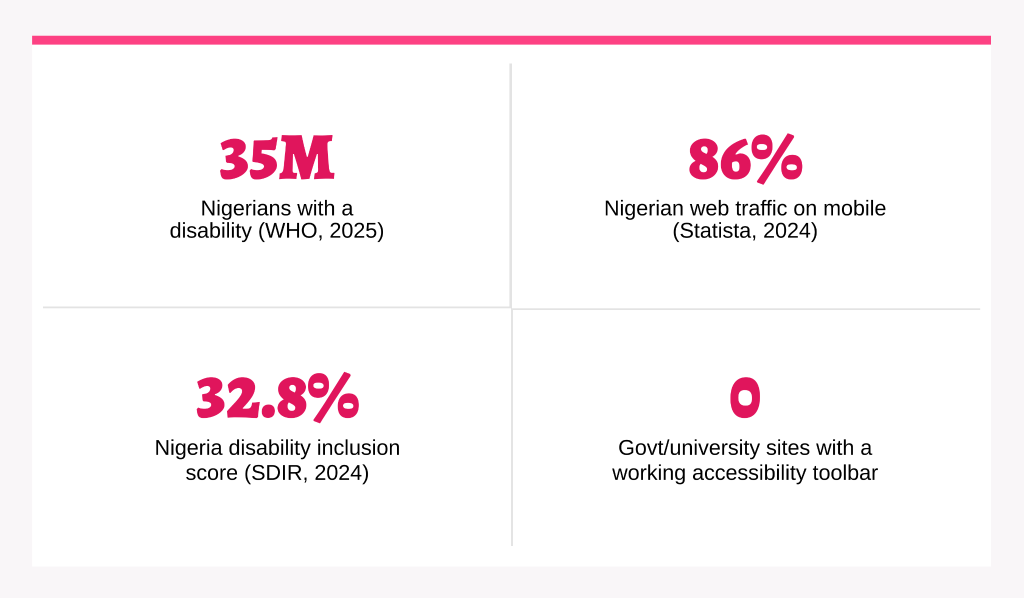
Nigeria has over 153 million internet users and an estimated 35 million people living with disabilities. Yet across every major federal government website, state portal, and public university I audited, I could not find a single one that has implemented even baseline digital accessibility features. This is what that costs us.
SCENE — LAGOS, 2026
Mama Tunde has been selling pepper at Mile 12 Market for twenty-two years. Her daughter just graduated from the University of Lagos, the first in the family to hold a degree. Someone tells her the results are on the university website. She opens the page on a fairly used ₦35,000 Android phone, carefully managing her 3G data as it loads. The page is heavy, and when it finally loads, it is filled with formal English text. There is no Yoruba option, not even pidgin that she can slightly understand, and no way to enlarge the letters. She cannot read it without help, so she hands the phone to a stranger. And just like that, her daughter’s results — her name, her class of degree, the proof of twenty-two years of sacrifice — are read to her by someone she has never met.
This is not a conventional story about poverty. Mama Tunde has a smartphone, even if it’s fairly used. She has access in a way that gets counted in government statistics. What she does not have, however, is a website designed with her in mind.
This moment reflects a broader digital accessibility problem. Nigerian digital accessibility cannot copy desktop-first Western assumptions. Most citizens experience government services through low-cost Android phones, unstable networks, outdoor lighting conditions, and prepaid data constraints. I have spent the last several weeks auditing Nigerian government and university websites — UNILAG, LASU, JAMB, NIMC, FIRS, the Lagos State Government portal, and the NCPWD’s own website. Across every site I audited, I found no language toggle, no font-size control, no high-contrast mode, no plain-language alternative. None have the features that thousands of UK council websites deliver as standard. We have the law, but sadly, we lack implementation
THE FIVE NIGERIANS NOBODY DESIGNED FOR
Accessibility is wider than a wheelchair
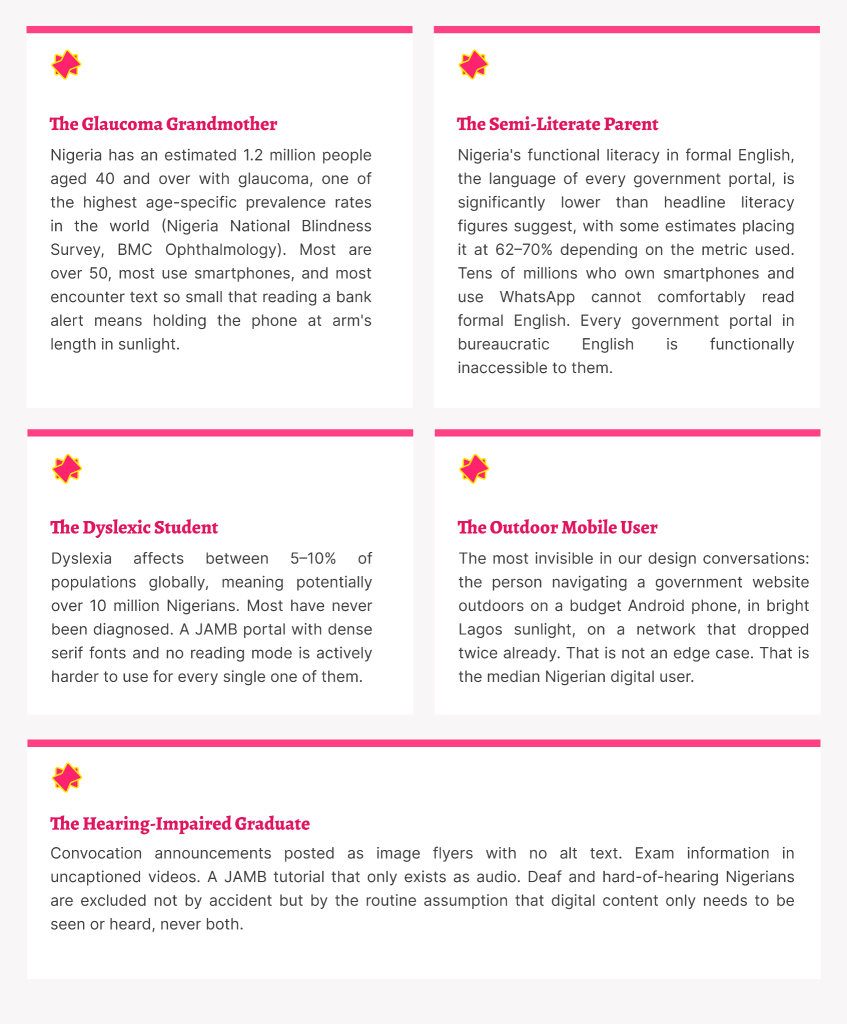
In Nigeria, the accessibility conversation almost always collapses into a single category: wheelchair users. But digital exclusion is far wider. Here are five people who exist in enormous numbers, and for whom our public digital infrastructure was never designed.
THE AUDIT
I Checked Eight Nigerian Public Websites. Here Is What I Found.
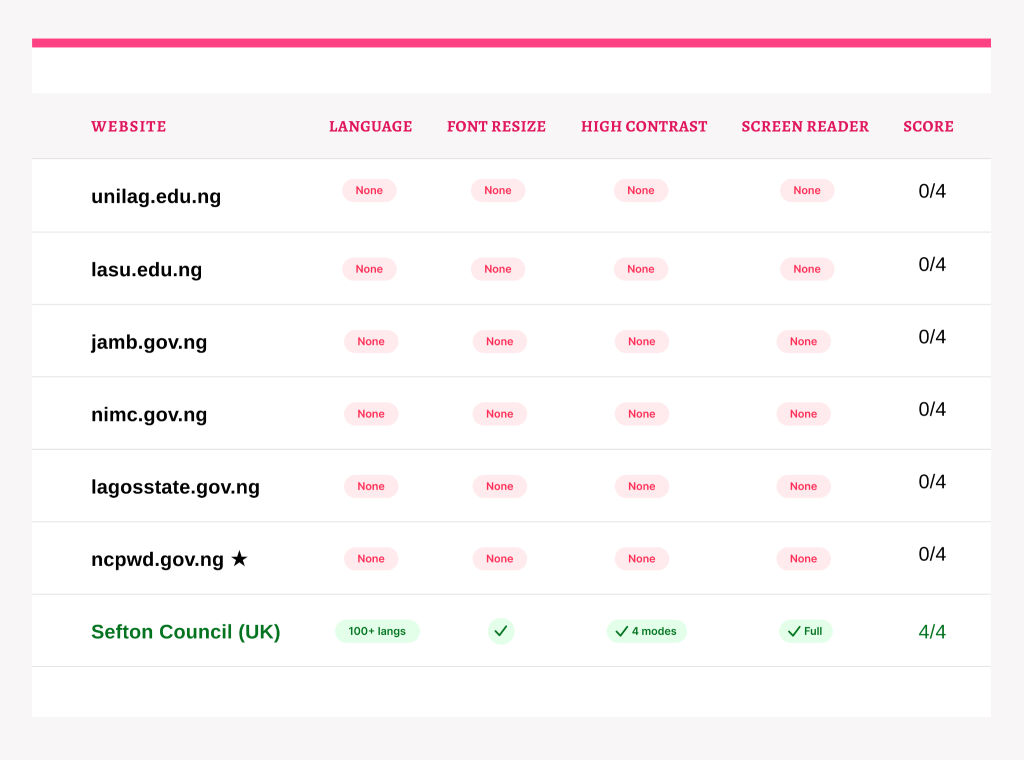
The NCPWD — the body mandated to enforce disability rights — scores 0. Sefton is a typical UK local authority, not a flagship government site — these features are routine across 300+ UK councils. Audit methodology: WAVE WebAIM, axe DevTools, and WebAIM contrast checker against WCAG 2.1 AA baseline. Each site was assessed on its public-facing homepage and primary user-task page.
THE LAW THAT EXISTS ON PAPER
Nigeria’s Discrimination Against Persons with Disabilities (Prohibition) Act 2018 mandates accessible services. A five-year compliance grace period expired in 2024. The NCPWD has issued compliance certificates. Not one covers a government website, which means digital accessibility was not in scope.
THE PSYCHOLOGY
This Is Not Just a Tech Problem.
Cognitive load theory (Sweller, 1988) is unambiguous: extraneous load—load caused by poor design—actively prevents task completion. Every form a semi-literate Nigerian cannot complete. Every results page a parent cannot read. Every deadline missed because the JAMB portal was overwhelming. These are not user failures. They are design failures with cognitive consequences.
Albert Bandura’s self-efficacy research adds a deeper dimension. The mother who cannot navigate the university website does not walk away thinking “the website is inaccessible.” She walks away thinking, “I am not smart enough for this.” That belief compounds. It makes her less likely to try again, with that website, with any government service, or perhaps with any formal institution. Bad design does not just fail people in the moment. It reshapes how they see themselves.
“When a system is designed to be navigated only by the educated, the young, and the able-bodied, it is not neutral. It is a quiet act of exclusion with a government letterhead on it.”
WHAT GOOD LOOKS LIKE
Five features. No excuse.
Here is what any Nigerian government or university website should have as a baseline — not luxury additions, but a minimum viable level of respect for its users.
- Language switching — Yorùbá, Hausa, Igbo, Pidgin. Machine translation is imperfect. A rough Yorùbá translation of “your results are available” is infinitely more useful to Mama Tunde than perfect English, which she cannot read.
- Font size controls and dyslexia-friendly mode. Four lines of CSS and one toggle button. Potentially over 10 million Nigerians with dyslexia benefit. So does every user on a small screen in sunlight. There is no excuse.
- High-contrast mode for outdoor mobile users. Most Nigerian web usage happens outside. Bright sunlight destroys most colour schemes designed for indoor use on laptops. A contrast toggle costs nothing and works for the environment most of your users are actually in.
- Text-to-speech with a Nigerian-accented voice. When a screen reader pronounces “Ikorodu” with an American accent, the cognitive friction is real. Nigerian-English TTS voices now exist on Google Cloud and Microsoft Azure. This is a configuration change, not a rebuild.
- Plain-language mode. A toggle that strips jargon serves everyone who isn’t a trained bureaucrat, which is most people. It does not insult anyone. It respects everyone.
CASE STUDY – UNILAG AS AN EXAMPLE
What it looks like in practice: one university, one addition.
To make the proposal concrete, I used the University of Lagos website as a case study. UNILAG is not being singled out; every institution in the audit scored identically. It is used here because it is Nigeria’s most prominent public university and because Mama Tunde’s daughter’s results are posted there. The screenshots below show the existing site and a proposed addition—no redesign, no new colour scheme, no new layout. Just one item in the navigation bar.

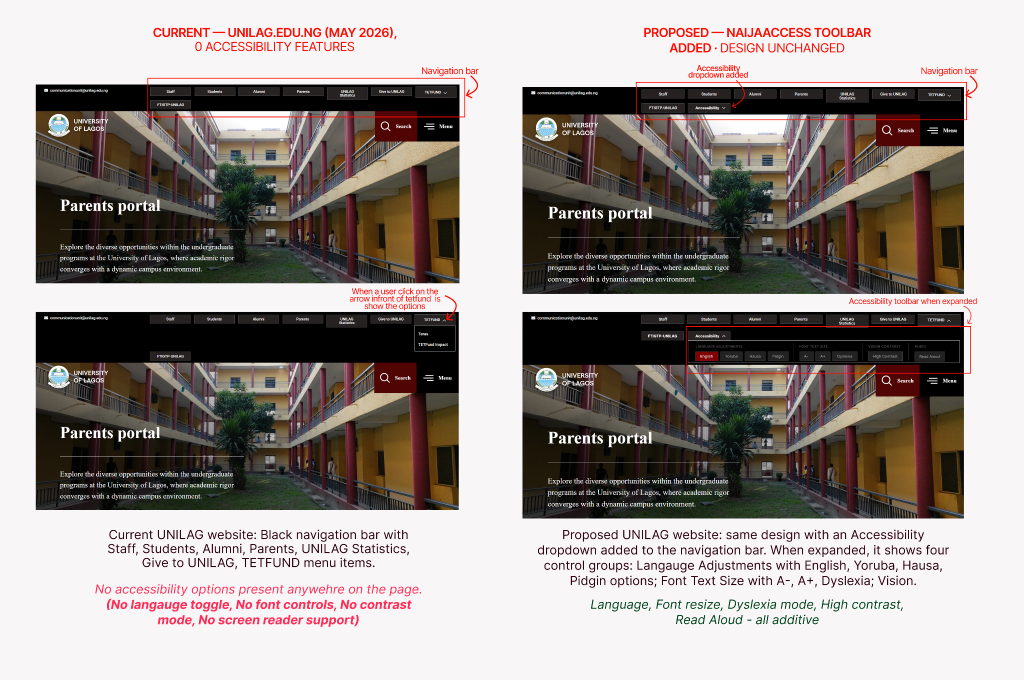
Design mockup by Sofiat. Proposed concept only — not implemented by the university.
The point is not UNILAG specifically. It is that the same one-item addition would work on LASU, JAMB, NIMC, lagosstate.gov.ng, and every other site in the audit. The design is already there. What is missing is the decision to make it usable.
RESEARCH GROUNDING · WCAG 2.1
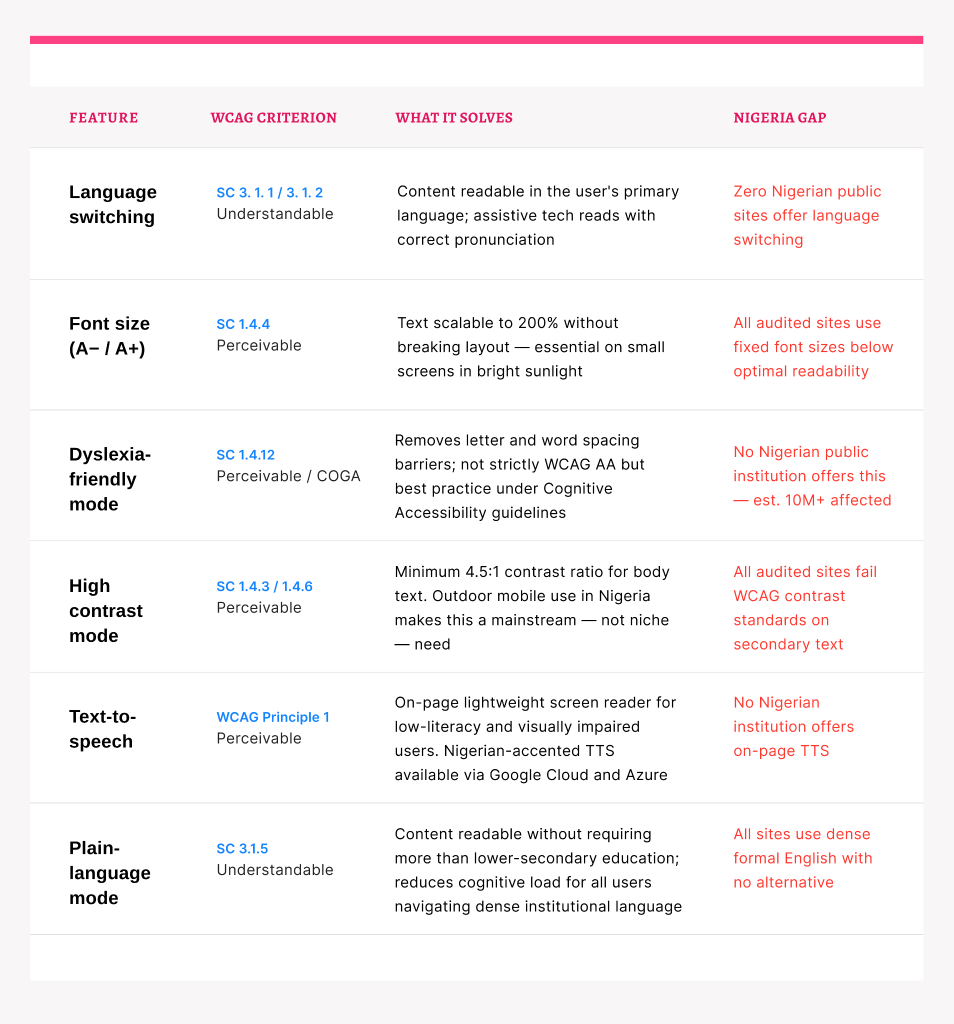
Every feature maps to an international standard required by Nigeria’s own law.
The Web Content Accessibility Guidelines (WCAG) 2.1 are the international standard referenced by the European Accessibility Act and the UK Public Sector Bodies Accessibility Regulations 2018, and widely used as the benchmark in US ADA web accessibility litigation. They are built on four principles — content must be Perceivable, Operable, Understandable, and Robust. Each feature in the proposed toolbar addresses at least one criterion directly.
THE ASK
What needs to happen, and who needs to do it.
- To NITDA and the NCPWD: A minimum accessibility standard — language support, contrast, font resizing, screen reader compatibility — must be audited annually and required as a condition of service approval. No government tech vendor should be paid without a VPAT demonstrating WCAG 2.1 AA compliance. Language support, contrast, font resizing, dyslexia mode, and plain-language toggles — all five — as standard. In the US, the 2019 Robles v. Domino’s Pizza ruling established that the ADA applies to websites. Nigeria’s Disability Act 2018 mandates the same standard. It deserves the same enforcement.
- To Nigerian universities: The pepper seller who cannot read your results page deserves better. So does the student with dyslexia learning on your platform. So does the deaf graduate whose convocation was posted only as an image with no alt text. An accessible website is not expensive. A deliberate one requires will, not budget.
- To Nigeria’s tech community: Building an open-source NaijaAccess toolkit — Yorùbá, Hausa, Igbo and Pidgin support, Nigerian-accented TTS, culturally contextualised UX patterns — is worth doing. It is the kind of infrastructure that multiplies value across every institution that touches it.
Mama Tunde should be able to read her daughter’s results herself. Not because it is convenient. Because her independence, her dignity, and her right to access public information are not optional features. They are the whole point.