Fifteen years after its founding, EXANTE has built a reputation on a simple but stubborn conviction: that institutional-grade technology should come with a human on the other end of the line. The global prime broker, regulated across Cyprus, Hong Kong, Malta, and the UK, has spent a decade and a half connecting professional investors to more than two million instruments across 50+ markets through a single multi-currency account. Now, it is turning that same focus inward, toward the operational machinery that sits behind every investment decision.
The problem nobody was solving
Portfolio management is getting more personal. Separately managed accounts, investment structures built around individual client preferences, restrictions, and mandates, have been gaining traction across the asset management industry for years. Demand for SMAs increased over the past year for more than 60% of both managers and allocators, with most expecting that momentum to accelerate over the next 12 to 18 months.
The operational consequences of that growth are less discussed. Every new client account brings its own set of allocation rules. Every market move that triggers a rebalancing decision must be acted on across dozens of portfolios, each requiring individual attention. Most firms are still handling this through fragmented, partially manual processes: spreadsheets, manual trade entry, workflows stitched together from tools that were never meant to work in concert. The margin for error widens with every account added.
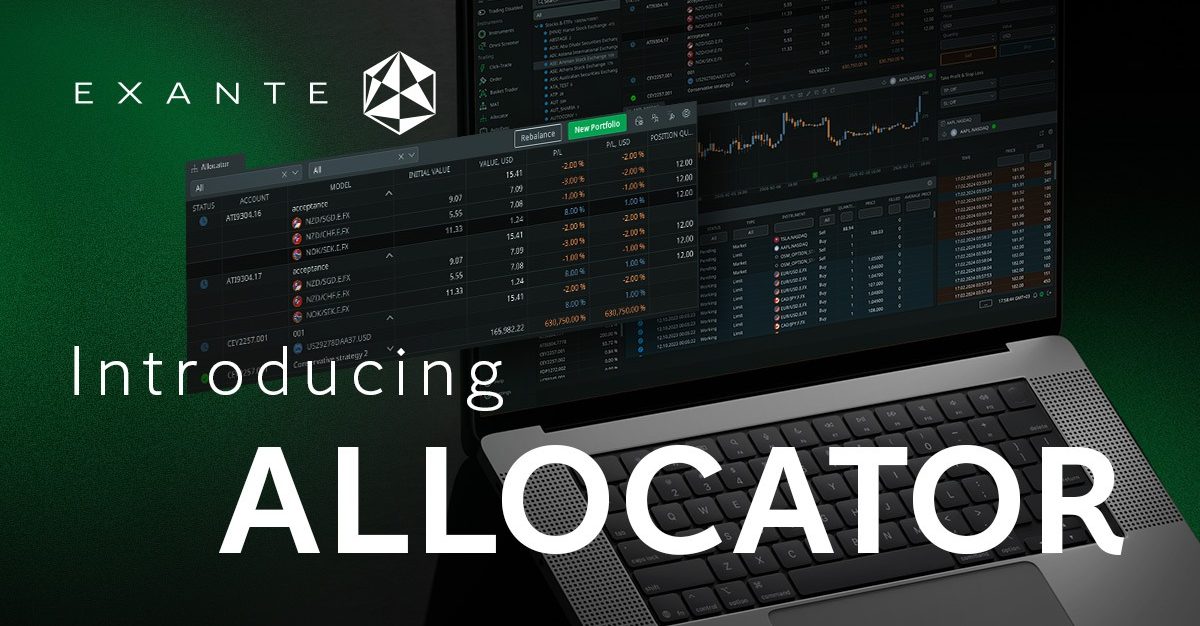
EXANTE’s answer to that problem is Allocator, a portfolio management infrastructure launched in May 2026. The tool allows asset managers to construct a master portfolio framework, then push strategy updates, allocation changes, and rebalancing actions across multiple client accounts through a single unified workflow. What once required repetitive manual execution can now be handled in one coordinated sequence.
What allocator actually does
The mechanics are precise by design. Managers can build portfolios containing up to 20 assets, with allocations expressed either as percentage targets or fixed quantities, a distinction that matters when client mandates vary widely. Draft portfolios can be saved in unlimited numbers, letting teams prepare, test, and version-control strategies well before any capital is committed. When market conditions move, and a strategy adjustment becomes necessary, the change propagates across all linked accounts at once.
“The industry has spent years focusing on investment performance, but operational scalability is becoming just as important,” said Richard Forss, Chief Technology Officer at EXANTE. “Allocator brings the operational infrastructure and execution discipline to any asset manager, regardless of size.”
Allocator sits within EXANTE’s broader multi-asset execution environment, which spans equities, ETFs, bonds, futures, options, and cryptocurrencies across 50+ markets and eight asset classes, all accessible from a single multi-currency account. The new tool does not replace that infrastructure. It coordinates it.
A platform built for what comes next
EXANTE has always operated from a particular philosophical position: that technology is most valuable when it reduces friction, not when it replaces the person managing the relationship. Competitors have moved toward automated, depersonalized client experiences. EXANTE has moved in the opposite direction, pairing its platform capabilities with named relationship managers for every client.
Allocator reflects that same logic applied to operations. The goal is not to automate judgment out of the investment process. It is to remove the manual overhead that slows judgment down. A portfolio manager who previously spent hours replicating the same trade across dozens of accounts can redirect that time toward the decisions that actually require human attention.
“Demand for separately managed accounts increased over the past year for more than 60% of both managers and allocators, with most expecting further growth over the next 12 to 18 months,” Forss noted. The release of Allocator, in that context, reads less like a feature update and more like a structural response to where the industry is heading.
The broader competitive picture makes that response timely. Firms like Interactive Brokers and Saxo Bank have long competed on platform breadth and execution speed. Where EXANTE has chosen to differentiate is in the layer between technology and client: the operational discipline that keeps complex, multi-account strategies running without the kind of errors that erode trust far faster than they erode returns. Allocator is a direct expression of that bet: that the next competitive frontier in prime brokerage is not just what markets you can access, but how cleanly you can manage the accounts that trade across them.
EXANTE marks its 15th year in 2026. The firm that began with a proprietary trading platform and a conviction about direct market access has grown into a multi-jurisdictional prime broker with regulatory licenses spanning four major financial centers and an active presence in markets from Warsaw to Dubai. Allocator is the latest expression of a longer argument: that the firms best placed to serve institutional investors are the ones willing to build the infrastructure that makes serious portfolio management operationally viable, not just theoretically possible.