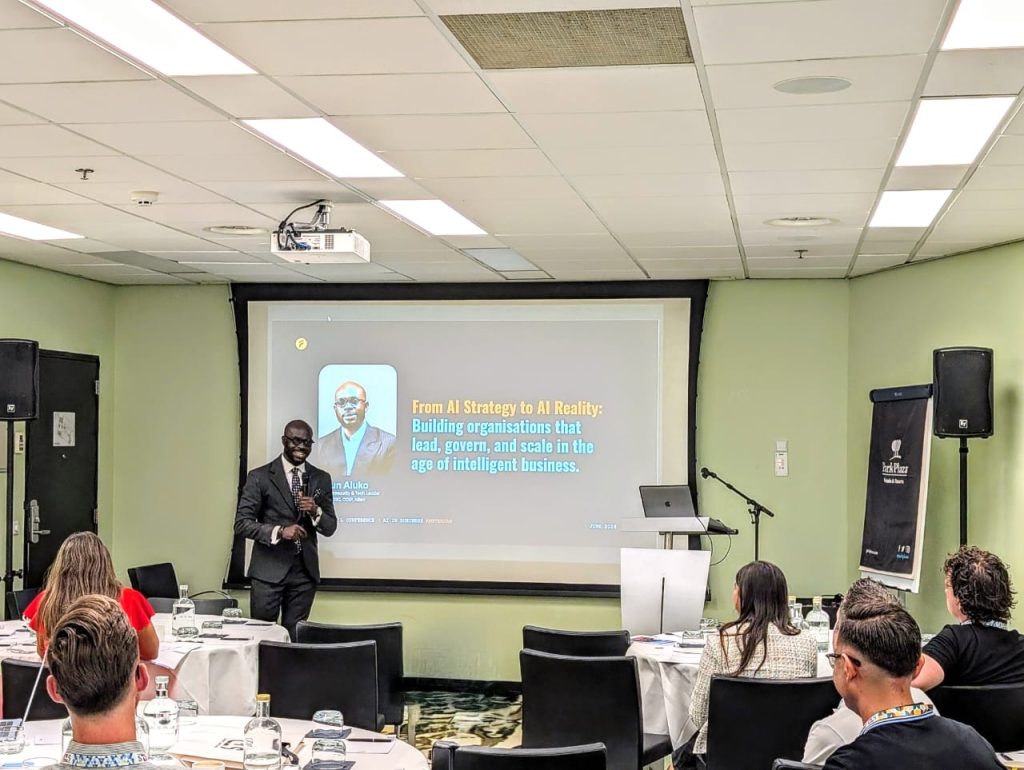
I said that from a stage in Amsterdam on the 1st of June, 2026. Founders, investors, engineers, researchers, and enterprise leaders at the 6th International AI in Business Summit went quiet in the way rooms go quiet when something lands not as a provocation but as a recognition.
How many of you have seen AI deployed primarily as a productivity tool, summarising documents, generating emails, without any real process redesign? Most hands went up.
That moment crystallised the problem I have worked inside for over a decade, across Big Four consulting, enterprise product leadership at pcl., startup programs at BeyondLimits, government programs at NITDA Nigeria, and innovation ecosystems spanning 4,000 startups across 30 countries and 5 continents. According to McKinsey, 88% of organisations are using AI.¹ Only 6% qualify as genuine high performers.¹ That gap is not a technology gap. It is a leadership gap. And it begins with a mental model.
The conversation that happens before any of it matters
Some years ago, I led the first enterprise-wide AI adoption programme across 5 business divisions in a leading EMEA business services firm. The leadership team believed AI would make their operations faster. My job was to change that model. AI was not going to accelerate their processes. It required redesigning them, or the investment would produce marginal gains and disappointment. That conversation, about what AI was before we decided what it should do, was the most important work of the entire engagement.
Getting it right produced significant gains across all 5 divisions. Getting it wrong produces what the WRITER 2026 Enterprise AI Survey of 2,400 respondents captured: 75% of executives admit their AI strategy is more for show than actual guidance, and 48% called AI adoption a massive disappointment.²
3 wrong mental models drive this failure. AI as a tool produces individual efficiency, not competitive transformation. Deloitte found 37% of organisations at this surface level.³ AI as a magic wand assumes AI will fix what is organisationally broken. It amplifies what exists. And AI as a risk to manage produces paralysis while competitors move. The right model is AI as organisational infrastructure. Inseparable from business strategy. Owned at board level. Resourced as a long-term investment. The 6% have not found better technology. They have made a different foundational decision about what the technology is.
Governance is not the brake. It is the engine.
From my experience building integrated risk and cybersecurity control frameworks, aligned to ISMS, BCMS, SOC 2, NIS2, the AI Act, and DORA, the resistance came from business units who believed governance would slow them down. What I observed was the opposite. The anxiety driving reckless speed, not knowing what systems were running or who was accountable, dissolved once governance was embedded. In its place was permission to move faster, because the infrastructure that made speed safe was finally in place.

Goldman Sachs embedded security controls before any user logged in and achieved 46,500 employees on their AI platform, 20%+ developer productivity gains, and a 30% reduction in client onboarding time.⁴ Rite Aid did the opposite, deploying AI facial recognition with no governance framework, no bias testing, no human review, resulting in FTC enforcement action and a 5-year ban in December 2023.⁵ The AI was wrong, and no one had the authority to override it. For Nigerian and African enterprises, any business with European clients or data flows touching GDPR-regulated jurisdictions is already inside the EU AI Act sphere of influence, with fines up to €35 million or 7% of global turnover.⁶ Those building governance architecture now are building the infrastructure that makes speed possible later.
What breaks when the foundation holds, but the people don’t
Coaching 78 engineers and 50 engineering managers at Multiverse, the UK top-ranked EdTech company, taught me that the most consistent gap is not knowledge. It is the distance between what people know and what they can do when the problem is live. DataCamp 2026 research found that 82% of leaders say they provide AI training, yet 59% still report a critical skills gap.⁷ The problem is not investment. It is design.
Leading the Beyond Limits Tech Startup Fellowship for 3 years across 30 countries confirmed the same finding. The founders who struggled most were experienced operators who could not translate what AI could do into decisions about what their organisations should do with it. That translation sits in the manager layer and it is precisely where most enterprise AI training never reaches. Organisations with mature upskilling programmes are nearly twice as likely to see significant ROI, with 42% reporting strong returns compared to 21% overall.⁷ Those that do not are paying the IDC’s estimated $5.5 trillion global price tag for the AI skills gap in 2026.⁸ Klarna illustrates the consequence. In February 2024, their AI system handled 2.3 million conversations in a single month, equivalent to 700 agents, with $40 million in projected savings.⁹ What followed was a reversal to a hybrid model. The failure was not in the technology. It was in the absence of people fluent enough to decide where AI should and should not operate.
What the diagnostic revealed
I closed my keynote, “From AI Strategy to AI Reality,” at the AI in Business Summit with a 12-question diagnostic spanning leadership mindset, governance architecture, and human capability. What struck me was not the scores. It was the silence. The governance questions landed hardest because most leaders could not name the human being accountable for their most consequential AI decisions. That single gap predicts where AI strategies stall more reliably than any other.
Every organisation in that Amsterdam room had access to the same models, the same platforms, the same vendors. The difference between the 6% and the 88% was never going to be technology. It was always going to be the quality of 1 decision, made before the deployment plan, before the vendor selection, about what AI fundamentally is. The organisations that make that decision clearly, and make it at the top, do not just use AI better. They become a different kind of organisation entirely. That is the distance between adoption and leadership. And it is available to any organisation willing to close it.
Fikun Aluko is an AI, Cybersecurity and Technology Leader, Chevening Scholar, and Fellow of the African Leadership Initiative. He delivered the keynote “From AI Strategy to AI Reality” at the AI in Business Summit in Amsterdam in June 2026. With over a decade of experience spanning Deloitte, pcl., NITDA Nigeria, Beyond Limits, Hikestack, Skillharvest, and Multiverse UK, he has led technology innovation across enterprises, governments, and startup ecosystems in over 30 countries. He is founder of Hikestack, an innovation studio operating across the EMEA region, and can be reached at [email protected] and https://www.linkedin.com/in/aluko-fikunayomi/
Citations
- McKinsey and Company, “The State of AI,” 2025. Survey of 1,993 respondents across 105 countries. mckinsey.com
- WRITER, “AI Adoption in the Enterprise,” 2026. Survey of 2,400 respondents across the US, UK, Ireland, Benelux, France, and Germany. writer.com
- Deloitte AI Institute, “State of AI in the Enterprise: The Untapped Edge,” 2026. Survey of 3,235 business and technology leaders across 24 countries. deloitte.com
- Goldman Sachs, GS AI Platform deployment data, reported across multiple institutional disclosures, June 2025. goldmansachs.com
- Federal Trade Commission, “FTC Order Prohibits Rite Aid from Using AI Facial Recognition Surveillance for Five Years,” December 19, 2023. ftc.gov
- European Parliament and Council of the European Union, “Regulation on Artificial Intelligence (EU AI Act),” Regulation (EU) 2024/1689, Article 99. eur-lex.europa.eu
- DataCamp, “State of Data and AI Literacy Report,” 2026. Survey of 517 US and UK business leaders conducted in partnership with YouGov. datacamp.com
- IDC, Global AI skills gap cost estimate, 2026. idc.com
- Klarna, “Klarna AI Assistant Handles Two-Thirds of Customer Service Chats in its First Month,” press release, February 2024; subsequent reporting on workforce rehiring strategy, May 2025. klarna.com