

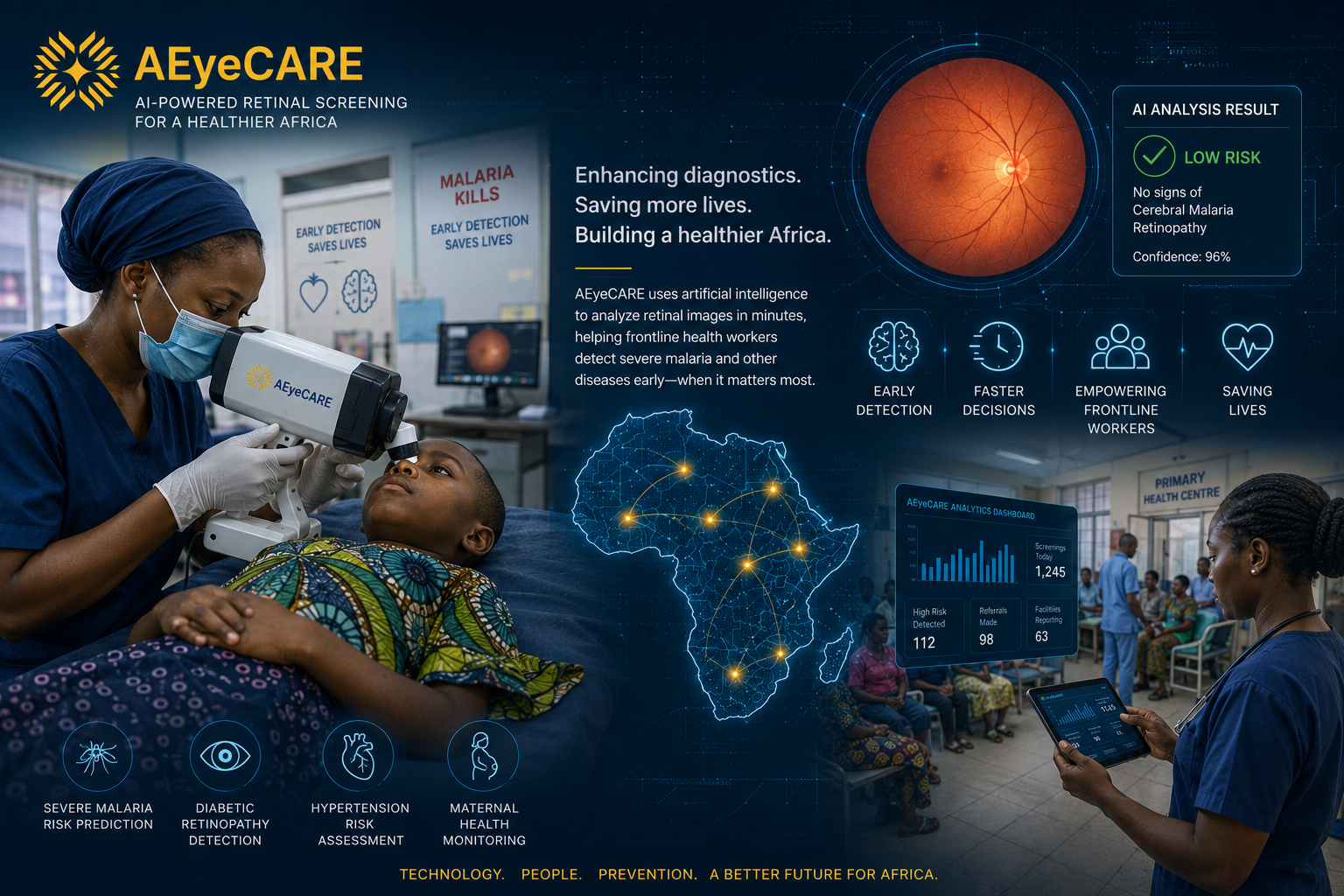
In a busy general hospital in Nigeria, a medical technician working in the emergency ward is about to screen a child brought in unconscious and suspected of having complicated or severe malaria—specifically, cerebral malaria. Cerebral malaria remains the most lethal form of severe malaria. However, the technician is screening the child through the eyes. He is taking images of the retina to confirm if this is really cerebral malaria or something else.
Even though Nigeria has the highest malaria mortality, and cerebral malaria is the most lethal form of severe malaria, sometimes misdiagnosis does occur.
The child could have malaria, and that may not be what killed the child.
This is not unusual.
A post-mortem study done in Malawi showed that out of 31 children diagnosed with cerebral malaria at the time of death, 7 were misdiagnosed. All 31 children tested positive for the malaria parasite. However, researchers had found that a clinical biomarker in the eye was consistent in true cases of cerebral malaria. This biomarker, called malaria retinopathy, was what the technician was looking for.
This discovery happened about 20 years ago; unfortunately, it was not a practical solution then. Retinal examination is the purview of Ophthalmologists, and Nigeria has fewer than 1,000 for the entire country.
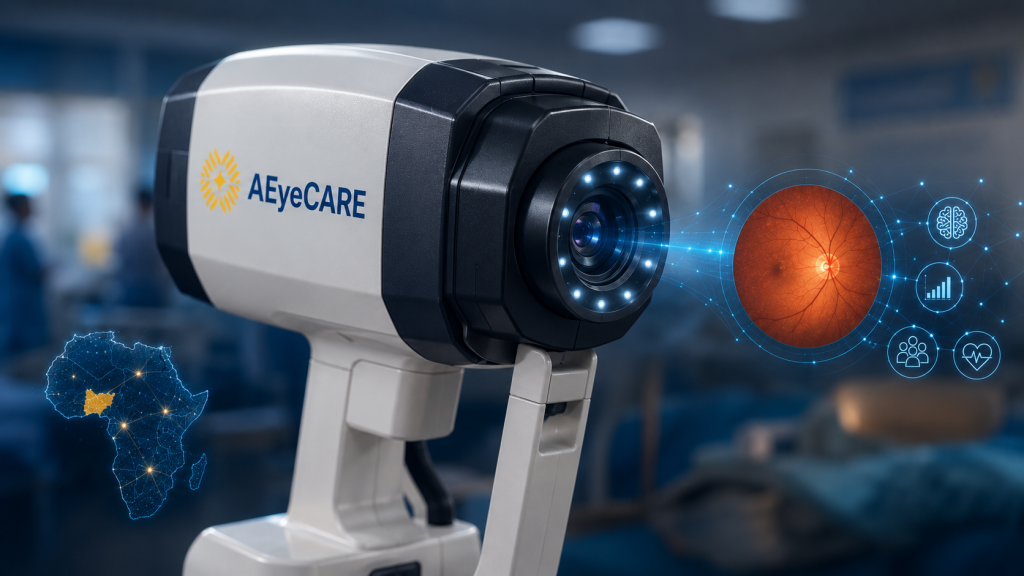
With the advent of AI and more advanced camera technology, this solution is practical now: ASPIRE, an AI-powered retinal screening tool for children presenting malaria symptoms
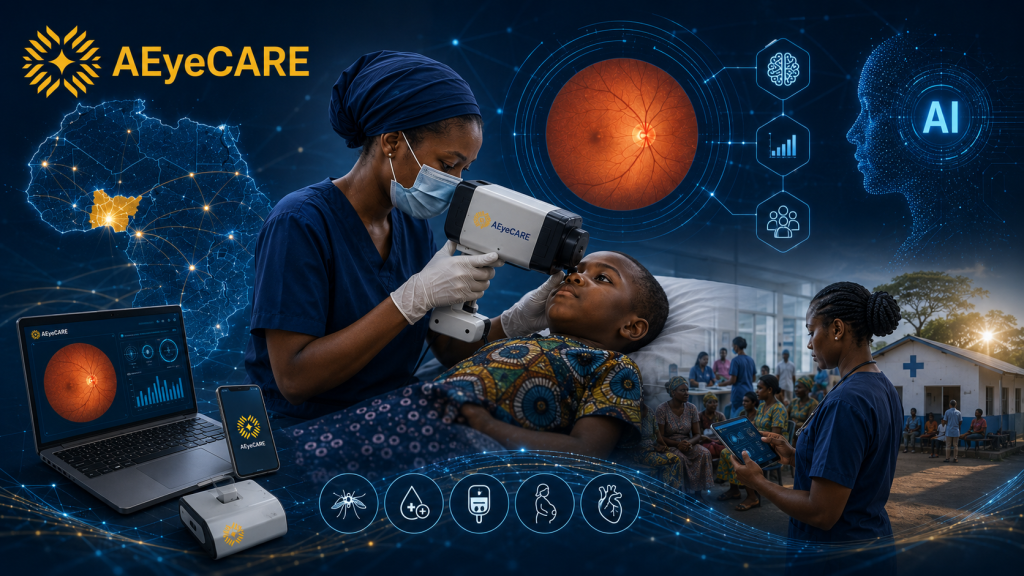
According to Dr Folajimi Adebowale, Co-founder of AEyeCare, a biomedical company that developed and deployed ASPIRE, the screening process can be completed in 20 minutes, with results available in a minute or less.
Co-founded in 2023 by Dr Folajimi Adebowale, MD, and Dr Vinayak Joshi, PhD, AEyeCare is using AI to transform retinal imaging from a specialised procedure into a frontline diagnostic and prognostic tool that can be used in patients bedside and in clinics across the country.
How many diseases can we screen from the eye?
There is no exact number for how many diseases leave signs in the retina, but medical science recognises dozens of primary eye conditions and over 30 systemic (whole-body) diseases that show visible signs there. Because the retina has tiny blood vessels and nerve cells that connect directly to the brain and the rest of the body, doctors can detect signs of many illnesses during a standard eye exam, even before drawing a single drop of blood.
AEyeCare is working to make this technology accessible at scale.
Nigeria has made progress in the fight against malaria, including the launch of Rethinking Malaria Elimination in Nigeria on May 3, 2024, by the Coordinating Minister of Health and Social Welfare, Professor Muhammad Ali Pate.
The Federal Ministry of Health and the National Malaria Elimination Programme also reported a reduction in malaria prevalence from 22% to 15% following the outcome of the Malaria Indicator Survey carried out in 2025.
By combining retinal imaging with AI-driven analysis, AEyeCare aims to strengthen the Federal Ministry of Health’s Task-Shifting and Task-Sharing policy (TSTS), which enables less specialised health workers to contribute more to quality healthcare delivery. The policy, according to Policy Vault Africa, allows lower-cadre professionals such as Community Health Extension Workers (CHEWs) and nurses to safely perform specific medical tasks previously restricted to doctors, thereby boosting access to primary healthcare in underserved areas.
For Nigeria, the opportunity is even greater. The country continues to face a significant healthcare workforce shortage, worsened by the migration of doctors, nurses, and specialists abroad. By equipping less specialised health workers with advanced diagnostic support tools, quality healthcare delivery and Universal Health Coverage could become more attainable. Early detection of complications related to diabetes and hypertension could help prevent avoidable deaths and improve life expectancy. The same is true for maternal mortality, given the devastation caused by deaths from eclampsia and gestational diabetes.
But why the eye? Why the retina?
The retina is often described as the only part of the human body where blood vessels and neural tissue can be directly visualised non-invasively. This means doctors can shine a light through the pupil to see a person’s internal tissues. The eye also shares the same blood supply route as the brain, implying that changes in the brain may often be visible in the eye.
The possibilities of this non-invasive procedure extend far beyond screening severe malaria. Hundreds of diseases leave signs in the eye and retina. Diabetes and its retinal complication, diabetic retinopathy, remain one of the leading causes of preventable blindness worldwide, and retinal imaging can also support early detection of retinal changes.
AI-powered retinal screening can identify damage long before patients experience symptoms, enabling early detection and timely intervention, thereby reducing disability and death. Retinal vascular changes can also provide insights into hypertension and cardiovascular risk, allowing earlier detection and management.
Maternal health may also benefit significantly. Conditions such as pre-eclampsia and gestational diabetes often place both mother and child at risk. Pre-eclampsia is a serious pregnancy complication marked by high blood pressure and signs of organ damage, typically occurring after 20 weeks of gestation, while Gestational diabetes is a type of high blood sugar that develops during pregnancy, usually around the 24th week. Retinal imaging can reveal vascular abnormalities associated with these conditions, creating opportunities for earlier identification of high-risk pregnancies, particularly in underserved communities where specialist care is limited.
Globally, AI-driven retinal screening has already demonstrated strong results. In countries such as India, the United Kingdom, and the United States, AI systems have been utilised to detect diabetic retinopathy with accuracy comparable to that of expert clinicians.
As of 2024, the World Health Organisation estimates that there is a 17% probability of the average Nigerian dying from cancer or diabetes between the ages of 30 and 70.
If deployed strategically and at scale, AI-powered retinal screening could become one of the most transformative public health innovations of this generation for diabetes screening. It represents a future in which technology democratises expertise, empowers frontline workers, strengthens health systems, and helps Nigeria reduce maternal and child mortality while improving life expectancy.
The future of healthcare may not begin in a laboratory or a teaching hospital. It may begin with a simple retinal image, captured in a rural clinic and interpreted by AI, bringing specialist-level insight to the communities that need it most. Through companies such as AEyeCare, that future is already taking shape.